













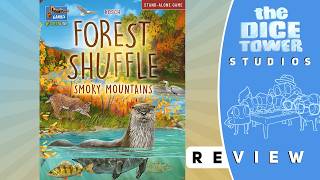





Forest Shuffle: Smoky Mountains Deep Dive
What the Community Thinks About Forest Shuffle: Smoky Mountains
Forest Shuffle: Smoky Mountains represents a deliberate evolution of the series that reviewers have embraced with genuine enthusiasm. The consensus is clear: this is the strongest standalone entry yet. Unlike Dartmore, which some viewed as a necessary stepping stone, Smoky Mountains arrives fully formed with mechanics that feel both familiar to series veterans and compelling enough to justify its existence. The Board Game Garden's Jenna, who approached it with cautious optimism, now advocates for it as a Gen Con must-see. Dice Tower's Camila went further, calling it the Forest Shuffle they'd wanted all along, giving it a perfect score. Even skeptics like All You Can Board's Dylan, who worries about franchise oversaturation, admit: "it's still fun and he'll keep playing."
Core Mechanics That Define Forest Shuffle: Smoky Mountains
River Terrain and Habitat Duality
Rivers are the heart of Smoky Mountains' mechanical identity. Unlike the static moors of Dartmore, rivers integrate seamlessly into player tableaux. When you play a tree, you can tuck a card underneath as a river, effectively creating a second habitat type. Trees with rivers can hold five cards maximum instead of four, and they can place two cards above and two cards below, versus one card on each side for standard trees. Many animals and plants have water requirements, forcing meaningful habitat decisions. Reviewers found this system more elegant than Dartmore's approach. Ella from kovray appreciated how it added "more interesting moves and plays and variety of strategies." The trade-off: learning where each card can go demands attention. Melissa from Tantrum House noted that managing two distinct habitats requires "a little extra level of planning and paying attention," but the mechanic feels thematically sound, not punishing.
Conditional Scoring and Ecosystem Building
Lookout Games introduced a scoring innovation that mirrors high-value cards in other engines: animals like elk, black bears, and bald eagles are worth 10 points by default but 30 points if you meet a specific condition. An elk scores 30 if you've placed five different tree types. A black bear scores 30 if a single tree has two fish on it. A bald eagle scores 30 if you've collected at least five fish anywhere in your forest. Dylan discovered after one play that hitting two or three of these conditions creates a "60 to 90 point swing," a magnitude of scoring that mirrors Race for the Galaxy's six-cost development cards. These conditional cards reward foresight and ecosystem thinking. You're not building a sanctuary; you're building a living forest where animal synergies matter. The tension is real: committing cards to these big-swing plays risks wasting resources if you can't meet the conditions, but ignoring them means ceding massive points to opponents who do.
The Forest Shuffle: Smoky Mountains Experience
Spatial Puzzle Satisfaction
The act of building your forest is fundamentally a puzzle. Every tree placement, every river decision, every card positioning ripples forward. You're not just executing an action; you're choreographing where future cards can go. Melissa from Tantrum House emphasized how the rivers forced them "to rethink some of my strategies for how I would play either regular for shuffle or dart more." That same puzzle discipline carries through the entire game. The clearing mechanic (discarding paid cards face-up) creates a secondary puzzle of what public information you leave for opponents, and the new search symbol (find a specific card or draw from deck) adds push-your-luck tension. This is Forest Shuffle at its most puzzle-focused.
Serene, Thematic Atmosphere
Visually and tonally, Smoky Mountains evokes a sense of peaceful place-building. The Smoky Mountains National Park setting brings authenticity. Bears, bobcats, bald eagles, and fish are actual fauna of the region. The card art uses a vibrant fall palette of oranges, yellows, and reds, which Dice Tower's Z called "gorgeous" and "way better than the other ones." That aesthetic shifts the game from abstract to place-like. Camila reinforced it: reviewers feel "like you're building a forest now" and describe the experience as "absolutely gorgeous" and "very alive." The thematic moments compound this. The beaver mechanic, instead of the old bear, takes trees from the clearing to your cave, forcing tree preservation strategy. These are not just mechanical tweaks; they're design choices that make the forest feel inhabited, ecological, alive.
What Makes Forest Shuffle: Smoky Mountains Stand Out
River Mechanic Adds Genuine Strategic Depth
The river system is not window dressing. It solves a real design problem: how to give the series mechanical novelty without wholesale redesign. Reviewers who'd played Dartmore found rivers superior to moors. They integrate into player tableaux naturally. They're optional (you can play them standalone), and they create asymmetric board states. No two forests look identical by mid-game. Dylan described the feeling: "even after one session, I already like rivers a lot more than moors." Kosh and the Lookout Games design team threaded the needle: rivers feel fresh yet faithful to series DNA.
Visual Identity Separates It from Predecessors
Dartmore's gray-and-brown aesthetic served its English moorland setting, but reviewers found it visually monotonous. Smoky Mountains corrects this with intentional color choices. The autumn palette doesn't just look better; it signals a tonal shift. Players aren't building an abstract tableau. They're curating a seasonal landscape. The clearing board itself shows dual art (fall on one side, green on the other) as a visual reminder of season and time. For collectors, this distinction matters: Smoky Mountains doesn't feel like a reskin. It feels like a deliberate artistic statement. Melissa and Kevin from Tantrum House circled back to the visual leap multiple times, suggesting it's the breakthrough element that shifts the game from competent to compelling.
Potential Drawbacks
Learning Curve Around River Placement Rules
The river mechanic, while elegant, requires teaching. New players need to internalize which cards require water, which cards can sit on rivers, why a tree with a river can hold more cards, and what happens to card placement when you mix river and non-river adjacency. Melissa observed that "rivers can trip you up a little bit because rivers can put you can put cards two above and two below. But if there's a tree with it, then you can only put one above the tree and two below the river." This is not a flaw. It's thematic. But it does mean first plays involve more questions. Experienced tableau builders won't stumble, but newcomers will appreciate patient explanation.
Scoring Overhead Remains Series-Standard
Forest Shuffle games are notorious for end-game math. Dice Tower's Z noted that Smoky Mountains carries forward "that same sort of very bumpy scoring." Scores in three-to-four-player games run 100+. In two-player games, 200+. The game's tactical speed, where turns flow quickly, masks a lengthy scoring phase where players count trees, adjacencies, sets, and conditions. An unofficial app exists to photograph your tableau for automatic scoring, but reviewers underscored that scoring overhead is baked into the series' identity. For some players, this is part of the charm. For others, it's a barrier. Smoky Mountains doesn't solve this; it inherits it.
If You Enjoy Forest Shuffle: Smoky Mountains
Reviewers who loved Smoky Mountains gravitated toward games that share its blend of hand management, tableau building, set collection, and thematic resonance. Great Western Trail and Dune: Imperium came up in passing. These are games where resource choices and spatial planning matter. The Crew series, mentioned as a parallel multi-version franchise, scratches a similar itch for dedicated players who want multiple entries in the same system. If you're drawn to the ecosystem-building feel, Cascadia and its sequel Cascadia Alpine Lakes offer similar spatial puzzle satisfaction with less overhead. For those who want the Forest Shuffle experience but worry about rules overhead, the original Forest Shuffle remains the gentlest entry point, though reviewers agreed that Smoky Mountains outpaces it mechanically once you're ready to step up.
What Reviewers Are Saying
"you're building an ecosystem. It feels like you're building a forest now and I think it's absolutely gorgeous. I love the way the animals are interacting with the trees, with the nature. Uh it just feels it feels very alive and I love that."
— Dice Tower
"the vibrancy of the colors that Smoky Mountains brings on the cards themselves. We showed you the board earlier. Um, Dartmore is a little gloomy, which I think makes sense with the theme. Yeah. Yeah. Yeah. And I mean, I like the animals and stuff like that, but yeah, the vi I really think the colors just really evoke I mean and they have a lot of that fall sort of the oranges and the yellows as you can see in here. So, totally different color scheme from the original and the Dartmore, which I really enjoy."
— Tantrum House
"I discovered really quickly that if you get too many of them, like it's really hard to hit them all. If you get two or three of the 30 conditions. And that right there is 60 to 90 points, which is like it's a big deal in for shuffle or can be."
— All You Can Board