



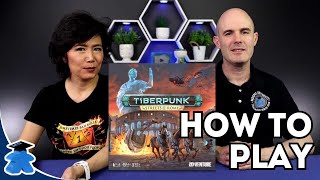

Tiberpunk: Streets of Rome Deep Dive
What the Community Thinks About Tiberpunk: Streets of Rome
Tiberpunk: Streets of Rome, published by iDventure, has so far been seen through prototype previews rather than finished copies. Meeple University walks through the standard competitive rules for two to four players, while BoardGameCo previews a sponsored Kickstarter prototype and The Dice Tower's Crowd Surfing show covers the project in a weekly roundup. Every source stresses that rules and components may still change, so the impressions below describe a work in progress.
The setting does most of the early talking. Ancient Rome has been reshaped by alien technology that crashed to Earth and was left behind, so competing gangs fight over drones, implants, and spaceships inside a city that still looks like its history. Meeple University describes players building up their gangs to make their way through this cyberpunk reimagining of Rome, with each player controlling both a character and a drone. BoardGameCo describes the board as recognizably Rome, only more futuristic, with drones moving through its streets.
The Dice Tower hosts were the most visibly enthusiastic. They felt the alien crash and the sudden spread of technology gave the project the strongest theme of their week, and they compared its anachronistic approach favorably with Lords of Helios, which they felt went in a very different direction. Their interest centered on the look and theme, and they said the rest of the presentation looked strong enough to carry it.
Core Mechanics That Define Tiberpunk: Streets of Rome
Dice Challenges Shaped by Gadgets
Most objectives resolve through dice. A character or drone rolls a number of dice equal to the matching skill, and Meeple University stresses that skills start low, so early challenges involve only a few dice. Upgrading skills at structures is the main way to improve those odds, and the reviewer calls judging when to stop investing in skills the central strategic question. A task card sets the target, such as requiring at least one die to show a particular value or a minimum number of dice to reach a threshold.
When a roll falls short, players can spend gadget cards to alter individual dice. By standard rules a single card adjusts a single die, and the Emperor's Genius favor allows up to three cards, each affecting one die face. BoardGameCo notes that the gadget can shift a die only so far, and that a die cannot wrap around from its highest face to its lowest. If the objective is still missed, a nearby lictor moves one step toward the active player, and if that movement reaches the player's piece, the attempt ends in failure.
Combat Objectives and Tiebreakers
Fights between pieces are settled by dice rolled against a chosen combat tile. The attacker rolls its offense skill, while the defender rolls hacking or guile depending on which piece is targeted. The attacker picks one of the two combat objectives on the face-up tiles, such as the longest run of consecutive numbers, the most even dice, or the most matching faces, and ties go to the defender. Gadget cards can be played by either side in any order, with the losing player usually responding last.
Results carry consequences on both sides. Meeple University explains that a winning attacker shackles the defender and marks any linked objective, while a losing attacker is shackled. A defender who wins still collects the objective reward, but cannot place a triumph token there, which keeps the reward for defense distinct from progress toward victory.
The Tiberpunk: Streets of Rome Experience
A Race Where Every Objective Counts
The feeling reviewers return to most often is urgency. Players collect triumph tokens by completing storyline and variable objectives, and the first player to clear their full set of triumph tokens sets the endgame in motion. BoardGameCo describes the result as a race in which everyone is chasing the same objectives as quickly as possible, and it notes that players must also watch what rivals are pursuing. Meeple University presents the victory condition in similar terms, with the most placed triumph winning the game.
Story Flavor That Welcomes Rather Than Interrupts
Storyline objectives carry lore. BoardGameCo reads flavor text from the Catch the Vandals card and reports that the narrative never feels like an interruption. Completing a stage one task reveals the matching stage two objective, and stage three challenges finish each chain with harder dice requirements. That structure makes personal quests feel like chapters, which the reviewer found engaging alongside the more strategic choices about when and where to act.
What Makes Tiberpunk: Streets of Rome Stand Out
A Theme Built on Anachronism
Crowd Surfing's hosts argued that the theme does serious work. Roman streets, crashed alien craft, drones, and implants sit side by side, and the hosts liked that the game explains how the technology arrived instead of leaving it unexplained. They called the mix of eras a bizarre but appealing idea, and they said the theme alone was enough to draw their interest, with the rest of the game looking good as well.
Action Pacing Through Limited Choice
Each turn, a player must place an interaction token and may also change divine favor, move a piece, or play a spaceship card, each at most once and in any order. BoardGameCo highlights that only a few interaction tokens are open at any moment, which keeps the choice manageable and helps prevent analysis paralysis. Meeple University explains that a token returns to a player only after it has waited on the wheel for a set number of turns, so timing becomes part of planning. Reviewers see this as a design that rewards long-range thinking about when to commit to an action.
Potential Drawbacks
Shackles and Lictors Compound Failure
A failed challenge or lost combat shackles the affected piece, which then rolls one fewer die on every roll until the player spends an entire movement action without moving any piece. Lictors add pressure because they drift toward players and can be steered by opponents. BoardGameCo warns that the lictors make things more and more difficult as the game goes on, and it calls a failed attempt against a nearby lictor the worst case scenario for the player in the example.
Prototype Caveats and an Unsettled Ending
Every source repeats that this is a prototype, and Meeple University frames the rules as subject to change. Setup is substantial, with a region board, several face-up spaceship decks, a lock token, separate stage one and stage three challenge decks, task stacks sorted by color and map area, and variable objectives sized to the player count. Reviewers also differ on how the game ends. BoardGameCo says the final round is completed immediately after the eighth triumph, while Meeple University says play continues until every player has taken the same number of turns. Buyers of the final edition should check the printed rules on this point.
If You Enjoy Tiberpunk: Streets of Rome
If you enjoy sandbox games where the city is the playing field and personal objectives unfold through a story, Tiberpunk offers a cyberpunk take on that structure. Players who like dice challenges that can be adjusted with cards they have collected will recognize the gadget system as a way to manage risk on each roll. Players who enjoy tight action economies, where each turn asks you to plan when an action will become available again, will find the token wheel a natural fit. Anyone drawn to a strong theme over pure simulation should look closely at the Rome setting, which reviewers singled out as the project's most distinctive hook.
What Reviewers Are Saying
"Judging when you think you've got the skills you need to win is the key to victory."
— Meeple University
"It feels very welcome where you're kind of going through these personal quests for yourself, but the actions that you're doing are very strategic but straightforward."
— BoardGameCo
"This is one that's captivating. Actually captivating to me. The theme doing some serious heavy lifting. Yes. But the rest of the game looks good, too."
— The Dice Tower