






Red Lanterns Deep Dive
What the Community Thinks About Red Lanterns
Red Lanterns emerges as a beautifully produced card game that delivers engaging gameplay through a tight, tactical design. Reviewers consistently praise the craftsmanship and visual presentation, with particular appreciation for the card foiling and the innovative 3D box design. The game's core appeal lies in its puzzle-like decision-making space: players must balance competing priorities across just five rounds, creating a game where every card play matters. Board Game Co enthusiasts have given the game a 3.5 out of 5 rating, describing it as a "fun game, beautiful game" with elements that resonate for some players more than others. Calavera's teaching content demonstrates that the core mechanics are accessible and teach cleanly. The broader consensus suggests Red Lanterns succeeds as a tightly designed competitive experience, though opinions diverge on whether the game length serves its ambitions.
Core Mechanics That Define Red Lanterns
Lantern Card Duality
At the heart of Red Lanterns lies an elegant dual-use card system. Each numbered lantern card (1-9) can be played in two fundamentally different ways: face-up to activate an immediate ability that manipulates treasures or grants information, or face-down to secure treasures at the end of the round using the card's value. This creates a perpetual tension between using cards for their powerful effects or preserving them as high-value claims. The elegant constraint is that playing a card face-down ends a player's turn, committing them to the treasure round early and losing access to further card abilities that round. Designer Grant Rodiek crafted this system to force meaningful trade-offs on nearly every turn, making the decision of how and when to deploy each card the primary strategic lever.
Elder Emblems and Progressive Unlocking
The second pillar of Red Lanterns is the emblem system tied to your player board. By playing lantern cards 1, 2, 3, or 4 face-down, players permanently unlock corresponding emblems that grant new abilities for the rest of the game. These abilities help you gather information about treasures, manipulate which cards come into play, or earn additional points at game end. Once unlocked, an emblem remains active even if its corresponding card leaves your tableau, encouraging early investment in specific abilities. This creates a light engine-building arc: early game sacrifices for ability unlocking pay dividends by creating more control and flexibility in later rounds.
The Red Lanterns Experience
A Puzzle of Perpetual Choices
Red Lanterns plays as a puzzle that changes with each round. The available treasures shift, your hand evolves, and opponents pursue their own paths. This creates a series of small, intense decision moments where the "right" play depends on reading the board state and anticipating opponent behavior. Reviewers describe the satisfying decision space: managing which treasures are worth pursuing, which abilities to unlock first, how to balance vault security for fragile treasures against accumulating quantity. The brevity of five rounds intensifies each choice, since there is limited time to recover from miscalculations or poor sequencing.
Mind Games and Interactive Manipulation
Beyond the puzzle lies a layer of player interaction that elevates Red Lanterns into competitive drama. With access to card abilities that swap treasures between the deck and the play area, players craft temptations and traps for their opponents. You might place a face-down treasure specifically to bait an opponent toward what you want them to ignore, all while positioning yourself to claim the more valuable prize. This blend of open information (treasures in play) and hidden information (face-down cards) creates opportunities for psychological play and tactical feints. For players who enjoy games like Citadels, where predicting and manipulating other players' moves is part of the fun, Red Lanterns offers a similar satisfaction through card effects rather than role selection.
What Makes Red Lanterns Stand Out
Production and Presentation
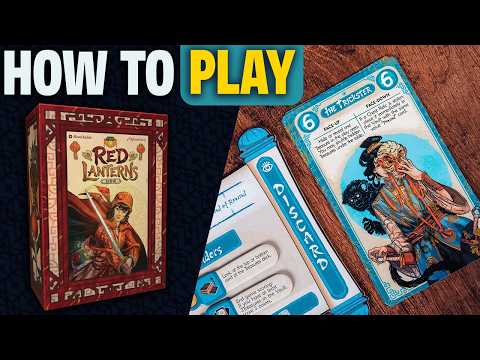
Red Lanterns immediately captures attention through superior production values. The card artwork features detailed faction imagery with foiling effects that catch light and draw the eye. The packaging itself is a standout feature, employing a striking 3D effect on the box face that creates a sense of dimensionality and craft. This thoughtful production extends to component quality and layout, signaling that Moon Gate Design invested in making the game feel premium. In an era where many games compete on similar mechanics, Red Lanterns' commitment to visual appeal gives it an advantage in the moment-to-moment experience of playing.
Efficient Hand and Tableau Management
The game balances two management challenges elegantly: your hand of cards and your tableau of treasures and emblems. Unlike games that ask you to simply accumulate resources, Red Lanterns forces meaningful hand-management decisions. Your hand feeds your deck as you cycle treasures back into it, creating a light deckbuilding element. Meanwhile, your tableau (vault, elders, activated emblems) grows and evolves, with each emblem unlock permanently shifting your capabilities. Board Game Co noted that this "good mix of hand and board management" creates multiple axes of decision-making, ensuring that even two plays of the same hand can unfold differently based on how you sequence your tableau development.
Potential Drawbacks
Five Rounds May Not Deliver Full Strategic Depth
The most consistent criticism from reviewers is that Red Lanterns attempts to do too much in too short a timeframe. Across five rounds, players balance unlocking abilities, managing treasures for vault security, building effective card combinations, and competing in mind games. Board Game Co raised the concern that this concentration leaves insufficient time to lean into the engine-building aspects. The reviewer estimated that six or seven rounds might allow strategies to fully develop, letting players see the payoff from early ability investments and treasure set collection in a more satisfying arc. For some players, the game feels slightly truncated, as though the system has more depth than the length allows them to explore.
Imbalance at Two-Player Counts
While Red Lanterns shines at three or four players, the two-player experience shows cracks. With fewer players at the table, the treasure pool available each round feels less rich and interesting. The decision space contracts because there are simply fewer treasures competing for attention, and the mind games layer, which draws much of the game's appeal, becomes muted with only one opponent. Reviewers noted that two-player games feel less free and therefore less engaging, though they acknowledged that designers are aware of this and may continue balancing prototype rules.
If You Enjoy Red Lanterns
Players drawn to Red Lanterns' core experience should explore several related titles. Fans of the card-play puzzle will find similar satisfaction in Panda Spin, which shares the same publisher (Moon Gate Design) and focuses on playing cards strategically in a hand-shedding framework. For those who appreciate the interactive mind games layer, Citadels is an essential touchstone, offering comparable psychological play and player manipulation through different mechanisms. If you're drawn to Red Lanterns' beautiful presentation and the idea of gathering and combining treasures in varied sets, Pop Art offers a visually distinct but mechanically adjacent experience where you overlay cards to create scoring patterns and artful arrangements.
What Reviewers Are Saying
"Deciding how and when to use each lantern card is key."
— Calavera
"This game looks absolutely beautiful. The card art over here, the foiling they have on these. The art in general is great, but the foiling touches look perfect on these cards. I think they did a great job with the production."
— Board Game Co
"Do I want that face-down card, or am I trying to tempt you with that face-down card? Because really I want that four on the table, and I know you're going to be tempted by the five because I just swapped it in. There is some degree of mind games as well that can be quite entertaining."
— Board Game Co