




Boo Party Deep Dive
What the Community Thinks About Boo Party
Reviewers are delighted by Boo Party, a 2025 LOKI release that brings whimsy and chaos to the family game table. The consensus is clear: this lightweight party game works for a broad spectrum of ages and play styles. Reviewers consistently praise the speed at which games resolve, the cute and detailed artwork, and the clever asymmetrical structure that keeps everyone engaged, whether they are the seer or one of the scheming monsters. While some note the memory challenge can be tough under pressure, that tension is part of the appeal, especially for younger players who often outshine adults at remembering the costume sequence.
Core Mechanics That Define Boo Party
Asymmetric Seer vs. Monsters Memory Deduction
Boo Party's central tension stems from its asymmetric structure. One player takes the role of the seer, a fortune teller attempting to identify monsters sneaking into a Halloween party. The remaining players are monsters, trying to disguise themselves in costumes and evade detection. The seer's job is to remember which costumes have already been revealed (and are therefore "burned" for that round), while the monsters must quickly grab costumes they haven't worn consecutively and hope the seer doesn't catch them. What makes this elegant is that everyone at the table is actually remembering. The seer tracks the costume deck; the monsters track which costumes are safe to repeat. Reviewers note this is not memory in the traditional "match pairs on a grid" sense, but rather a dynamic, pressure-cooker version where knowledge decays as the game goes on.
Rapid Costume Swapping Under Time Pressure
The second pillar is the speed element. Each round, the seer counts down (anywhere from "one, two, three, I'm going to catch you" to a leisurely five-count), and during that window, all monsters must have selected and equipped a costume. If a monster is caught without a costume, the seer wins immediately. This creates frantic physical play, where players are reaching across the table, sometimes colliding hands and arms in their haste to grab what they believe is a safe costume. Reviewers describe this as genuinely chaotic fun, especially with younger children who embrace the bumping and scrambling. The seer, meanwhile, controls the pacing: they can count quickly to pressure the monsters or count slowly to give newer or younger players time to collect themselves and make deliberate choices. This built-in difficulty adjustment means a single set plays well across a 4 to 12-year-old spectrum, and adults find it humbling and entertaining precisely because kids' faster reflexes and fresher memories often give them an edge.
The Boo Party Experience
Tense Cat-and-Mouse Energy with Whimsical Charm
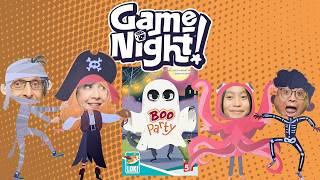
Despite the pressure cooker mechanics, Boo Party never feels mean-spirited. The theme of monsters trying to crash a Halloween party, combined with the adorable costume illustrations, keeps the energy light and playful. Reviewers consistently mention the cute factor as a major draw. The costumes range from witches and ghosts to devils and unicorns, each illustrated with personality. The physical design elevates the charm: each costume card has a cutout for the eyes, so when a player holds the card up to their monster character card, the character's eyes peek through the hole, creating an immediate, delightful visual gag. Even the box itself features this eye-peeking element. This attention to detail transforms what could be a cold memory puzzle into a game that feels warm and lived-in. The tense moments (will the seer catch me?) are balanced by laughter and friendly competition, making it as much about the shared moment as the outcome.
Quick, Repeatable Play Sessions That Invite Rotation
Boo Party resolves in roughly 10-20 minutes, depending on the seer's counting speed and the number of rounds before someone slips up. This brevity is a feature, not a bug. Because rounds are short and each player can take a turn as the seer, a group can play multiple rounds in a single session, rotating roles so everyone gets to experience both sides of the asymmetry. Reviewers appreciate how accessible the teaching moment is: explaining the rules takes just a minute or two, and new players can jump in immediately. The game's low barrier to entry makes it a natural choice for casual family play, convention demos, or that moment when a group wants something light between heavier games. The fact that you can play five complete rounds with five kids in 10-20 minutes means it doesn't overstay its welcome.
What Makes Boo Party Stand Out
Cute Artwork and Physical Design with Standout Cutout Details
Multiple reviewers highlight the costume illustrations as a major strength. The art is whimsical and colorful, with each of the 18 costumes having a distinct look and personality. More importantly, the eye cutouts on every card create a mechanical marriage of form and function: they are not just a decoration; they become the gameplay interface when you place your character card behind the costume card. This small detail makes the game feel considered and delightful at every touch point. The production quality, reviewers note, is high for what is ostensibly a light party game. The foil or special coating on some cards, the careful illustration of each face cutout (no two are identical), and the overall polish signal that the designers and publisher took this seriously, even if the game itself is meant to be silly and fun.
Adjustable Difficulty Through Seer Pacing and Costume Deck Thinning
Embedded in the rules is a natural difficulty dial. The seer can make the game easier for struggling players by counting slowly, giving monsters time to think and choose deliberately. The seer can make it harder for confident players by counting quickly, forcing faster decisions and tighter memory under pressure. Beyond that, the finite costume deck means that as the game progresses and fewer unseen costumes remain in the pile, the monsters' task becomes harder: there are fewer "safe" options, and the seer's memory task paradoxically becomes slightly easier because the search space shrinks. Reviewers note this creates a natural tension arc, where early rounds are more forgiving and late-game rounds feel genuinely tense. This emergent difficulty scaling means a single game can challenge a table of mixed ages and experience levels without requiring any house rules or variant cards.
Potential Drawbacks
Memory Challenge Can Be Brutal for Some Players, Especially Under Time Pressure
Reviewers are candid: speed memory is not everyone's strength. Adults often struggle to track costumes as the deck grows, and the combination of memory and time pressure can be what one reviewer calls "a lethal combination for some people." The game rewards players with sharp, quick recall, which means older players or those with memory challenges might feel at a disadvantage, especially against children, whose memory capabilities are often fresher and less cluttered with everyday information. If a table includes someone who gets anxious under time pressure or frustrated by memory-heavy games, Boo Party may not be the right fit. The seer's ability to slow the count helps, but it does not eliminate the core challenge.
Chaotic Physical Play and Deck-Thinning Challenges
The reaching-across-the-table scramble is part of the fun, but in a rambunctious group, it can get boisterous. Players grabbing the wrong costume or accidentally elbowing a neighbor is genuine risk. Some families or groups might find this too chaotic or worry about players getting frustrated when they cannot reach their chosen card. Additionally, as the costume deck thins late in a round, the remaining cards become harder to locate on the table, and players are sometimes forced to grab what is immediately available rather than what is strategically wise. This can feel less like clever play and more like blind luck, which some reviewers note undermines the sense of control. Playing multiple rounds back-to-back also means repeat plays have a different character: by the second or third playthrough of the same evening, players remember more costumes from the previous game, which shifts the balance and makes fresh plays feel less surprising.
If You Enjoy Boo Party
Players who love Boo Party typically enjoy light, memory-based party games where asymmetry and social deduction create dynamic tension. If the charm of charming artwork, quick play, and a mix of memory and speed appeal to you, look for other asymmetric games that balance seer-and-hunters themes, as well as light memory games designed for families and mixed-age groups. Games that reward quick thinking, encourage table talk, and deliver a complete experience in 15-20 minutes will likely land well. Boo Party's greatest strength is its inclusive difficulty scaling and whimsical theme, so seek out games that share that philosophy of accessible challenge and warm presentation.
What Reviewers Are Saying
"I love the physical design of it. I mean, it's basically a card game, right? But it's a card game where even the box has these cutouts where the eyes are peeking through. So it just it has a charm factor for sure. And the art is really really cute on that one."
— BoardGameGeek
"It's a memory game for everyone."
— BoardGameGeek
"One thing I really like about Boo Party is it's quick. You know, I could teach this game to a group of five kids and they could all play and all be the seer and play five complete rounds in 10 minutes. Maybe 20, maybe 25. But like, you know, a complete game just lasts until the seer is fooled or the seer catches a monster and that's it. Pass the seer to the next player and go again."
— BoardGameGeek