

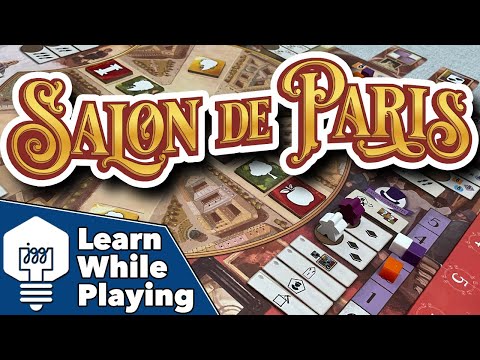




Salon de Paris Deep Dive
What the Community Thinks About Salon de Paris
Salon de Paris, published by Talon Strikes Studios, casts players as rival painters in 1852 Paris. They move between city locations to gather canvases and paint tiles, build standing with art critics, and hang finished works on a shared Salon wall. The reviews available for it were all based on prototype copies tied to a Kickstarter campaign, and each reviewer cautioned that components and rules could still change. Within that caveat, the reviewers agree on the core: the gameplay is the strength, and the mechanisms fit together better than the presentation.
Brains On Games offered the most enthusiastic verdict. Dr. Brian McDonald described the game as a midweight Euro that streamlines worker placement, tile drafting, and tile placement into one package, and called it the best tile placement game they had played in a long time. Let's Table It, hosted by Brody, was more measured. Brody concluded that the gameplay and mechanics shine above everything else in the box while finding the art unremarkable. Getting Games approached the game as a full rules walkthrough, so its perspective focuses less on verdicts and more on how the rules create decisions during play.
Disagreement is limited and mostly concerns who the game suits. Dr. McDonald's group felt the game had just the right amount of brain burn without becoming frustrating. Brody concluded that the strategic layer is demanding enough that a young child could not yet join in. Both views describe the same design from different tables, and together they frame Salon de Paris as a rewarding strategy game for players who are comfortable with dense iconography.
Core Mechanics That Define Salon de Paris
Worker Placement
Every turn begins with movement. Each artist meeple travels to an unoccupied action space, and the route determines the cost and the reward. Moving to an adjacent location is free. Reaching a location two steps away means discarding one painting tile from the Sketchbook, and a three-step trip costs two tiles. The painting tiles a player collects come from the road just traveled, so both the destination and the path matter. Brody summarized the design as worker placement with a limited number of spaces, and Dr. McDonald noted how quickly a plan can collapse: a player who has spent several turns setting up a large canvas can lose that space to an opponent in a single move.
Power and supply are tied together at each location. Dr. McDonald observed that stronger actions yield fewer paint chips, so every placement is a trade between a better action and more materials for the Sketchbook. Players can share a location with an opponent but not an action slot. An Academy card that lets an artist act on a spot an opponent occupies turns that blocking into a tool. Apprentices add another layer, since each one can be discarded to take an extra action at a location, once per visit.
Tile Placement
Painting tiles are collected from the roads and pressed onto canvases in the Sketchbook. Once a canvas is complete, the finished work goes onto the Salon wall, and that is where reviewers located the game's hardest decision. A painting must sit orthogonally adjacent to another painting or a starting swatch, and it must produce a number of color matches equal to the highest-numbered row it occupies. Favor can reduce that requirement by one per point, but Getting Games pointed out that spending favor on a placement can cost as much as the placement earns. Tiles cannot be rearranged once painted, although overpaint tiles can cover a matching color to add genre icons. Brody noted that another player may take the exact spot you were planning to use, so the wall is in constant flux. Dr. McDonald called placement "super important" and described the late game, when the wall is crowded and canvases with three or four tiles have nowhere to go, as a real test of focus.
The Salon de Paris Experience
Satisfying Puzzle Tension
Salon de Paris feels like solving a jigsaw whose shape keeps changing. Dr. McDonald's group described a tension that built as the wall filled, so that by the final rounds there were few spaces to place a painting and the choices narrowed sharply. Getting Games explained that the game ends once the wall has only a few vacant spaces left, which compresses the last rounds further. Reviewers did not find this frustrating. Dr. McDonald said the group never felt stuck, and Brody described the placement as the most complex part of the game, the part where one well-timed move by another player can undo a careful plan.
Contested Spaces and Shifting Plans
The second tension is social. Sketchbooks are open information, so Dr. McDonald observed that everyone can see what each player is building and that opponents can interfere. Blocking an action space or a route is a standard move, and players who invest several turns in one large painting may lose it to a rival. Brody described an opponent placing a painting right where Brody had planned to put one. The reviewers treated this constant adjustment as central to the appeal, because success depends on adapting to whatever the table does next.
What Makes Salon de Paris Stand Out
Academy Cards and Personal Powers
Brody named the Academy cards as the favorite element of the game. Each card scores points at the end of the game and grants an ongoing ability that belongs to its owner alone. Brody admitted to feeling jealous when opponents received their own special actions, which shows how much the cards change what a turn is worth. Getting Games walked through several examples, including a card that lets a player paint an additional tile for the rest of the game and another that allows an artist to remain at a location while still taking a different action there. Cards can only be added once a painting is completed and its signature token is removed, so the painting track and the Academy track stay linked.
Action Power Against Paint Supply
Dr. McDonald praised the trade-off between action strength and paint supply as one of the strongest decisions in the design. Stronger spaces bring fewer paint chips, so players often choose between building materials for the Sketchbook and a more powerful effect. Dr. McDonald also highlighted the rule that a road is not refilled until every tile on it has been taken. Players can deliberately leave a road nearly empty to limit what the next player receives, and that restraint adds a layer of denial to every draft.
Potential Drawbacks
A Steep Learning Curve
The symbology is the most frequent concern. Dr. McDonald felt the icons could be intimidating for players unfamiliar with this style of game, while also noting that numbered cards and an organized rulebook make reference easier. Brody's eight-year-old asked to play, and Brody had to say no. Brody explained that the actions themselves are manageable, but the strategic question of which action to take and why is where the complexity begins. Both reviews point toward tables already comfortable with dense iconography and multi-step planning.
Artwork and Theme Presentation
Presentation drew the least praise. Dr. McDonald said the tile artwork is not the fanciest and does not evoke the feel of a Paris painter working in the period. Brody described the art as underwhelming, with the box art as the standout, and credited the box art to James Churchill. Both reviewers noted that their copies were prototypes, so components and art may change before release. For players who buy mainly for theme, this is a fair warning, although the reviewers felt the mechanisms carry the experience.
If You Enjoy Salon de Paris
Salon de Paris rewards a specific kind of player, and its design points toward a few familiar tastes in the hobby.
- Players who enjoy worker placement where blocked spaces force a replan will find the action-space contention familiar, and the travel costs add a second decision layer.
- Players who like spatial puzzles where each placement is permanent and scored by matching will appreciate the Salon wall, especially its late-game squeeze.
- Players who appreciate asymmetric personal powers that unlock as the game progresses will relate to the Academy card track.
- Players drawn to drafting, where leaving options for others is itself a strategic move, will recognize the way the roads stay thin until they are fully emptied.
What Reviewers Are Saying
"I'm not a guy who really seeks out tile placement games, but this is probably the best one I've played in a dog's age. I can't remember the last time I had so much fun with tile placement."
— Dr. Brian McDonald, Brains On Games
"My favorite thing in this game is the Academy card. Some of those either give you a lot of points, so you want to get those spots free so that you can get more of those cards, but also some of them give you less points but also gives you like a great special ability that only you have."
— Brody, Let's Table It
"In this way painting tiles are not just a currency to actually create paintings, but there are also a flexibility currency to be able to go to the location that you want to."
— Getting Games