

Marvel Champions: The Card Game - Trickster Takeover Scenario Pack Deep Dive
What the Community Thinks About Marvel Champions: The Card Game - Trickster Takeover Scenario Pack
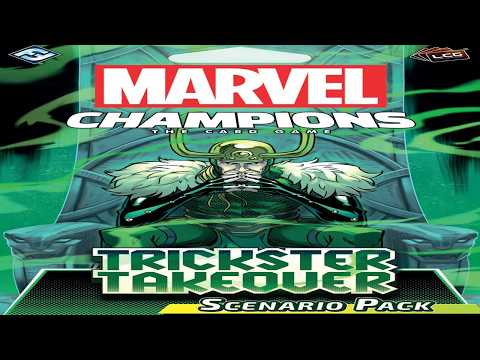
Reviewers at Board Games UnLocked land on a split verdict for this Fantasy Flight Games scenario pack, and the disagreement centers on how many people sit at the table. The pack includes two separate villains, Enchantress and Loki, God of Lies, and introduces an Epic Multiplayer Mode in which groups of players each fight their own version of Loki while their progress feeds a shared main villain. In one discussion the host gave the pack an eight out of ten, calling the Loki group concept a nice surprise and describing the two scenarios as completely separate from one another. In a later video from the same channel, the host gave it a six, called it a scenario pack that is not for them, and placed it at the bottom of the scenario packs released so far.
The reviewers agree that the Enchantress half is the more approachable part of the set. Both discussions praise her mechanics as a sensible addition to the lineup, and both recognize that the Loki group design is ambitious. Where they part ways is on the question of whether the game can sustain a large group. The enthusiastic reviewer sees the group structure as a fair and balanced way to play with a crowd, while the more skeptical reviewer believes the experience only works in small numbers and that the length of the game outstrips its content.
Core Mechanics That Define Marvel Champions: The Card Game - Trickster Takeover Scenario Pack
Forced Actions and Hypnotic Gaze Counters
The Enchantress scenario is built around a hypnotic gaze card that is distributed to each player. Charm counters accumulate on this card over time, and once five or more are present, the card is flipped to reveal a lasting effect that affects that player for the rest of the game. Enchantress also introduces forced actions, which are obligations a player must perform at some point during their turn. The host of the playthrough video explained that each forced action carries a benefit alongside its cost, such as healing the villain for one, drawing a card, and then discarding a card. Reviewers describe this as a double-edged system: a player might reduce a card's cost to play more cards and work around the enthralled effect, but that choice also pushes the charm counters higher. The second reviewer found the design genuinely new for the line, noting that it restricts play without completely killing a build or the game.
Group Pods and Shatter Counters in Epic Multiplayer Mode
The Loki scenario expands the game into a group event. An organizer runs the session, and each group of up to four players, called a group pod, fights its own copy of Loki. When a player defeats their version of Loki, shatter counters are placed on the Loki, God of Lies villain, which is a separate, shared threat that the whole room works against. Each copy of Loki has a substantial health pool, and the villain cycles through several variants as each one is defeated. The reviewers compared this structure to the Kang the Conqueror scenario, which also gives each player a unique version of a villain. The key difference, according to Board Games UnLocked, is that the Loki design pushes damage from every individual fight toward a single common objective, which creates a stronger team dynamic than the solo splits in the Kang scenario.
The Marvel Champions: The Card Game - Trickster Takeover Scenario Pack Experience
Tense, Double-Edged Pressure
Playing against Enchantress produces a steady sense of pressure that the reviewers found engaging. Each turn requires weighing the benefits of a card against the charm counters it might push onto the gaze card, and the host of the playthrough repeatedly described having to choose between a useful play and a manageable consequence. The reviewers did not describe these moments as punishing. Instead, they describe the tension as a series of small trade-offs that keep the player thinking through the enemy's turn. The second reviewer summarized the feeling by noting that Enchantress is a cool addition with forced actions that are not terrible, which means the threat is always present but rarely overwhelming.
The Satisfaction of a Built Hero
The clearest moments of joy in the reviews come from building up Iron Man. Both reviewers explained that his power depends on collecting tech upgrades and his full suit, and that once those cards are in play, the hero feels overwhelmingly strong. The playthrough host described a turn where Iron Man's suit cards combined into a powerful sequence that finally defeated Enchantress. The discussion video called him one of the most fun original characters to play once his kit is assembled, emphasizing that he can deal damage and absorb punishment in ways that make the player feel overpowered. Reviewers also warned that without the tech cards, Iron Man becomes a liability, which makes the reward of building him feel earned.
What Makes Marvel Champions: The Card Game - Trickster Takeover Scenario Pack Stand Out
The Enthralled Minions Turn Enemies Into Allies
The second reviewer singled out the Trickster Magic encounter set as a thoughtful addition. Certain minions represent characters who were enchanted by Enchantress, so defeating them lets the player replace the minion with an ally that has its own special ability. The reviewer explained that this rewarded focus fire, because players knew that defeating a minion would hand them a useful ally. The concept turns what is normally a simple threat into a reward, and it fits the scenario's theme of Enchantress converting opponents into her followers.
A Group Design That Feels Fair
The discussion video praised the Loki scenario for avoiding a common problem of split-party designs. In the Kang scenario, some heroes struggle when they are isolated, because their decks depend on allies or support cards that they cannot use alone. The Board Games UnLocked host argued that the Loki design avoids this by letting every player fight a version of the villain that they can handle, while the synergy cards and shared damage keep everyone connected. The host also appreciated that the pack remains playable in standard mode and that the structure does not require an entire room to function.
Potential Drawbacks
Length That Outpaces the Content
The most consistent criticism concerns playing time. Both reviewers argued that Marvel Champions already runs long for a game with only a modest amount of variety, and that the Loki group mode multiplies that length. The discussion host pointed out that some enemies at thirty or more health already make a two-player game last about an hour, and that a four-player table effectively doubles the time. The second reviewer found the Loki health totals excessive, arguing that the shared villain's health scales so sharply that the game drags, and that the individual versions must be beaten several times before the group can win. Both reviewers concluded that the game does not contain enough content to justify this length.
Limited Replayability and a Narrow Audience
The second reviewer also raised concerns about replayability. After a player has assembled their build and seen most of the encounter cards, the game can shift into a routine of going through the motions. The reviewer said they prefer Marvel Champions at solo or two players because a smaller game keeps the encounter deck from being fully revealed. The reviewer also noted that the Loki scenario requires multiple copies of the pack for a true group pod experience, which limits the audience to players with access to a large group. Although the reviewer acknowledged that the design is not inherently bad, they felt that it serves a niche audience that already enjoys large group play.
If You Enjoy Marvel Champions: The Card Game - Trickster Takeover Scenario Pack
Players who enjoy the Enchantress scenario's forced action system will find similar satisfaction in other Marvel Champions packs that reward careful sequencing, particularly the Kang the Conqueror pack, which uses a comparable structure of unique villain versions. Players who appreciate the Loki group design should look at Kang the Conqueror as well, since the reviewers described it as the closest precedent, though they felt the Loki version gives teams a stronger common purpose. Fans of the Mojo Mania scenario pack are also a good fit, since the reviewers described it as a solid and enjoyable standalone scenario that delivers a satisfying single-experience arc. Players who want a shorter session with a strong sense of character building should consider the base Marvel Champions game, because the reviewers consistently framed the game as best at solo or two-player counts. For players who want more standalone scenarios, the Red Hood and Wrecking Crew packs were both referenced in the discussion as additional single-scenario options within the same line.
What Reviewers Are Saying
"Yeah, Iron Man plays exactly as I remember him with he's absolutely useless until you actually get all of his you need you pretty much need you don't need both rocket boots, but you need at least these four cards to make him worthwhile in any way."
— Board Games UnLocked
"And then I mean the group effort of the Loki god of lies is something that I would never do because I don't like Marvel champions at more than two players because your decks and the game play does not justify the length that it extends because some enemies even when you're playing with just two players at 30 plus health is okay this is going to be an hour and if you play with four people, you've just doubled that time."
— Board Games UnLocked
"I actually thought that that was a pretty cool introduction of a new mechanic because it it wasn't so restrictive that it completely killed any build you had going on or killed your game, but it was something you had to keep in mind. A lot of them weren't actually that bad. Some of them would be like, 'Oh, heal the villain by one, but then you get to draw a card and then discard a card.' So they had it was a double-edged sword kind of system."
— Board Games UnLocked