


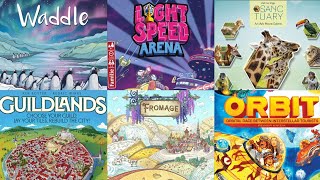

Guildlands Deep Dive
What the Community Thinks About Guildlands
Reviewers agree that Guildlands has one of the more original premises in recent tile-laying games, but they split on whether the execution lives up to it. The Chairman of the Board, who covered six releases in one video, found the concept fascinating yet came away disappointed, calling the game too light and saying it did not do enough with its asymmetry. Joey Evans, in The Dice Tower‘s top 10 overlooked games of 2025, placed Guildlands at number five and said it surprised Joey Evans how good it is. Tom Vasel, in the Look Back episode on The Dice Tower, gave it an 8 out of 10 and praised the neat ideas behind it, Tom Vasel, The Dice Tower.
The disagreement comes down to expectations. Those who want tight, confrontational decisions tend to find the game too gentle, while those drawn to a novel take on city building see it as a fresh and replayable experience. Nobody dismisses the premise, which is part of why the criticism reads as frustration that the design did not fully deliver.
Core Mechanics That Define Guildlands
Outset Media‘s Guildlands is built on two ideas that work together: a shared tile-laying board and a set of factions that each score in their own way.
Tile Placement
Each turn centers on adding a new tile to the city or rotating a tile already in play so that new patterns form. Everyone builds on the same map, so every placement changes the landscape for the whole table. The Chairman of the Board described the core action as very easy to grasp, and noted that colored workers can also be moved along the roads to hinder rivals from shifting existing tiles. The Chairman of the Board wished that physical interaction went further, since it only operates at a fairly minor level.
Asymmetric Guild Factions
At the start of the game, each player is assigned a guild with its own scoring goal. The wizards build squares of wizard towers, the gardeners connect groups of foliage and trees, the market guild links markets together, and the defense guild raises fortresses along the edges of the board. Joey Evans noted that every faction plays and scores in a fundamentally different way, which gives the game its replay value: a new guild changes what you need to build and what your opponents are trying to block.
The Guildlands Experience
Parallel Building in a Shared City
Much of the play feels like each player is optimizing a private engine while the city grows around everyone else. The Chairman of the Board admitted to not being especially concerned with what other players wanted, and said that the game‘s interaction felt fluffy and not especially deliberate. Players tend to step on one another‘s toes only by accident, which keeps the mood calm and focused but can leave some reviewers wishing for more friction.
Replayability From Changing Factions
Joey Evans said replayability is through the roof because of the number of guilds, and Joey Evans was surprised that the game plays better with more players, which is unusual for a city builder. Even though blocking is not the main goal, Joey Evans noted that players will often want to move into areas to deny a rival‘s lead, so the table always has some interaction to track. The variety of guilds keeps each game feeling different enough to warrant another play.
What Makes Guildlands Stand Out
Factions That Score in Completely Different Ways
The clearest praise from reviewers centers on the faction design. Joey Evans described the asymmetric powers as being on the next level, and appreciated that players must keep an eye on how everyone else is scoring. Tom Vasel summarized the concept as a tiling game in which you build a city while everyone plays an asymmetric faction that scores based on how things are placed. The factions give the game a distinct identity that most tile-laying titles lack.
A Shared Cityscape That Everyone Shapes
Several reviewers liked the idea that every player contributes to a single city, even when each person is pursuing a separate objective. The Chairman of the Board praised how everyone has their own thing going on while still adding to the same cityscape, calling it a genuinely nice touch. The shared map gives the finished layout a sense of collective authorship that makes the experience feel more like a community project than a solitary race.
Potential Drawbacks
Decisions That Feel Obvious
The most serious criticism comes from the Chairman of the Board, who felt the decisions were fairly obvious and that the game was closer to a one-trick pony than a fully realized design, concluding that the design did not do enough with its asymmetry and left the decisions too easy to read. Joey Evans offered a counterpoint, noting that asymmetric games demand you understand how everyone is trying to win, which is a demanding requirement but also a source of depth. Players who want quick, mechanical clarity may find that the factions do not translate into meaningful choices at the table.
Visuals That Do Not Pop
The Chairman of the Board also found the visuals less clear and less attractive than they could be, suggesting that minor adjustments would have made the visuals more appealing and easier to read during play. For a game where you constantly need to read what each tile and faction is doing, that criticism matters, and it is one reason the Chairman of the Board believes the concept outpaces its execution.
If You Enjoy Guildlands
Players who like the asymmetric powers in Guildlands should look at Villainous, which Joey Evans used as a point of comparison. In both games, knowing how each opponent wins is central to strategy, and the variety of starting powers keeps the experience fresh.
Fans of the tile-based approach should consider Sanctuary, the tile placement follow-up to Ark Nova. The Chairman of the Board praised its clear visuals and well-explained design, while Tom Vasel found it a bit too random for their taste. It is a good pick for players who want spatial tile decisions with cleaner presentation than Guildlands offers.
For a lighter tile-laying experience, Cascadia is a game Tom Vasel said is probably its publisher‘s best-selling title, rating it 7 out of 10 on The Dice Tower. Its simple placement and scoring suit players who want to build a landscape and watch it grow.
What Reviewers Are Saying
"Guildlands as a concept fascinates me."
— Chairman of the Board
"Every single faction plays and scores completely differently."
— Joey Evans, The Dice Tower
"Guildlands, a tiling game in which you‘re building a city, and everyone is playing an asymmetric faction that scores based on how stuff is placed out there. Some really neat concepts there."
— Tom Vasel, The Dice Tower