
Game Info
Year
2025
Players
1-99
Playtime
20 min
Collection
Your Tier
Loading…
Mechanic profile
Not enough video data yet
Vibe profile
Not enough video data yet
Description
A medieval flip-and-write game where players act as architects rebuilding a ruined town to royal specification
Featured Videos
Playthrough

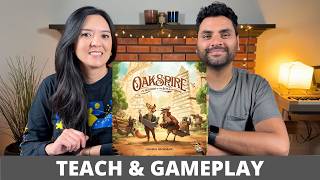
Oakspire - Teach & Playthrough
Ask a Rules Question
Images
GID0458286.jpg

GID0458286_thumb.jpg
All mentions
Browse transcript mentions, sentiments, pros/cons, mechanics, topics, quotes, and references.
Total mentions: 3
This page: 3
Sentiment:
pos 3 ·
mix 0 ·
neu 0 ·
neg 0
Showing 1–3 of 3
Video _sPo1quW4IM
BoardGameCo News And Weekend Review at 7:49 sentiment: positive
video_pk 81837 · mention_pk 204654

Click to watch at 7:49 · YouTube ↗
Overall sentiment (raw)
positive
Pros
- Intrigued by final copy
- engaging
Cons
none
Thematic elements
Comparison games
none
Mechanics (from transcript analysis)
Mechanics unknown.
Video topics + discussion points
No key topics recorded for this video.
Quotes (from this video)
- It sucks.
- Not sustainable.
- Longer conversation, effectively big box productions are more viable via crowdfunding than they are via traditional retail models.
- I like the Unstoppable system.
- I hope you have a better week than I'm going to have.
References (from this video)
No references stored for this video.
Video i7i5Z5xsnnM
Before You Play Playthrough at 0:00 sentiment: positive
video_pk 69798 · mention_pk 205380
Click to watch at 0:00 · YouTube ↗
Overall sentiment (raw)
positive
Pros
- rich engine-building and card-interaction depth
- high replayability due to many unique project cards and specialist abilities
- intuitive core loop (collect, process, fulfill) with clear upgrade paths
- engaging endgame scoring with multiple scoring vectors
- specialists add asymmetry and strategic variety
Cons
- prototype art and components indicate potential design/production changes
- higher complexity with many interacting rules can be intimidating
- opponent interaction can create 'box-out' leverage in two-player games
- manual tracking of limits and resources can be fiddly during play
Thematic elements
- cozy, community-driven tableau building with resource processing and positional strategy
- Sunleaf Grove city; animal construction companies reclaiming wood to build projects
- educational/illustrative explanation of game rules and playthrough
Comparison games
none
Mechanics (from transcript analysis)
- Action economy — on a turn, players take three actions chosen from six possible actions, with combinations including or requiring coins for both actions
- blueprints and construction-site management — cards placed in wood or blueprint zones persist across turns and influence future actions and fulfillments
- Card-driven tableau building — players draft and play project cards that can be used to fulfill projects, provide immediate benefits, or grant company actions
- community action phase — at the end of each turn, the rightmost card in the display can be executed by all eligible players, affecting resources or actions
- Multi-Use Cards — cards can be used as projects, or as blueprints, or for their company actions, depending on where they’re played
- specialist/advantage cards — each player has a specialty that grants ongoing abilities and unlocks a powerful advanced ability
- wood processing hierarchy — reclaimed wood progresses from reclaimed wood to logs to boards to panels, with processing occurring in a shared workshop area
Video topics + discussion points
No key topics recorded for this video.
Quotes (from this video)
- This is a cozy tableau building game for one to five players.
- Project cards are multi-use cards.
- Seven in a two-player game signals the end of the game.
- You must fulfill the entire order at once.
References (from this video)
No references stored for this video.
Video so8dnbK6mFw
Tabletop Tolson Playthrough at 0:03 sentiment: positive
video_pk 40916 · mention_pk 124117
Click to watch at 0:03 · YouTube ↗
Overall sentiment (raw)
positive
Pros
- Delightful and approachable village-building puzzle with quick, satisfying turns
- Strong replayability thanks to map variety and changing two-objective goals
- App-assisted setup reduces printing and card management, increasing convenience
- Engaging theme and charming artwork; balance of strategy and planning
- Solid solo experience with a clear path to multiplayer competition
Cons
- Reliance on the app (or printing) to realize full map options and maps variety
- Learning curve associated with understanding adjacency rules and cog activation
- Some players may prefer more direct combat or exploration mechanics not present here
Thematic elements
- Town construction, resource management, and defense against encroaching threats while meeting personal objectives
- Village/town building in a stylized rural landscape with hex-grid neighborhoods, resources, and threats
- Solitaire puzzle with an optional competitive multiplayer layer and map-driven variability
Comparison games
none
Mechanics (from transcript analysis)
- app_maps_and_randomization — An accompanying app configures maps, provides 10 turns of randomized cards, and tracks progress; maps include QR codes for setup.
- Asymmetric Mechanics — Threats (swamps, bandits, wolves, insects) threaten buildings and crops; swamps negate adjacency benefits and require defensive planning.
- building_placement — Players place buildings on a hex grid with proximity constraints (e.g., away from water, near trees) to unlock resources and scoring potential.
- cog_actions — Cogs allow activating actions; players can use up to six hammers (actions) per turn to trigger various effects.
- map_variability_and_replayability — Multiple maps with different configurations and a rotating objective pool create high replayability and varied puzzles.
- objectives_and_scoring — Each game presents two objective cards out of a pool; completing both objectives yields bronze, silver, or gold scores (20/30/40).
- Resource Management — Gaining and managing resources such as grain, eggs, furs, coins, and hammers to activate actions and fulfill objectives.
- resource_management — Gaining and managing resources such as grain, eggs, furs, coins, and hammers to activate actions and fulfill objectives.
- threat_mechanics — Threats (swamps, bandits, wolves, insects) threaten buildings and crops; swamps negate adjacency benefits and require defensive planning.
- Worker Placement — A house must have a person to run a building in order to generate outputs; running buildings is necessary to convert resources and gain bonuses.
- worker_placement/operating_buildings — A house must have a person to run a building in order to generate outputs; running buildings is necessary to convert resources and gain bonuses.
Video topics + discussion points
No key topics recorded for this video.
Quotes (from this video)
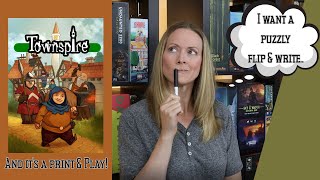
- Townspire.
- This is a flip and right that you can play one to as many as you'd like.
- It's a 10turn game that is pretty quick and you are town building.
- One of the coolest things about this is there's this QR code right here on each map.
- I'm going to be scoring my gold that I earn, but only if I've completed my objectives.
- This is a solitaire game.
- What a delightful fun village building solo and multiplayer game that takes you about 20 minutes to play.
- Tons to like here.
- It has replayability because your objectives are going to be different every time.
- And of course, you're doing some drawing, so have fun with that.
- This is a really cool puzzle feature.
- That's going to be it for me this time, folks.
References (from this video)
No references stored for this video.
Transcript Navigation
Showing 1–3 of 3