





Word Wipe Deep Dive
What the Community Thinks About Word Wipe
Word Wipe divides reviewers in interesting ways. Tantrum House embraces it enthusiastically as a quick, social word game that scales elegantly to large player counts. The Dice Tower enjoyed playing it at Big Game Night alongside hundreds of other players, suggesting strong social mechanics. But BoardGameCo's Alex Radcliffe loved the conceptual premise so much that their disappointment with execution in practice stands out as the most detailed critical take available. Radcliffe frames the core tension well: the idea of a "reverse Codenames" experience is brilliant, but translating that concept into a reliably satisfying 20-minute game proved difficult for their group. The consensus suggests Word Wipe works best in certain social contexts, but players should approach it knowing the difficulty curve on word association can be steep.
Core Mechanics That Define Word Wipe
Silent Clue-Giving Through Pointing
Designed by Peter Hayward and published by Alderac Entertainment Group, Word Wipe inverts the clue-giving formula familiar from party games like Codenames. Instead of one player giving verbal clues, the clue giver here silently points to groups of cards on the table. The other players must guess the single connecting word that links those cards together. As Alex Radcliffe explained, once players start guessing, the clue giver can point to more cards or gesture to confirm when guesses move in the right direction, but they cannot speak the connecting word themselves. It is a fundamentally silent, physical puzzle where communication flows through gesture, not language.
Real-Time Timer Pressure
Each round runs against a strict 30-second timer, creating immediate urgency. The clock is the game's heartbeat. Players must find and communicate connections quickly enough to eliminate cards from the table before time expires. If they fail to name the connecting word within the window, the cards stay out and must be cycled through again. This time constraint shapes everything about Word Wipe: the pace is frantic, the guessing must be instinctive, and the reward for success is tangible. Tantrum House noted in their gameplay session that clearing all cards within the allotted 5-minute game window is the goal that defines victory.
The Word Wipe Experience
Frantic Collaborative Puzzle-Solving
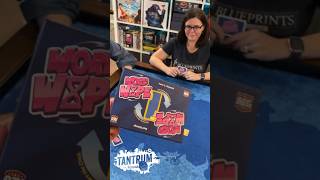
The dominant feeling reviewers describe is one of pressure and collective urgency. You are not playing against the game or each other; you are all working together under the weight of a ticking clock to figure out what single word connects a scattered assortment of cards. This is not a leisurely deduction puzzle. Tantrum House captured the tone perfectly in their play video, where excitement rises as players call out guesses in rapid succession, building momentum toward clearing a group. The anxiety of the timer creates a shared emotional stake that reviewers found engaging, even when execution fell short.
The Satisfying "Aha" Moment
When a connection clicks and the group collectively understands the linking word, the payoff is immediate and rewarding. Dice Tower players found this particularly true at Big Game Night, where hundreds of people playing simultaneously felt the same moment of recognition. Tantrum House's gameplay shows multiple successful rounds where players celebrate finding the connections. These peaks of clarity make Word Wipe memorable. The challenge is that they do not arrive often enough, or reliably enough, for some groups to feel the experience justified the 20-minute investment.
What Makes Word Wipe Stand Out
The Reverse Codenames Design
Word Wipe's central innovation is its inversion of the party game formula. Rather than one player giving clues to lead others toward a secret word, here the cards themselves become the clues. The group must work backward from visible objects to the abstract concept that connects them. This flip creates a fundamentally different challenge than games that provide language and ask players to find meaning in it. Tantrum House called it "Codenames Reverse" precisely because the structure mirrors Codenames but flips the direction of inference. It is a genuinely fresh take on cooperative word games.
Scalable Real-Time Group Play
Word Wipe plays 2 to 10 players with consistent pacing regardless of count. Multiple groups can play simultaneously, as Dice Tower confirmed at Big Game Night. The real-time, simultaneous-play format avoids the downtime that plagues many party games. Tantrum House emphasized that this scales gracefully, letting both small intimate tables and large convention crowds participate in the same kind of experience. If execution is working for your group, the social momentum builds quickly.
Potential Drawbacks
Finding Satisfying Word Connections Is Genuinely Difficult
Alex Radcliffe from BoardGameCo articulated the core failure mode with precision. In their session, the clue giver would discard cards repeatedly because no meaningful connection existed between any of the available words on the table. The problem is not the timer or the format; it is that some card combinations simply do not yield satisfying word associations. Radcliffe described cycling through cards repeatedly while waiting to land on a combination that actually worked. The game can devolve into mechanical card-shuffling rather than genuine puzzle-solving, depending on what the table draws.
Limited Guidance Tools Constrain Creative Thinking
Word Wipe provides only three categories as signposts: Person, Place, and Being (the redesigned version of the traditional Thing category). Radcliffe pointed out that this constraint leaves blind spots. If a connection is conceptual in nature, or requires a verb to articulate, players have no way to guide each other toward it. Radcliffe suggested that adding Verb and Concept as additional guidance categories would dramatically improve the game's accessibility. Without these tools, clue-giving often feels like pointing in the dark, hoping players intuitively make the same mental leap the clue giver is attempting.
If You Enjoy Word Wipe
Radcliffe named the natural companions: Codenames (the inspiration), So Clover (another word-association game that challenges lateral thinking), Decrypto (which combines word guessing with team strategy), Things and Rings (which asks players to think creatively about categories), and Alibis (which builds bridges between scattered clues). All of these games share Word Wipe's core appeal: they reward creative thinking about language and meaning. If you love the satisfaction of finding unexpected connections between ideas, and you have a group that enjoys rapid-fire discussion without pressure to be "right," any of these alternatives will likely click more reliably than Word Wipe itself.
What Reviewers Are Saying
"Beard, weapon, port... And the card from your hand... pirate. Yes. So, these go away. And that goes away. And now we're going to try and swipe these cards. And that uh will win us the game."
- Tantrum House
"It just feels like most of the time you're cycling and then you have to clear the table. So, because you have to clear the table, you're kind of cycling until you find a perfect combination of things, which just isn't a satisfying experience for me. Real-time word association that doesn't actually seem like it's easy to associate things does not work for me."
- BoardGameCo
"It was really good. Yeah, I I love Big Game Night. I like it because I like playing those games when you're What is it? 4 or 500 people? I'm not sure if that if it There's several hundred people. You're all playing the same games together, and that kind of community feeling, that's what I like a big about Big Game Night."
- The Dice Tower