










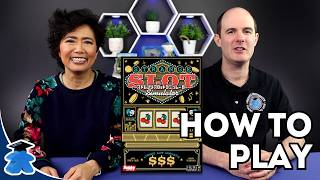


Strange Slot Simulator Deep Dive
What the Community Thinks About Strange Slot Simulator
Strange Slot Simulator inspires genuinely mixed reactions, even among seasoned reviewers who admire the boldness of its design. Meeple University and others praise it as a refreshingly unusual concept, while The Dice Tower expresses serious reservations about its mechanics. What unites nearly every reviewer is the recognition that this game is something genuinely different from anything else on the market, though whether that difference translates to "good" remains hotly debated. The Dice Tower's Tom Vassel and Mike Delisio both rate it a 6, signaling respect for the design while declining to recommend it without qualification. Chairman of the Board appreciates its brevity and uniqueness but worries about its fundamental reliance on luck and shuffling discipline. Across the board, reviewers acknowledge that Strange Slot Simulator works precisely as designed, even if they disagree about whether that design is worth the table time.
Core Mechanics That Define Strange Slot Simulator
Real-Time Shuffling and Card Draws
The heart of Strange Slot Simulator is its central mechanism: players gather around six decks of cards, each representing a different slot machine with its own hidden card distribution. On each turn, a player flips three cards from their chosen deck, records what they see, then shuffles the cards back in and repeats. A timer pressures players to gather as much information as possible within four-minute rounds. Meeple University notes that this creates constant tension between the need to shuffle thoroughly (to ensure random draws) and the pressure to move quickly. The designer, Party Taro, recognized that how players shuffle directly affects their success, leading to the rulebook's unusually lengthy passages on shuffling technique. This mechanic sits at the core of the game's identity: it feels like pulling a slot machine lever, marking symbols as they appear, then returning them to the deck for the next spin.
Bonus Accumulation and Card Draw Upgrades
Every time a player draws a bonus symbol (bells with various fruits or empty bells), they mark progress on a bonus tracker. Once a player accumulates five bonus marks, they unlock a star that grants them one bonus draw: on their next turn, they can draw five cards instead of three. Later in the game, if a player reaches 30 bonus marks, they achieve "lucky" status, granting one extra card on every subsequent draw. This system creates layered decision-making within the real-time chaos. Players decide when to spend their bonus stars and whether to accumulate toward the lucky upgrade. It transforms the bonus-tracking from mere bookkeeping into tactical choice, rewarding players who manage their resources against the pressure of the timer.
The Strange Slot Simulator Experience
Frantic and Chaotic Energy
The dominant experience of Strange Slot Simulator is one of energetic urgency. The four-minute spin phases are relentless. Players are shuffling, flipping, marking, and swapping decks simultaneously while the clock runs down. Chairman of the Board describes this as "frantic fun," and Meeple University calls it "really fun" specifically because of the time pressure. This isn't contemplative puzzle-solving; it's controlled chaos where players must balance speed with thoroughness.
Addictive and Compelling Loop
What reviewers find most fascinating is how accurately Strange Slot Simulator mirrors the psychological experience of actual slot machines. The Dice Tower's observations about living in Las Vegas informed their realization: the game creates a "very satisfying loop of flip flip flip flip" that draws players deeper with each round. No Pun Included crystallized this insight, noting that the game simulates the monotonous yet compelling feeling of slot machines themselves, something the game designer seems to have achieved intentionally. The physical act of shuffling, drawing, and marking creates a tactile rhythm that feels oddly engaging, even when reviewers acknowledge the game is not particularly deep.
What Makes Strange Slot Simulator Stand Out
Genuinely Unique Design Space
Reviewers repeatedly emphasized that they have never seen anything quite like Strange Slot Simulator. Chairman of the Board states, "I don't know any other game that does this." Meeple University calls it "quirky" and "so fun," while acknowledging its oddness. The game occupies a space where deduction meets real-time action meets probability estimation, a combination that no other title in the community seems to have attempted. This alone earns respect from reviewers who might otherwise dismiss the game.
Exceptional Brevity and Replayability
At 25 minutes for a complete game, Strange Slot Simulator respects players' time investment. Multiple reviewers noted this favorably: Chairman of the Board points out that despite its roughness, "the game takes 20 minutes," which mitigates some frustrations. The game is also fully replayable with the same six decks: the randomization comes from which deck is which, not from shuffling new content. The rulebook includes several variants (easy mode, mixed-up mode, freestyle mode, and bonus modes with bugs and trophy cards), giving players ways to extend the experience beyond the base game.
Potential Drawbacks
Shuffling as a Source of Unfairness
The Dice Tower identifies what may be the game's most structural problem: shuffling quality directly affects outcomes. If one player shuffles faster or more thoroughly than another, they see more cards and gather better information. Tom Vassel articulates this clearly: "If I can shuffle faster than Mike, I have an advantage. Or if I just don't shuffle, if I shuffle worse than Mike, I have an advantage, right? And that's such a weird mechanism." The rulebook attempts to address this by recommending players agree on a standard shuffling protocol, but this places a burden on the table to self-regulate fairness. This cuts to the heart of a deeper issue: whether Strange Slot Simulator is truly a game of deduction at all.
Luck Over Logic, Setup Burden, and Divisive Reception
Reviewers are frank about what Strange Slot Simulator actually is: not a deduction game but a probability-estimation game where luck plays a massive role. The Dice Tower notes, "It's noticing patterns" rather than deduction, and those patterns can be misleading due to randomness. If a player sees two grapes three times in a row after shuffling, they might conclude the deck is "grapes heavy," but statistically, that could be pure chance with a deck that has only three grapes total. Chairman of the Board observes that outcomes are largely determined by who gets lucky card draws rather than who reasons best. Additionally, The Dice Tower mentions that setting up the game, building the six decks from the table and then randomizing their positions, is "a chore" that makes players reluctant to play again. Tom Vassel says after the first game, Vassel didn't want to "go through the whole process of setting it up, which is a chore." This friction at the start discourages replays. Finally, reception is genuinely divided: some players "bounce off it" entirely, while others embrace the oddness. No Pun Included struggled so much to find meaningful commentary that they abandoned their video review, suggesting the game's conceptual appeal doesn't always translate to compelling discussion or strong opinions at the table.
If You Enjoy Strange Slot Simulator
If you love real-time games that create a tactile, chaotic experience, you'll likely appreciate the kinetic energy of Strange Slot Simulator. If you're drawn to Dominion (referenced by The Dice Tower as the other major shuffling-heavy game), you might tolerate or even enjoy the shuffling here, though be aware Strange Slot Simulator leans harder into real-time pressure. The game's closest mechanical ancestor might be Captain Sonar (real-time deduction under time pressure), though Strange Slot Simulator's mechanism is entirely its own. Those who appreciate experimental, offbeat designs, games that try something genuinely different from the modern board game mainstream, will find Strange Slot Simulator worth a table. Expect a brief, energetic experience that simulates the hypnotic appeal of actual slot machines more accurately than you might expect.
What Reviewers Are Saying
"It's a very odd idea. I applaud the odd idea. It works in in what it's trying to do, but I I I just come down to I can't quite recommend it. But I I don't hate the game. I just think that there's too many issues for me to to give it a blanket recommendation."
— The Dice Tower
"There's not really any deterministic winner in this game. You're probably going to be lucky if you win it or not. But again, it takes 20 minutes, and I do kind of like that frantic nature of it. And if anything, it is super unique. I don't know any other game that does this."
— Chairman of the Board
"One thing it does simulate very well is that you get into this very satisfying loop of flip flip flip flip flip flip flip. It's like, and it's I think that phase is called pull. It does kind of give you this feeling of you just get into this kind of like almost addictive thing of I I should be switching out decks, but I want to just keep flipping cards."
— The Dice Tower