




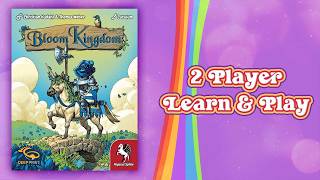
Bloom Kingdom Deep Dive
What the Community Thinks About Bloom Kingdom
Bloom Kingdom has struck a chord with the gaming community, though reactions split along interesting lines. Board Gaymes James is consistently enthusiastic, calling it one of the best small card games and praising its elegant mechanics and beautiful presentation. Rahdo Runs Through acknowledges the clever design but approaches it more cautiously, recognizing its sharp, cutthroat nature as a potential barrier for players who prefer collaborative or less confrontational experiences. Both reviewers agree on the game's core brilliance: it is a sharp, thinky puzzle that rewards careful anticipation and head-to-head maneuvering.
Core Mechanics That Define Bloom Kingdom
Simultaneous Card Play Into a Shared Tableau
The heart of Bloom Kingdom is its simultaneous reveal mechanic. Each round, players privately select a card from their hand and reveal it at the same time. Those cards join a growing shared collection, or tableau, that persists across all three rounds of the game. Each card has an initiative number that determines the order in which its special ability resolves. Some cards can remove other cards from the tableau, others can add to specific columns, and still others let you peek at an opponent's hand or draw and discard to manipulate your options. What makes this moment-to-moment interplay so engaging is that players never know exactly what the shared tableau will look like when it matters most, because every player is actively reshaping it with their choices.
Scoring Based on What Remains in Hand, Not What Was Played
The real puzzle emerges at the end of each round. You do not score the cards you played. Instead, you score only the final two cards you kept in your hand, and their value depends entirely on what is in the shared tableau. Each of the ten card types has a unique scoring condition: Kings score only if no Jester was played; Nobles score only if there are enough Farmers to support them; Dragons score based on whether Knights are present; Unicorns need to outnumber everything else. Because the tableau is constantly shifting throughout the round as players add and manipulate cards, the scoring landscape is in constant flux. A card that looked worthless at the start of the round might become priceless, or vice versa. Rahdo describes it plainly: "the scoring of all of these things is based on all the choices we make up to those big moments. And it's super duper clever." This inversion, where you benefit from what you do not play rather than what you do, is what transforms a simple card game into a deep tactical puzzle.
The Bloom Kingdom Experience
Sharp, Thinky Tension
Reviewers consistently emphasize how much mental energy Bloom Kingdom demands. Every card you hold is a potential gamble. Do you play a strong card now to shape the tableau in your favor, knowing you are giving up the chance to score it? Or do you keep it, hoping it will reward you at the end? Board Gaymes James describes the constant calculus: "we're all planning, all right, these are going to be my final two cards. Am I going to score well on them? We all reveal, we all tally up, and we all see: did I anticipate correctly?" Rahdo adds depth to this observation, noting that the game is full of micro-information: "every little bit of information you can get, whether you peek at somebody, whether you see somebody play a card, whether you see somebody discard a card, you got to keep it all in your head because you're trying to arrange yourself to score the best you can."
Mind Games and Outmaneuvering Opponents
What elevates Bloom Kingdom beyond a mechanical puzzle is its social dimension. This is a game about getting inside your opponents' heads. When someone discards a Farmer, what does that signal about their strategy? If they are holding nobles, they need farmers to feed them. If they just threw a farmer away, they are clearly pursuing a different path, and that information ripples through your planning. Rahdo notes that anticipating opponents' goals is core to winning: "if I can anticipate um you know, I might try to say because oh, I think there's going to unicorns and nobles are going to score really well. Um then I I hold those back." But there is a darker edge to this interaction: if you see where your opponent is going, you can actively sabotage them. Play a Wizard to remove a card type they are building toward. Play a Jester to mock the Kings they are planning to score. This is where the game becomes cutthroat. Rahdo is explicit about this tension: "this can be a pretty cutthroat game. You know, especially as it goes on... you are constantly making moves to build yourself up, but also ruin your opponents if you can successfully anticipate where it is they're going." For some players, that is precisely the appeal. For others, including Rahdo, it is a point of friction.
What Makes Bloom Kingdom Stand Out
Beautiful Hand-Drawn Artwork and Component Design
Both reviewers pause to praise the visual presentation. Board Gaymes James notes: "Plus, this art is really pretty. They're all flowers turned into characters." The game's aesthetic is consistently described as hand-drawn and charming, with a cohesive style that carries the entire game. All three Board Gaymes James videos mention the beauty of the components. However, there is an interesting split: while Board Gaymes James finds the art simply lovely, the creator in the year-end roundup points out a tension: "the artwork is also really beautiful. It's got these like hand-drawn aesthetic to it. Although it's also very creepy at the same time because these are these flowers that have been turned into humans." That duality, where the art is both beautiful and unsettling, is part of what gives Bloom Kingdom its distinctive personality.
Quick Playtime and Elegant Rule Set
Bloom Kingdom accomplishes its strategic ambitions in just twenty minutes. Board Gaymes James calls it "a short dinky card game" with affection, and multiple reviewers note how efficiently the game conveys its depth without long rule explanations. The card types are intuitive once you see them played, their abilities clearly telegraphed through art and text. The simultaneous reveal structure means there is no downtime waiting for opponents to think. Three rounds move quickly, yet each round feels consequential because the shared tableau accumulates, raising the stakes. This combination of brevity and weight is rare: normally a game this thinky demands at least an hour. Bloom Kingdom proves that is not always necessary.
Potential Drawbacks
A Cutthroat, Confrontational Play Experience
Rahdo's primary reservation deserves serious attention. The game is built on the premise that you win by both building yourself up and tearing opponents down. When you identify a card type another player is pursuing, the smart move is often to remove it from the tableau or prevent it from scoring. Rahdo frames it this way: "I just don't enjoy trying to maneuver such that I can ruin your plans by killing. Oh, if I just kill that one king... you using this... jester or this wizard that might change everything and I do it specifically because I think you're going to really make big and I'm trying to beat you. I'd rather just play a game where I'm just trying to build myself up, not build myself up and tear you down at the same time." This is not a bug in the design; it is intentional. But it means Bloom Kingdom is fundamentally a game about competition and prediction, not cooperation or puzzle-solving for its own sake. Players who find satisfaction in building their own engine or achieving aesthetic goals may find the constant adversarial maneuvering exhausting.
Scoring in Flux Creates Uncertainty and Can Frustrate
Because the shared tableau belongs to everyone and is constantly changing, the value of the cards in your hand is never fixed. A card might be worth eight points when you plan to play it, then become worthless when another player removes its scoring condition before the round ends. This is a feature to some (it creates drama and forces adaptation), but a frustration to others. You cannot simply execute a plan; you must remain flexible and ready to pivot. Rahdo points to this as a natural consequence of shared tableau building: "you might not always get what you need. So you kind of have to do this a little bit dynamically." For players who enjoy executing a well-laid plan from start to finish, this constant revision can feel like chaos masquerading as strategy.
If You Enjoy Bloom Kingdom
Bloom Kingdom appeals to players who love sharp tactical card games where reading opponents is as important as managing your own hand. If you enjoy games that reward pattern recognition, quick decision-making under uncertainty, and the mental challenge of anticipating what others will do, Bloom Kingdom will likely hit the table often. Reviewers suggest it shines as a two-player experience (becoming chess-like in its intensity), though it gains a different character with more players, where chaos dilutes the ability to plan too far ahead. Players who enjoy simultaneous reveal mechanics, compact games that respect your time, and elegant rule sets that hide their depth will find Bloom Kingdom rewarding. The twenty-minute playtime makes it ideal for a quick match between heavier games or as a sharp opener to game night.
What Reviewers Are Saying
"That is Bloom Kingdom. I really like this one. I love these short dinky card games."
— Board Gaymes James
"This is a very sharp, very, very thinky, puzzly, get into the head of your opponents and outmaneuver them sort of card game. Every little bit of information you can get, whether you peek at somebody, whether you see somebody play a card, whether you see somebody discard a card, you got to keep it all in your head because you're trying to arrange yourself to score the best you can."
— Rahdo Runs Through
"Beautiful, beautiful art. It is a shared tableau builder. The cards that are left in your hand at the end of the building of the tableau are how you're going to score and you're going to score based off of the tableau. But everybody is contributing to that tableau, so that could change drastically. Very cool."
— Board Gaymes James