




Colosseum: The Grand Spectacle Deep Dive
What the Community Thinks About Colosseum: The Grand Spectacle
Reviewers consistently praise Colosseum: The Grand Spectacle as a breath of fresh air in the modern board game landscape. For a 20-year-old design brought back to life, the new edition has struck a chord with players who appreciate smooth, streamlined Euro game design. Board Games Unlocked and Rahdo Runs Through both emphasize that this re-implementation offers a refined rules experience while maintaining what made the original special. Paul Groan, reviewing the game during their June 2025 coverage on Gaming Rules!, highlighted how the new version serves newer audiences while delivering something genuinely classic in feel. The consensus centers on elegance: the game feels complete and satisfying without unnecessary bloat, a quality many note is rare in contemporary designs.
Core Mechanics That Define Colosseum: The Grand Spectacle
Auction and Bidding for Performers
At the heart of Colosseum sits a dynamic auction system where players bid on performer tiles to build their arenas. During the hiring phase each round, one player positions a marker to divide available performers into a section, then players bid in turn order to acquire all three performers from that section. The minimum bid is eight coins, and once someone wins an auction, they secure those tiles but must pay the agreed price. What makes this elegant is the feedback loop: when you don't win a bid, you get to start a new auction immediately, potentially getting the performers you actually want. Reviewers note that this creates rich tactical moments where players must decide whether to push an auction higher or concede and pivot to a new section. The bidding economy directly feeds into how much money you have available for future rounds, making each decision consequential.
Trading and Negotiation
Following the auction phase comes trading, a mechanic rare in modern Euro games. On your turn, you may offer trades with other players: exchanging performers, coins, or special tokens called Achilas. Unlike many negotiation games, everything is transparent. Paul Groan emphasizes how refreshing this is, noting that players can openly discuss what they need and why a trade benefits both sides. A player might say, "I need this gardener and you need this musician; if you give me the gardener, I'll give you the musician plus two coins." There is no secret dealing, no hidden information about player hands. Reviewers highlight how this mechanic creates genuine social gameplay where coalition-building and mutual benefit actually matter. The designers, Wolfgang Kramer and Markus Lübke, crafted a trading system that feels natural rather than forced, rewarding players who understand what their opponents need.
The Colosseum: The Grand Spectacle Experience
Roman Pageantry and Spectacle
Playing Colosseum immerses players in the role of Roman impresarios staging increasingly grand shows. You invest in gates to expand your arena's capacity, acquire temples to influence visiting nobles, and purchase improved spectacles to attract larger crowds. When you perform a spectacle, you roll dice and move nobles along tracks. If a noble lands on one of your gates, that spectacle earns bonus points. The thematic loop is tight: you bid for performers, trade to complete your show requirements, roll to determine noble movement, then perform your best show. Reviewers describe the satisfaction of finally assembling exactly the performers you need after rounds of strategic bidding and trading, then seeing your spectacle score climb as nobles align with your gates and star performers amplify your points. The atmosphere builds naturally across four rounds.
The Tension of Incomplete Information and Risk
While performers and spectacle requirements are fully visible, the nobles' movements create unpredictability. You might have the perfect performers for a high-value spectacle, but if the emperor doesn't land on your gate during the spectacle phase, you miss that bonus. Reviewers describe this as engaging rather than frustrating, because the base points remain regardless of noble positioning. There is always something to perform, always a way to score. The negotiation phase itself creates tension: other players know what you need, so they may withhold key performers unless the price is right. Rahdo Runs Through captures this dynamic well, showing how players must weigh immediate needs against long-term positioning. The game feels like a living negotiation where threats, alliances, and blocking moves all have weight.
What Makes Colosseum: The Grand Spectacle Stand Out
Elegant Streamlined Design for a Modern Audience
Colosseum brings a 2007-era game design sensibility that modern designers have largely abandoned. Paul Groan and Rahdo Runs Through both emphasize how rare it is to find a game where trading between players is not just allowed but central to the experience. The streamlined rules accomplish a lot in just four rounds. No campaign mode, no sprawling turn structure, no unnecessary chrome: just clear decisions, direct player interaction, and satisfying scoring. The updated components and artwork make the game accessible to newer players while the smooth rules make it quick to teach. Reviewers appreciate that the new edition removes some friction from the original while respecting the core design. Board Games Unlocked praised how Colosseum: The Grand Spectacle makes itself available to players who never encountered the original, and Allies or Enemies flagged it as a standout at Essen 2026 previews for exactly this reason.
Open Information and Transparent Negotiation
Unlike many modern games with hidden player boards and secret information, Colosseum plays with full transparency. Every player sees every available performer, every spectacle requirement, and every gate. This creates a different kind of puzzle: not "what does my opponent have?" but "what do we all need, and how can I convince them to trade fairly?" Rahdo Runs Through shows multiple trade sequences where players explicitly discuss the math of their offers. Gaming Rules! emphasizes that this transparency makes negotiation feel genuine rather than cutthroat. When a player agrees to a trade, they do so with full knowledge of the game state, making the social contract real. Reviewers consistently flag this as a breath of fresh air in an era of information asymmetry and hidden mechanics.
Potential Drawbacks
Math-Intensive Optimization Play
Colosseum rewards deep calculation. Players who enjoy analyzing every possible auction outcome and trade chain will find rich, satisfying decision trees. However, reviewers note that this optimization can slow the game if players are prone to analysis paralysis. The performance point calculation itself is straightforward, but deciding which spectacle to perform, which performer to retire, and which noble to move involves considering multiple rounds ahead. Players who prefer faster, more intuitive play may find this tedious. Rahdo Runs Through demonstrates the depth available but also shows how much mental overhead a full optimization-focused playthrough demands. For casual groups, this depth can be a feature; for others, it becomes a drawback.
Component and Manufacturing Issues in the Prototype
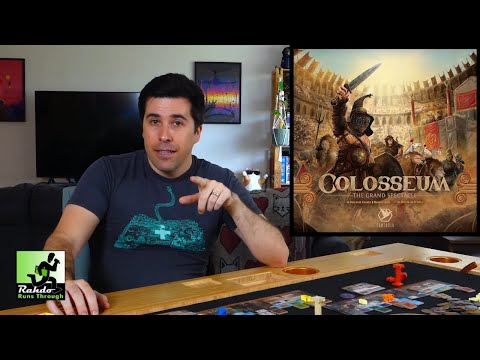
Rahdo Runs Through notes that the prototype version includes dice with muddy printing that makes pip symbols hard to read. While confirmed to be a manufacturing error being corrected for the final version, this serves as a reminder that the game does rely on rolling dice for noble movement. Additionally, Rahdo mentions that Colosseum is a significant table-hog in its proper setup: performer stacks should be displayed vertically, and all spectacle tiles from multiple players should be visible. Some reviewers found the physical footprint a constraint for filming or smaller tables. Once the final components ship, legibility should improve, but the space requirement remains inherent to the design.
If You Enjoy Colosseum: The Grand Spectacle
Players who love the auction and trading core of Colosseum will find similar satisfaction in Colosseum (the original 2007 edition), which uses the same designers and core mechanics but with older rules and artwork. The fresh re-implementation makes the new version more appealing, but the classic remains mechanically sound.
For those drawn to the trading and negotiation aspects, Merchants of Venus offers another auction and trading experience, though with a space exploration theme. The transparent information and negotiated deals create a similar social dynamic.
Gamers seeking a negotiation-heavy Euro with a different flavor might explore Empresario, a Colosseum-inspired card game that strips the auction mechanic to focus on pure trading and economic interaction.
What Reviewers Are Saying
"For example, there is a part of the game where you are trading with the players. And you don't generally see that in games these days, but it worked really well in this game. If you are worried like I normally am about negotiation in games, it's not really that. I mean, technically it is. You're like, well, you've got a horse and I've got some shrubbery. Do you want to swap the horse for the shrubbery?"
— Gaming Rules!
"You're in the Colosseum and you're putting together the Gladiator fights. You're trying to impress the emperor, all of that. So, you're kind of like matchmakers in ancient Rome."
— Allies or Enemies
"Once we've done that, we're now going to choose one of our spectacles to perform. So we have all that we need for the venatio. And because we've got two horses, we've got actually three lions. So we have one more than we need, and we have an elephant. So, we're gonna get the maximum number of points because we have all of the performers that we need."
— Rahdo Runs Through