




Flamenco Deep Dive
What the Community Thinks About Flamenco
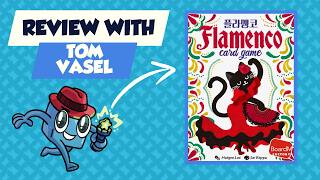
Reviewers treat Flamenco as a light, approachable card game with one distinctive twist rather than a deep strategy title. Published by BoardM Factory, this two to five player climbing game asks players to beat the previous play, and the reviewers who covered it agree that its signature idea is the split, which lets an even-valued card become two cards worth half as much. Tom Vassal of The Dice Tower called it a fun little shedding game that is easy to play and gave it seven out of ten. A shorter The Dice Tower clip of the same review reaches the same verdict.
Pair of Dice Paradise took a more enthusiastic view. The host described Flamenco as a traditional card climbing system remixed with dance-inspired moves, and presented it as a title that raises the stakes for experienced players. The main point of divergence is tone: The Dice Tower valued the game's simplicity and quick moments, while Pair of Dice Paradise emphasized how much flair the design adds to a familiar genre.
Board Gaming Ramblings, the channel run by Johannes and Cinema, mentioned Flamenco only briefly while sorting through a pile of trick-taking and shedding games, and its remarks centered on the cat artwork rather than on how the game plays. The community consensus is therefore narrower than the number of channels might suggest. The split is the memorable element, the color rule is the detail most open to criticism, and the game works best as a quick, lighthearted card game.
Core Mechanics That Define Flamenco
Beat-the-Previous Climbing Play
The base rule is a climb. The leader plays a single card or a set of matching-size cards, and each following player must answer with a higher play of the same size or pass. Once every player passes, the last player to act leads the next round. Reviewers place this in the family of shedding and ladder climbing games, since the goal is simply to empty your hand. A seven can also be answered by a one and a two, a special exchange that Tom Vassal said ends the round. The first player to go out takes the highest of the three shoe point tokens, worth three, two, and one points, and the tokens keep passing out until they are gone. Most points at the end wins.
Splitting Even Cards Under the Color Rule
The defining mechanic is the split. An even-numbered card can be played as two cards worth half its value, so a four can be answered with two twos, while a two cannot be split at all. Pair of Dice Paradise described this as a stylish step that lets a single card become two. Color matters at only this moment: split cards must not share the color of the card they replace. A gold two cannot stand in for a gold four, but it can stand in for a blue card. BoardM Factory uses color in this one narrow place, which is why reviewers see it as either a clever twist or an awkward restriction.
The Flamenco Experience
Quick, Simple Shedding Fun
Most reviewers describe the baseline feel as brisk and uncomplicated. Tom Vassal called the game a very simple shedding game, and the cycle of playing a higher card or a matching set is easy to pick up. The 30-minute playtime suits that pace, and the point tokens awarded for going out give each round a clear finish. For players who want a low-pressure card game for a short session, that lightness is the main appeal.
Playful Moments From the Split
Reviewers say the high point arrives when a split ripples across the table. Tom Vassal described a sequence in which a single four is answered with two twos, and said that when a player answers several sevens with a long run of ones and twos, the result is hard to pull off but entertaining and interesting. Pair of Dice Paradise framed the same tension as a dance step that surprises the table. The experience is less about constant strategy and more about the occasional flourish that catches everyone off guard.
What Makes Flamenco Stand Out
A Split Mechanic That Adds Real Surprise
Reviewers praise the split as the element that turns a familiar climbing system into something memorable. Tom Vassal called the splitting mechanism pretty fun, and Pair of Dice Paradise described it as the ingredient that adds complications to a game that might otherwise look straightforward. Because any player holding an even card can use the split, it creates new options on each turn and keeps the climb from becoming predictable.
A Dance-Inspired Theme and Artwork
Flamenco's theme gives it a clear identity. Tom Vassal praised the cards as beautifully illustrated and noted the game's connection to the flamenco dance, while Pair of Dice Paradise highlighted the dancing cat on the cover of the box. The cards run from one to seven in several colors, so the table has a distinctive look that sets the game apart from plainer card games in the same genre.
Potential Drawbacks
The Color Rule Creates Occasional Friction
The most direct criticism concerns the color rule. Tom Vassal observed that color only matters when splitting, that it usually has no effect, and that it occasionally blocks a split a player expected to make. Tom Vassal said it is the rule to drop, though the splitting was still considered fun overall. The friction is real but limited, and it tends to appear in the moments that otherwise feel most exciting.
Spectacular Combos Are Hard to Pull Off
The most memorable sequences depend on the right hand arrangement. Tom Vassal noted that long chains of splits are hard to pull off, which means the dramatic moments that make Flamenco stand out will not appear at every table or in every round. Players who expect a steady stream of big plays may find that the simpler exchanges make up most of the game.
If You Enjoy Flamenco
Reviewers place Flamenco among shedding and ladder climbing games, and Tom Vassal also grouped it with trick-taking games in the same broad family. Players who like the core rhythm of beating the previous play may want to look at these titles, which Board Gaming Ramblings described as shedding games.
- Loop: Board Gaming Ramblings described this as a shedding game that addresses a familiar problem in the genre, where a player who runs out of the right cards is effectively finished. A player who goes out sends their hand to the next player, who must replay the same cards and try to do better.
- Odin: Board Gaming Ramblings described this simply as a shedding game and said they had heard it was good, making it a natural next pick for players who enjoy the genre.
What Reviewers Are Saying
"Instead, Flamenco does its best to spin, turn, and mix up the traditional card climbing systems with dazzling dance deviations that up the ante for experienced players."
— Pair of Dice Paradise
"The coloring is my biggest problem with the game. I don't love that coloring means nothing except when splitting something, and most of the time it doesn't matter."
— The Dice Tower
"It's a very simple game, but the idea if I play a single four, now you play two twos. That sort of thing is fun. It's simple and easy."
— Tom Vassal, The Dice Tower