
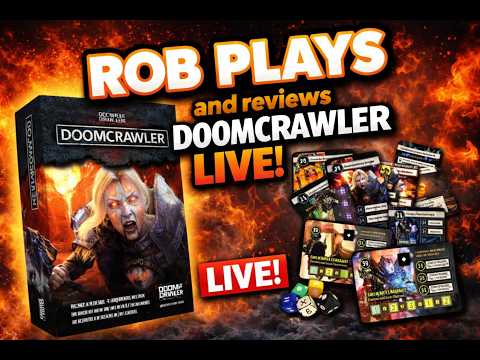


Heroes of the Sanctum: Doomcrawler Deep Dive
What the Community Thinks About Heroes of the Sanctum: Doomcrawler
Heroes of the Sanctum: Doomcrawler is a solo card-and-dice dungeon crawler from Firetap Games in which one hero tries to escape the depths while fighting horrors from the Rift. Rob's Tabletop World is consistently enthusiastic about it, calling the game "pretty cool," saying it is probably one of the best games played in a long time, and describing Firetap Games as a publisher doing excellent work with small, compact releases. The concerns raised center on upkeep rather than on the core design: the game asks a lot of the player to keep track of, and the early sessions are admitted to have been rough.
Core Mechanics That Define Heroes of the Sanctum: Doomcrawler
The two systems that shape the experience most are the dice-driven combat and the layered track management that Firetap Games builds around it.
Dice-Driven Threat Combat
Combat in Heroes of the Sanctum: Doomcrawler is resolved by rolling the black die against a threat's health. As the reviewer explains in Rob's Tabletop World, the damage dealt equals the roll minus the threat's current value, so a higher result does more harm. A roll of six is especially valuable because the player may roll again and add the results, which lets a lucky streak carry an attack or an escape. Escapes work the same way: the player rolls against the value of a threat that is trying to pull the hero out of the dungeon, and a successful roll knocks that threat down. Defense is handled at the end of each round, when the black die is rolled to determine how much incoming damage is absorbed. The reviewer's sessions show how quickly this turns. A promising attack can stall on a poor roll, and a single bad defense can leave the hero dangerously low on health. The result is a system where good planning improves the odds but never fully removes the dice from the outcome.
Threat and Track Management
The second defining system is the set of tracks that govern the dungeon. Each turn, the game asks the player to update the hero dice track, the threat dice tracks, the side quest tracks, the dungeon die, and the doom die in sequence. Side quests are placed at the start, and each one can help or hurt depending on how it resolves. The doom die rises when a black die roll comes up low, and the reviewer notes that higher doom makes things "real bad." Threats can be pushed into the darkness to be set aside temporarily, and critical hits attach lasting effects to the hero that must be tracked and dealt with over time. Firetap Games has built a game in which almost every turn requires moving several dice on the table, and the reviewer describes this constant bookkeeping as the central demand of play.
The Heroes of the Sanctum: Doomcrawler Experience
Two feelings dominate the reviewer's account of play: a steady sense of escalating danger and the satisfaction of a lucky result turning the tide.
Escalating Tension
Rob's Tabletop World repeatedly describes the game as one that can end quickly or demand that the player hang on. Early in that playthrough, a single encounter card spawned threats, and the board became difficult to manage within a few turns. The game "gets nasty on you," and in the first attempt the board held five threats before being overwhelmed. The tension comes from the sense that every unresolved threat compounds the next turn's problems, so the player is always deciding which danger to face first and which to let linger.
The Reward of a Lucky Roll
Despite the punishing moments, the reviewer returns repeatedly to the pleasure of small victories. Rolling a six and then adding a follow-up roll to beat a difficult escape is presented as a highlight, and the loot that comes from defeating creatures gives the player concrete rewards to build around. The reviewer's enthusiasm grows with comfort in the rules, landing on the game being something players "really really get into." That shift from frustration to absorption is a recurring theme in the coverage.
What Makes Heroes of the Sanctum: Doomcrawler Stand Out
Compact Design for Play Anywhere
Rob's Tabletop World praises the game as a "small, compact, fantastic experience," noting that its footprint makes it easy to set up and play in tight or unconventional spaces. Rob's Tabletop World points to Firetap Games' broader catalog as proof that the publisher builds games that deliver a lot in a small package. For players who want a tabletop experience that fits in a limited space or a short session, the compact format is a central part of the appeal.
Campaign Progression and Card Variety
The reviewer highlights replayability as one of the game's strongest features. Beating the game unlocks additional dungeon cards that are held in sealed envelopes, which the reviewer describes as rewards for finishing the campaign. Different heroes, each with their own special skills and passive abilities, change how a session unfolds. Dungeon cards vary in difficulty, so a player can pick a harder card and face a noticeably nastier opening. The reviewer also notes that the beginner setup allowed coming close to winning on the first run, calling it a useful way to learn the system before moving to tougher setups.
Potential Drawbacks
Heavy Upkeep
The reviewer is candid that the game carries a significant maintenance load. There is "a lot of little upkeep" in each turn, and critical hits are described as effects that keep affecting the hero and force the player to keep moving dice back and forth on the table. Tracking several dice tracks at once, along with threats, side quests, and the doom and dungeon dice, adds up quickly. The summary is that the game is "a lot of maintenance, but a lot of fun," which makes clear that the upkeep is the price of admission.
Steep Difficulty Spikes and a Learning Curve
The reviewer also raises concerns about the difficulty and the rules. Some encounter cards hit hard enough to undo a turn's progress, and the jump from the beginner setup to harder dungeon cards is substantial. Setup mistakes during the first session are acknowledged, including starting with the wrong number of threats, which had to be corrected along the way, along with "little nuances" that players must remember and keep track of. For new players, the early sessions may require careful reading and patience before the game clicks.
If You Enjoy Heroes of the Sanctum: Doomcrawler
Readers who enjoy the reviewer's description of Heroes of the Sanctum: Doomcrawler will likely find value in these directions:
- Heroes of the Sanctum: the base game in the same universe. Rob's Tabletop World calls it a great game and places Doomcrawler within its world, so it is the natural next step for players who want more of the setting.
- Solo dungeon crawlers with threat tracks: players who enjoy deciding which threat to face first, and managing several pressures at once, will recognize the same appeal the reviewer describes.
- Compact solo card and dice games: the reviewer's emphasis on a small footprint and self-contained play makes this type of game well suited to limited spaces or short sessions.
What Reviewers Are Saying
"I love playing this. I'm enjoying it. There's a lot of little upkeep with it, but you're going to find that you're really going to enjoy it."
Rob's Tabletop World
"Doom Crawler, which is a really cool little dungeon crawler set in the Heroes of Sanctum universe, which is a great game. If you haven't got it, go over to Firetap Games. Great people doing great things."
Rob's Tabletop World
"Heroes of Sanctum and Doom Crawler. Just tons of great stuff in this one."
Rob's Tabletop World