



Battles of the American Revolution Travel Games Deep Dive
What the Community Thinks About Battles of the American Revolution Travel Games
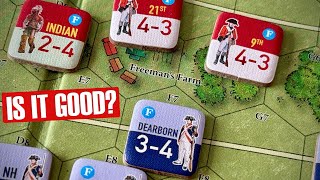
Reviewers treat this Worthington Publishing release as a compact hex-and-counter package with two battles, Oriskany and Freeman's Farm, printed on a single double-sided mounted board. Zilla Blitz works through both scenarios on camera, playing several turns of Freeman's Farm before offering impressions. The rulebook is described as very light, learnable in roughly ten to fifteen minutes, yet still packing in leadership, artillery, several combat types, and a step-loss system. The Discriminating Gamer approaches the set as a fast two-player skirmish game, unboxing it on the table and estimating about 45 minutes of play. Both channels land on a similar verdict: a strong entry point for newcomers and a quick game for veterans, but not a deep simulation. Zilla Blitz had also flagged the series in an introductory wargames discussion while it was still in crowdfunding, describing the boxes as mini Hex Encounters games with a low counter count.
Core Mechanics That Define Battles of the American Revolution Travel Games
Dice Differential Combat Resolution
Combat is resolved by comparing totals rather than reading a combat table. Each side adds its combat factors, any leadership bonus, and a die roll, and the difference determines the outcome. The winning side's advantage matters: the defender retreats one hex when the attacker wins, while a margin of four to six points costs the defender one step and a margin of seven or more costs two steps. Zilla Blitz notes that a tie or a defender-high result forces the attacker to retreat instead. Because every unit is double-sided, a single lopsided exchange can strip a regiment down quickly, and Zilla Blitz demonstrated how a three-unit attack on one British regiment eliminated it in a single resolution. Attacks are always optional, and a unit can attack any combination of adjacent enemies, which lets players concentrate force on a single target as Worthington's design intends.
Leadership Track and British Artillery
The leadership track gives the American commander a pool of points to spend once per turn on one of three options: a force march that adds two movement points, a charge that adds two combat factors to an attack, or a rally that restores a half-strength unit to full strength. Zilla Blitz points out that leadership cannot be used defensively, so it rewards aggressive planning and offers the British no counterplay of their own. Freeman's Farm adds an abstract artillery track for the British, with five uses across the battle and at most one per turn. Artillery either bombards an American unit within three hexes, regardless of line of sight, or adds two defensive factors to a British unit. The artillery chart uses a single die, where a low result has no effect, a middle result forces a one-hex retreat, and a six also reduces the target by a step. Oriskany omits artillery entirely, so the leadership track carries more of the decision-making in that scenario.
The Battles of the American Revolution Travel Games Experience
A Fast, Beer and Pretzels Tempo
Both reviewers stress how quickly a session moves. Zilla Blitz estimates a typical game at around half an hour once the rules are understood, perhaps 45 minutes for a more deliberate pair of players, and always under an hour. The Discriminating Gamer frames the set as a way to get a hex-and-counter fix when there is no time for a multi-hour wargame, with a 16-turn battle that fits comfortably into a single sitting. The feel is closer to a casual evening game than a heavy simulation, and Zilla Blitz describes it as the kind of game to throw down with someone after a longer session when there is no appetite left for something demanding.
Tense, Momentum-Driven Battles
Despite the modest size, the battles produce real tension. Zilla Blitz describes Freeman's Farm as a struggle in which the Americans start badly outnumbered, must decide whether to hold the woods on their left flank or contest the farm, and can still swing momentum with a few strong rolls. Each side's early decisions shape the rest of the battle, and a single successful attack can shift the balance of force on the map. The Discriminating Gamer enjoys the historical tension of the scenarios as well, noting how the two battles are presented as pivotal engagements in the Saratoga campaign. The result is a game where the pace stays brisk but the choices in each turn still feel consequential.
What Makes Battles of the American Revolution Travel Games Stand Out
Travel-Size Production Value
Reviewers consistently praise the physical package. The mounted board measures roughly 14 by 7 inches and folds into a box small enough to slip into a backpack, and the Discriminating Gamer highlights that the board can be bent slightly without fear of snapping. Each token is double-sided with a full-color back, and the inside of the box carries artwork rather than plain cardboard. The set includes two dice, a turn record track, a leadership track, and fold-out charts, and the Discriminating Gamer notes that the tokens store neatly in a bag or in the bottom of the box. Zilla Blitz singles out the travel-friendly size as a major reason to bring the game along.
An Accessible Gateway to Hex-and-Counter Wargaming
Zilla Blitz argues that the set packs a surprising number of core wargame concepts into a compact design. Zones of control, combat factors, dice rolls, leadership, artillery, terrain, and movement all appear, which makes the game a useful teaching tool for someone curious about board wargaming. Zilla Blitz recommends it specifically for two players learning together, who can get through the rules and a complete battle in about an hour on the first attempt. The rulebook is described as roughly sixteen pages including scenario information, and the setup is short enough that a new group can start playing without a long lesson.
Potential Drawbacks
Luck Can Decide a Battle Early
The most frequently noted concern is the influence of dice. Because the battles are short and the counter count is small, a couple of favorable rolls in the first turns can push one side into a substantial force advantage. Zilla Blitz observes that the player who gets the early swing can keep producing two-unit and three-unit attacks that the opponent cannot match, which makes a bad start hard to recover from. Zilla Blitz also acknowledges that most games will likely even out and that the better player usually wins, but still flags the swingy nature of the early turns as something that will frustrate some players.
Limited Depth for Experienced Wargamers
Experienced players may find the game too transparent. Zilla Blitz explicitly states that this is not a deep, thoughtful wargame for seasoned hex-and-counter players, since the counter set is light and the mechanics are standard enough that the strongest tendencies become obvious after a few plays. The Discriminating Gamer makes a similar point by noting that the rules are simple enough to learn quickly and that the two battles play nearly the same, so familiarity with one scenario carries over to the other. Zilla Blitz nonetheless sees a place for the game among veterans as a lighter option, comparing it to checkers rather than chess.
If You Enjoy Battles of the American Revolution Travel Games
Reviewers point toward the other entries in Worthington's travel series as the natural next step. Battles of the 1812 shares the same compact box, the same double-sided board approach, and the same hex-and-counter systems, and Zilla Blitz mentions a solitaire War of 1812 playthrough in the same series. Because the Discriminating Gamer observes that the games in this line play very similarly, anyone who learns one of these sets can move to the next with little additional study. Battles of the American Mexican War carries the same low-counter design into a different conflict, and Zilla Blitz describes the three games in the series as accessible hex encounter titles that can be explored in a short period of time. Players who want a broader gateway into the hobby may also appreciate that the series keeps each session short enough to fit around a busy evening.
What Reviewers Are Saying
"This is not Wargame tic-tac-toe. There is enough depth here. There's enough meat to the game that it's going to engage you with some challenging and interesting decisions."
— Zilla Blitz
"They're really, really fast. When you want to play hex and counter game and you just don't have two, three hours to put the whole entire thing on the table, you get this one down here, you play in 45 minutes or so, and they're a lot of fun."
— The Discriminating Gamer
"Worthington does a great job with their production values with games. So I think these almost look like mini Hex Encounters games that you can dig into in a very short period of time."
— Zilla Blitz