


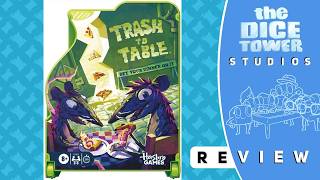

Trash to Table Deep Dive
What the Community Thinks About Trash to Table
The Dice Tower reviews of Trash to Table land on a consistent verdict: it is a light, silly Hasbro dice game that is more amusing than compelling. Tom Vasel scores it a six out of ten each time it comes up, and the score never moves into recommendation territory. Nobody in these discussions calls the game bad. The praise is real but modest, and the hesitation is about how long the fun lasts rather than whether the game works.
The tone shifts a little depending on the format. In the full review, Tom Vasel spends time on the rolling and the scoring decisions, then concludes that the game is a good laugh for one or two sessions before it goes back on the shelf. The rapid-fire roundup and the weekend review treat it as a passing diversion, a way to pass the time with friends rather than a game to seek out. The shared thread is that Trash to Table works as a low-stakes filler that gets a chuckle, and that is the extent of its appeal in these reviews.
There is also a note of surprise running through the coverage. Mass-market publishers rarely earn praise from this channel, so the host's comment that this one stands above many similar releases carries weight. The reviews suggest that expectations matter here: a viewer who approaches the game expecting a sharp strategy experience will be disappointed, while one who expects a silly novelty will likely leave pleasantly entertained.
Core Mechanics That Define Trash to Table
Rolling Pizza Slices Down the Dice Tower
The defining action is dropping pizza slice pieces into a custom dice tower and seeing which ones land face up. Players can stop and keep the face-up slices or roll again to try for more. Rolling all of your slices face down at any point leaves you with only a single slice, which gives the decision a sharp edge on paper. In practice, Tom Vasel argues that the push-your-luck element is weaker than it sounds. When a player is rolling four pieces, at least one will almost always land face up, so there is little real risk. The tension only appears when a few pieces remain, and then the host notes that players tend to simply keep what they have. Even so, the act of rolling is described as fun, and the tower itself is praised for holding everything neatly in place.
Assigning Slices to Table Cards
After the roll, slices are assigned to cards on the table, and each card has its own requirement for how many slices it needs and how many points it is worth. Flipping a card reveals whether the assignment works, and the reviews point out that this moment carries most of the game's uncertainty. Tom Vasel describes the assignment as an interesting and enjoyable point of decision making, but also as something that feels very random, since a player might guess right on one card and miss on the next. The host also prefers the alternative rule that shuffles the cards together and has players assign a set number of slices in order. That version, in the host's view, produces a better experience because it removes some of the guesswork about which card to fill first.
The Trash to Table Experience
Amused, Not Impressed
The feeling that comes through most clearly is amusement. Tom Vasel describes being entertained by the premise of rolling pizza down a dice tower, and the reviews treat the silliness as the main draw rather than any depth of play. The host acknowledges that the premise sounds ridiculous, yet the game does not take itself too seriously, and that lightness is what keeps it from feeling like a chore. Everyone at the table is likely to laugh at the small moments when the slices land wrong or a card requires an unexpected number of pieces, and those moments tend to matter more than the scoring.
Quick, Disposable Fun
The game is clearly meant for short, casual sessions, and the reviews reflect that. Tom Vasel does not see it as a game to play repeatedly, and suggests that a couple of plays may be enough before the novelty fades. The host still sees a place for it, describing it as something worth pulling off the shelf for a good laugh when someone else has brought it out. That framing makes the game feel more like a social icebreaker or a finale to a game night than a centerpiece for a dedicated group.
What Makes Trash to Table Stand Out
Better Components Than Expected
Reviewers were surprised by the production quality. Tom Vasel calls the pieces surprisingly good and says the dice tower works well as a feature rather than a gimmick. For a game that is largely driven by tactile rolling, a sturdy tower that contains the pieces and feeds them smoothly makes a noticeable difference. The reviews do not claim the components are premium, only that they are better than the price and publisher would lead you to expect.
A Flexible Rule Set
The reviews also highlight that the game offers more than one way to play. The standard approach assigns slices to each card in turn, while the alternative shuffles the cards together and has players distribute slices in a set order. Tom Vasel finds the alternative more satisfying and suggests that players who find the default too random may want to try it. That flexibility gives the game some extra life for groups who want a slightly different balance between chance and decision making, even if the core experience stays the same.
Potential Drawbacks
Luck That Overshadows Decisions
The most consistent criticism is that chance dominates the outcome. Reviewers note that the roll is so lucky that the push-your-luck tension rarely develops, and that the card assignment can feel more like guessing than strategy. Tom Vasel summarizes this as the core limitation: the game is fun to watch and fun to do, but the results often come down to whatever the dice happen to produce. Players who enjoy careful planning will find little to hold onto, and even players who like randomness may tire of the lack of meaningful choice.
Limited Replay Value
The second concern is longevity. Tom Vasel does not expect to play the game many times and describes it as a little too silly for their own taste. The reviews make clear that the game is strongest in its first session or two, and that the lack of depth means it does not reward repeated plays. For a family or party group that enjoys the spectacle, that may be acceptable, but anyone hoping for a long-term game will likely be disappointed.
If You Enjoy Trash to Table
None of the reviews name a direct comparison game for Trash to Table, so the best guidance comes from the experience the reviewers describe. If you enjoyed the silliness of rolling pizza down a tower and the laughter it sparks, look for other light party and family dice games that make the physical act of rolling the main attraction. Games in this space tend to prioritize quick setup, low stakes, and shared reactions over tight strategy, which matches the mood the reviewers pick up on here. If the luck in this game frustrates you, it may be worth looking for light dice games that give players more control over which risks they take, since those will feel more rewarding over repeated play.
What Reviewers Are Saying
Rolling the pizza's fun. It's not as push your luck as you might expect because, well, first of all, it's super lucky.
— Tom Vasel, The Dice Tower
A game about rolling pizza slices. It's not terrible.
— Tom Vasel, The Dice Tower
This is a game where you drop pizza slices through a little dice tower and score points for them. You would think this wouldn't work.
— Tom Vasel, The Dice Tower