


Cosmic Cowboy Deep Dive
What the Community Thinks About Cosmic Cowboy
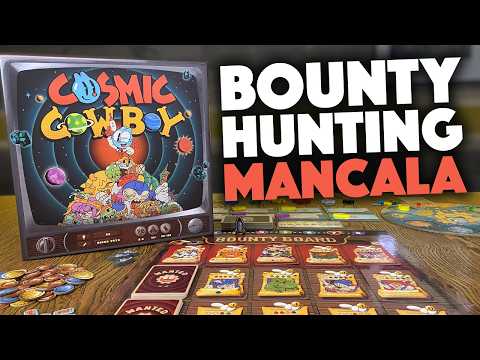
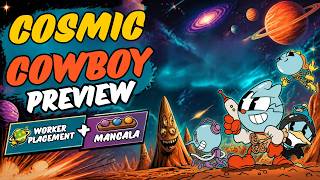
Man vs Meeple and TheGameBoyGeek both present Cosmic Cowboy, published by Mugen Gaming, as a game that is hard to file under a single heading. Man vs Meeple describes a space bounty hunt in which players chase outlaws from a bounty board and score from both captured bounties and upgraded planets. TheGameBoyGeek frames it as a blend of worker placement and mancala mechanisms and walks through a crowdfunding preview, noting that the art and components shown were prototypes and not final.
Both channels are most enthusiastic about the presentation. Man vs Meeple praises the graphic design, describing the action tiles as small computer windows and the player tokens as little fingers pressing a button. TheGameBoyGeek highlights the cartoony captains that give each player a distinct look. Man vs Meeple's praise for the systems is balanced by candor: its hosts say they have not played the game many times, so their judgments about long-term play are more tentative than their judgments about how the parts fit together.
Core Mechanics That Define Cosmic Cowboy
Worker Placement
Man vs Meeple describes the action selection in Cosmic Cowboy as worker placement style, in which taking an action blocks other players from using it. The number of actions grows over time. Players take one action in round one, two in round two, and three in each round after that, so the game starts slowly and then accelerates. The available actions come from tiles that change throughout the eight rounds. Some tiles leave the board on a printed schedule, so reviewers say players often grab a useful tile while it is still there. Capture actions pay an outlaw's minion cost to claim a bounty, improve actions upgrade one of the four planets offered, and collect actions return minions at the end of the round. Interrupt tiles add an extra go button to an action that is already occupied. Executive bounties appear only in the final rounds, and because a limited set of them does not refill once claimed, they are a race.
Mancala-Style Minion Spreading
The second core system is the payment process, which Mugen Gaming built on a mancala mechanism. When a player pays for a bounty or a planet upgrade, minions are placed one at a time, starting at the planet clockwise from the player's captain and paying the lowest tier first. The tiers run from black and white up through red, yellow, green, and blue. Each planet accepts only certain colors, so a minion that cannot fit moves on to the next planet. TheGameBoyGeek explains that the order of spending determines the order of recovery, because the collect phase returns minions in essentially the order they were placed. This is why both reviewers stress planning several turns ahead. Man vs Meeple adds that the faster a player can get minions back, the better, and that collect actions only take effect at the end of the turn, when the captain moves.
The Cosmic Cowboy Experience
The Satisfaction of Planning Payments
Both reviewers describe a pleasure in the payment puzzle. Man vs Meeple says planning feels very satisfying when a collect action pulls a large group of minions back into a player's pool. Players weigh which colors to spend, which planets can absorb them, and whether the captain will reach them before the round ends. That same system creates tension. Man vs Meeple describes a turn where a player moves only a single space, recovers one minion, and then looks at a thin pool with little to do on the next turn.
An Escalating Race Across Eight Rounds
Reviewers describe the game as opening gently and then accelerating. Man vs Meeple says the first round feels like dipping toes into the water, and that after round three the game is kind of off to the races. TheGameBoyGeek notes that as the game progresses, higher-level actions appear, including some with two distinct windows, so options expand as the game goes on. Time-limited action tiles add urgency, since a player who spots a valuable tile may need to take it immediately. Man vs Meeple is skeptical that anyone can settle into one rhythm from start to finish, because a big bounty often forces a recovery turn that resets the plan.
What Makes Cosmic Cowboy Stand Out
Rubber-Hose Art and Board Presentation
The art style is the first feature both channels mention. Man vs Meeple compares the rubber-hose look to Cuphead as a visual reference only, and says the game feels as though it could have been based on an old cartoon. TheGameBoyGeek describes the captains as cartoony and light, with each player receiving a captain and a planet board in a matching color. Man vs Meeple also praises the interface treatment, with the extra go button drawn like a sticky note on a computer monitor. Reviewers treat this presentation as part of the appeal rather than decoration.
Layered Scoring Through Bounties and Planets
Man vs Meeple argues that Cosmic Cowboy scores points through several interlocking systems. Captured outlaws score points, upgraded planets score points and grant abilities, and some executive bounties use conditional scoring. One requires holding the most blue minions, and another scores based on how many upgraded planets a player holds in the first four spots. TheGameBoyGeek points out that some planets grant ongoing abilities that change how minions are paid, which connects the scoring layer to the payment puzzle. Reviewers present this interlocking design as the reason every decision feeds the same goals.
Potential Drawbacks
Black and White Minions Clog Your Board
The most detailed criticism concerns the black and white minions. Neither color is part of a player's own supply. They are drawn from the general supply during payments and placed on the board, where they occupy neutral spaces that better minions would otherwise use. Man vs Meeple explains that black minions can never be collected and permanently block a space, while white minions return to the supply when collected, making them temporary clogs. TheGameBoyGeek makes the same point, observing that these minions push spending farther from the captain. Both reviewers frame this as a tradeoff, since some of the better bounties cost very few minions, so players accept the clutter to reach them.
Slow Recovery and an Elusive Rhythm
Man vs Meeple's main hesitation is that the rhythm is hard to establish. Minions spread across much of the board can take several turns to return, and a costly payment can leave a player with little to do afterward. The reviewers also note that the executive bounties arrive late, starting in round seven, and that they reward players who committed to a long-term plan early. Because both channels reviewed a game they had not played extensively, and because TheGameBoyGeek's footage came from a prototype, viewers should treat these concerns as first impressions rather than settled verdicts.
If You Enjoy Cosmic Cowboy
Players who enjoy the action-blocking worker placement in Cosmic Cowboy may also enjoy Lords of Waterdeep, which rewards efficient placement on shared action spaces. Players who like the set-based scoring, where assembling matching groups earns points, may enjoy Sushi Go!. For those drawn to the mancala-style redistribution of pieces, the classic Mancala offers the same core idea of spreading pieces one at a time and landing for a reward.
What Reviewers Are Saying
"Well, and also it is it is like worker placement style. So, when somebody takes an action, they're blocking that action. So, early in the game, if there's only a couple tiles out and somebody takes the capture action or somebody takes the collect action that you wanted to go, you can't really go there."
— Man vs Meeple
"the order that you're spending these and putting them out in Mancala style is essentially the order that you're going to be getting them back in."
— TheGameBoyGeek
"In Cosmic Cowboy, each of you is going to have your own specific colored captain, and this highlights the sort of cartoony and light art style in the game."
— TheGameBoyGeek