



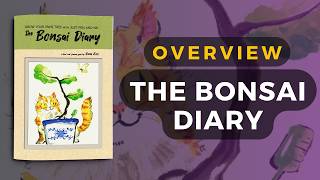
The Bonsai Diary Deep Dive
What the Community Thinks About The Bonsai Diary
Reviewers agree that The Bonsai Diary is a quiet, reflective game that asks for patience rather than skill. DaniCha, who recorded a solo session, describes it as a relaxed ritual, and DaniCha's take is that the game is "not something that you want to stress over." Gaming with Edo & Jessica approaches it as a game to savor between other plays rather than finish in one sitting. Beyond Solitaire's conversation with designer Jean Coup places the game inside a wider discussion of journaling games, paper prototyping, and the emotional weight of working on paper. The reviewers differ mainly in framing. Beyond Solitaire notes that Jean Coup prefers to drop the word "solo" from the genre name because the game works just as well for groups, while Gaming with Edo & Jessica treats it primarily as a solitary practice.
Core Mechanics That Define The Bonsai Diary
Tracing and Incremental Growth
The central mechanic is tracing. Each page shows the sapling from the previous entry, and the player traces it before adding a set number of strokes to make the tree bigger. DaniCha points out that the pages are meant to be see-through: the instructions ask players to "leave the space below blank as a window to the future," so drawing in the lower half of a page would obscure the tree on the page beneath it. Jean Coup has described the tracing idea arriving immediately, with a first version built in a single weekend and roots that remain in the finished game. The physical act of following a tree from one page to the next is the signature of the design, and reviewers treat it as the reason the game feels like a living record rather than a worksheet.
Journaling Prompts as a Story Engine
Alongside each drawing, the book asks a question about the grower's life. Early prompts ask where the seedling was found and what words of encouragement the grower whispers as the soil is pressed down, while later entries ask how a repotted tree reflects the grower's feelings. DaniCha calls these "thought-provoking questions" worked through at DaniCha's own pace. Jean Coup connects the prompt design to the idea of writing to find out, a principle associated with designer Paul Sega in which journaling works best when the writer is not writing for an imagined audience. The prompts are what turn a simple tracing exercise into a story about a family and its legacy, which is the premise Jean Coup named when explaining that the first idea came from a suggestion for intergenerational games about generational legacy.
The Bonsai Diary Experience
Unhurried Reflection
Every reviewer describes the pace as deliberate. Gaming with Edo & Jessica says the game is not meant to be rushed through, and that its appeal lies in the gap between sessions, when the player returns to the tree and sees how it has changed. The experience is closer to tending a plant than working through a puzzle. DaniCha reads the rules as an invitation to "really do for yourself and really just think and be present with yourself," and that tone of quiet attention runs through all three videos.
Quiet Emotional Weight
Jean Coup said the emotional response to the game surprised them during playtests. Players who sped through the pages reported feeling overwhelmed, and the designer's response was to stress that the book is meant to be played once a day over several weeks. The result is a feeling of tenderness and reflection, with the tree serving as a record of a life. Jean Coup also described couples at PAX Unplugged who played together, with one person drawing and the other writing the story, and found that interaction very moving. The game produces the feeling of a private confession that a player shares with a companion, not a scoreboard to beat.
What Makes The Bonsai Diary Stand Out
Built for People Who Cannot Draw
Reviewers consistently highlight the game's accessibility. DaniCha reads from the opening pages that "You don't have to be an artist to play," and that anyone who can trace can grow a bonsai. Jean Coup treats accessibility as a core design test, wanting a new player to be able to start on the very first page without first learning a body of lore. The designer also noted that adult playtesters often apologized before they started by saying they could not draw, a reaction the designer found sad. The game's answer is that tracing and small, deliberate strokes are enough to produce a satisfying result.
Designed for Shared Tables
Beyond Solitaire's conversation with Jean Coup highlights that the game is not limited to one person at a time. The designer has run events where people play from the same book but make different choices, then compare what they wrote. Gaming with Edo & Jessica describes the book as a personal, slow experience, which means the shared play the designer reports complements the solitary practice rather than replacing it. Reviewers value that the book can be a solo ritual one week and a conversation starter the next.
Potential Drawbacks
Print-and-Play Paper Demands
Gaming with Edo & Jessica points to a practical hurdle. The print-and-play version has to be printed on double-sided paper that's not too thick, so that the tracing can show through from the page behind. Players who want clean tracing will need to match their paper to the printout. This is a small obstacle, but it is one that the physical design depends on, so the game's experience is closely tied to the quality of the paper a player chooses.
Limited Branching Agency
Beyond Solitaire explores whether the game offers enough agency. Jean Coup acknowledges that the core book makes no classic choices and plays out the same way each time, and that people have raised the question of whether that matters. The designer includes a randomized version in the back of the book. Jean Coup's answer is that agency here lies in deciding what each page means rather than in plot branches, a different kind of agency from the one most players expect from games. Reviewers accept that framing, but it is a real trade-off for players who want their choices to change the outcome.
If You Enjoy The Bonsai Diary
Players who enjoy The Bonsai Diary's tracing will find similar satisfaction in Color Jam, the coloring game that Jean Coup co-designed with Joe Kell. Beyond Solitaire notes that the team set out to make a game "fundamentally about the creativity of coloring," with ambiguous pictures and a sliding number mechanic that invites players to turn an unexpected color into a story. Its publisher, Lunar Punk, releases it as a print-and-play game, which carries the same low-cost, reprintable approach that makes The Bonsai Diary easy to pick up. Players who enjoy the prompt-driven side of the diary will also find a kindred design in The Quiet Year, the map-drawing game whose mechanic of drawing cards and answering prompts inspired Jean Coup's early experiments with the form.
What Reviewers Are Saying
"But yeah, a very relaxing type of game. Like this is not something that you want to stress over."
— DaniCha
"But one of the great affordances of paper is your ability to write on it, fold it, burn it."
— Beyond Solitaire
"This is not something to quickly journal through and go page to page to page. It's more of something to play very slowly, enjoying those moments in between playing and coming back to it and seeing kind of how life goes for this bonsai."
— Gaming with Edo & Jessica