




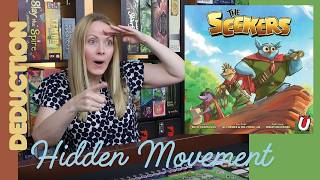



The Seekers Deep Dive
What the Community Thinks About The Seekers
Board game reviewers have embraced The Seekers as a standout achievement in accessible hidden movement design. The overwhelming community response emphasizes how cleanly Jay Cormier and Sen-Foong Lim have executed a streamlined take on a notoriously complex genre. Rahdo Runs Through praised it as a family-friendly entry point that doesn't sacrifice strategic depth. Tabletop Tolson called it "slick, smart, and scalable." What emerges across reviews is a shared appreciation for how the game opens deduction mechanics to players who might otherwise find hidden movement intimidating, while offering meaningful decisions at every turn. The Hungry Gamer summed up the experience as genuinely lovely to play, even for someone who struggles with the genre.
Core Mechanics That Define The Seekers
Hidden Movement and Asymmetrical Deduction
The Seekers centers on one player, the Mushroom, moving secretly behind a screen while the Seekers use logic and information to narrow down the Mushroom's location and catch them. The Mushroom gets 15 turns to collect 8 of 12 possible crystals, but every time they collect a crystal, they reveal which turn it happened. This creates a clever tension: grabbing crystals quickly gives the Mushroom progress toward victory, but the information leak accelerates the Seekers' deduction. The Seekers never see the Mushroom's actual path, only the footprints the Mushroom player reveals through searches. When a Seeker searches an animal location, the Mushroom responds with token markers showing whether the Mushroom visited any of the three spaces of that animal family between turn one and the current turn. This information slowly converges into a reconstructed path. The game is fundamentally about asymmetric knowledge: the Seekers work backward from clues; the Mushroom works forward under pressure, knowing they're being cornered.
Dry-Erase Shift Cards and Mechanical Accessibility
From Off the Page Games comes an elegant system for managing information without overwhelming players. The Seekers' deduction tool is a dry-erase board where they mark which animals have no crystals and track suspected path positions. The Mushroom player uses their own dry-erase board to note where they've moved. Reviewers consistently praised how tactile and intuitive this design is, allowing players to think spatially and revise their theories without friction. Equally important are the shift cards, which balance the game by giving advantages to whichever side is losing. If the Mushroom is being found too easily, shift cards help keep information hidden longer. If the Seekers are struggling, shift cards guide them toward critical clues. This system scales the game across different experience levels without requiring house rules or the hider having to play less optimally.
The Seekers Experience
Tension Through Deduction and Communication
Players consistently report that The Seekers creates genuine tension through collaborative deduction among the Seekers and individual puzzle-solving as the Mushroom. Everyone at the table stays engaged every turn. While the Mushroom moves and draws hint cards, the Seekers must discuss possibilities and coordinate their searches. The Seekers never know if they're close or far away; they only have the accumulating pattern. The Mushroom, listening to the Seekers' discussion, gauges how much the Seekers have figured out and whether to push for more crystals or play defensively. Reviewers noted that there is very little downtime. Unlike many hidden movement games, The Seekers packs decision-making into a brief window without making it feel rushed.
Accessibility for Families and Entry-Level Players
A distinguishing feature of The Seekers is how it welcomes players unfamiliar with hidden movement or deduction games. Optional hint cards guide both the Mushroom and Seekers on strategy without solving the puzzle for them. Numbered tips remind newer players about arc considerations: avoiding edges, using winding patterns to obscure the path, and timing special abilities wisely. Reviewers highlighted that the game's 45-minute playtime, combined with clear player cards and simple turn structures, makes it approachable for younger or casual players. Yet the design is sophisticated enough that experienced players enjoy multiple replays, trying different strategies and adapting to shift cards that change game dynamics.
What Makes The Seekers Stand Out
Slick, All-in-One Design with Inherent Scalability
The Seekers ships as a complete package in a surprisingly compact box. The base game includes the Mushroom player board, Seeker character cards, dry-erase boards, tokens, animal cards, shift cards, and optional expansions (Fun Gals and Shiny Stuff) as bonus content. Multiple reviewers noted that the art, component quality, and presentation feel polished. Everything has a purpose and nothing feels wasted. The shift card system is built into the core box, meaning players have a tool to tune difficulty on the fly. This foresight elevates The Seekers above games that feel unbalanced or require optional modules to play fairly.
Streamlined Hidden Movement Mechanic for Modern Players
Hidden movement games often demand significant mental load from the hider (remembering an intricate path) and brute-force pattern recognition from seekers. The Seekers removes that friction by having the Mushroom use a compact board to track their own path, and by limiting the Seekers' deduction to spatial reasoning over three animals at a time. Reviewers praised how clean this streamlining felt, especially compared to older entries in the genre. Jay Cormier and Sen-Foong Lim, who previously designed the cooperative deduction game Core Discovery, applied that experience to deliver hidden movement that doesn't punish inexperience but rewards clever play.
Potential Drawbacks
May Not Fully Replace Heavier Hidden Movement Games
One BoardGameCo reviewer noted that while The Seekers is fun and well-designed, it doesn't replace heavier mind-management games for those already invested in that genre. The streamlining that makes The Seekers accessible also means some depth is traded away. A player seeking the complexity of a game like Mind Management might find The Seekers too lean, even if they admire its elegance. This is less a flaw and more a positioning: The Seekers targets a different audience, one that values accessibility and elegant design over maximum complexity.
Hidden Movement Skill Gap Between Hider and Seekers
The Hungry Gamer openly noted being bad at hidden movement games, yet still enjoyed The Seekers. That said, the game has a natural skill dynamic: an experienced Mushroom player who understands path inference and when to use sneaky step cards can dominate unprepared Seekers. The shift cards help, but a severely mismatched table might find the game lopsided. Reviewers did not report this as a serious issue, likely because the shift system catches it early, but it remains a consideration for mixed-experience groups.
If You Enjoy The Seekers
Fans of The Seekers should explore other hidden movement and deduction games. Core Discovery, the designers' earlier cooperative title, shares their design philosophy and rewards similar logical thinking. Players who appreciate the family-friendly, accessible approach should also consider games emphasizing clean mechanics and elegant scalability, such as other titles from publishers known for refining complex genres into approachable forms. The Seekers' success comes from respecting player time and cognition while preserving meaningful decisions, a principle worth seeking in similar designs.
What Reviewers Are Saying
"While it's not necessarily like my number one go-to mechanic, which is the hidden movement deduction, I think this does it so well, it could possibly become one of my favorites. So, The Seekers definitely doing what it set out to do and very accessible for uh entry gamers, for family gamers, um just does it so cleanly."
— Rahdo Runs Through
"I talked about this game being slick. I love the dry erase feature. This is so easy. You just take a pen and you just write on this stuff. The game is a deduction game. Players are working really hard to hem in and determine the route. The shift cards are going to essentially give that kind of replayability and range for players to continuously come back to this."
— Tabletop Tolson
"I demoed with Jay from Off the Page Games and actually played the whole game and it's called The Seekers. And this is a reimagining and streamlining of mind management, hidden movement, and you're just trying to figure out where the mushroom critters running around. And I'm still real bad, real bad at that kind of game. But just had a really lovely time with it. And they have these cool little plushies that you can have magnetic little tools."
— Hungry Gamer