



Beat the 8 Ball Deep Dive
What the Community Thinks About Beat the 8 Ball
Beat the 8 Ball comes across in these reviews as a light, social novelty rather than a serious strategy game. Its appeal lies in the moment of release, not in long-term planning. Chairman of the Board was candid that the game is a gimmick, grouping it among eight recent plays with no real blockbusters among them, and they still called it out as a highlight of that batch. They gave it a modest score because they felt there was little depth beneath the fun, but they recommended it on the strength of its toy factor alone. Lance, UndeadVikingVideos described it from a host's perspective. It was a title set up on a table for guests to drop into between longer games, and players kept returning to it throughout a weekend convention. The Dice Tower offered only a short clip, but it captured the same energy: four players shouting countdowns, celebrating narrow misses, and laughing at the results.
Chairman of the Board and Lance diverge mainly on how much the game can sustain. Chairman of the Board sees a single idea that is enjoyable for a few rounds and then runs its course. Lance and the group in The Dice Tower clip treat that short lifespan as a feature, since the game is designed for quick replays between other activities. Neither review frames Beat the 8 Ball as a centerpiece for a game night, nor argues that it should be one.
Core Mechanics That Define Beat the 8 Ball
Push Your Luck
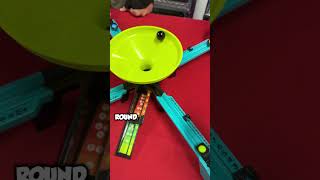
The central tension in Beat the 8 Ball is a push-your-luck decision about timing. Each player must release a ball from a hinged track into a spinning funnel that holds the 8 Ball, and the score depends on where each ball finishes relative to the 8 Ball. Chairman of the Board explained the risk plainly: going too early costs points or scores nothing, while going after the 8 Ball produces negative points. The rational target is a narrow window after the other players have committed but before the 8 Ball drops into the chute. Lance described the same bind from the table, noting that players are trying to release their marble while also waiting for someone else to go first. Because each additional second of waiting shrinks the safe window, the player must keep judging how long to hold back. Chairman of the Board put the margin in stark terms, calling it a matter of "a fraction of a fraction of a second."
Timing-Based Release
The physical act of releasing the ball is where the dexterity element lives. Players do not simply choose a moment on paper. They must commit a hand movement that sends a ball down the track at the right instant, and the spinning 8 Ball gives little room for correction. The Dice Tower's clip shows how quickly this unfolds: players call out "Go," "Drop it now," and "It's about to go," and the rounds end in cheers, groans, and laughter. Chairman of the Board said the outcome depends on a timing judgment rather than skill built over many plays, which is why they see the game as "a gimmick that works" rather than a deep test of ability. For many tables, that quick and uncertain release is precisely what makes it entertaining to watch as well as to play.
The Beat the 8 Ball Experience
Playful Tension Around the Countdown
Both longer reviews describe a brief, intense anticipation before each release. The funnel spins, the 8 Ball circles, and every player watches the others to avoid moving first. Lance noted that the decision is partly social, since the table asks, in their words, "who's going to go, who should go." The Dice Tower clip captures that same moment in real time, with players urging one another on and reacting to each outcome. The tension is short but sharp, and it resets with each round, which keeps the table engaged.
Lighthearted Silliness
Beyond the tension, reviewers emphasize how silly the experience feels. Chairman of the Board praised it as a case where "sometimes silliness works," and they valued the way it lets a group enjoy a deliberately simple activity. The Dice Tower's players joke about nicknames, shout at one another, and erupt in laughter at the results, which suggests the fun comes from the table as much as from the rules. Lance also treated the game as a relaxed palate cleanser that lets players unwind between heavier titles. The overall mood is light, loud, and easy to join.
What Makes Beat the 8 Ball Stand Out
Instant Accessibility
Both Chairman of the Board and Lance point to how easily the game is understood. Each player has one ball to release, the scoring fits in a sentence, and a new player can join a round almost immediately. Lance noted that the game was played repeatedly over a weekend without anyone needing a long explanation, and Chairman of the Board described it as something that can fill ten, fifteen, or thirty minutes without effort. Its published playtime of about ten minutes per game makes it an easy filler between longer titles.
Practical Uses Beyond the Game
Chairman of the Board highlighted an unexpected benefit: the timing ritual is useful for decisions that need a quick, neutral outcome. They suggested it could settle who takes the first player role or break a tie, treating that as a sign the design rewards creative table use beyond its own box. The idea of a game that doubles as a randomizer for everyday decisions is a distinctive part of its reputation.
Potential Drawbacks
Limited Depth and Replay Value
The most common criticism is that the game has a narrow range of decisions. Chairman of the Board openly called it a "one-trick pony" and said that, after a point, there is little to it beyond the release. They scored it modestly for that reason, even while calling it their favorite title in the group. Lance also framed it as "something to play" rather than a challenge that rewards study. Players who want strategic depth will likely find the game thin, though reviewers felt that the trade-off is intentional and suits a casual table.
Scoring Details and Luck
Reviewers describe the scoring slightly differently, which can cause confusion at the table. Chairman of the Board said that releasing too early scores nothing or costs points, while Lance described the first player down the track as scoring zero and the last as scoring the most. The Dice Tower's clip shows players tracking plus and minus points as each round resolves. Because the difference between a good and a bad release can be a fraction of a second, a close call can feel more like luck than skill. Groups should read the rules carefully before the first round so that the scoring is clear for everyone.
If You Enjoy Beat the 8 Ball
Players who enjoy Beat the 8 Ball tend to appreciate quick push-your-luck games where the decision is made under time pressure. The appeal is the same as in classic dexterity party games: a simple action, a clear risk, and a result that the whole table can see at once. Games in this style reward a willingness to take a calculated chance, and they create the same shared anticipation as watching a ball fall toward a target. As Chairman of the Board's own use of the game as a tiebreaker and first-player decider suggests, it fits best alongside other quick, physical party games meant for the gaps between longer sessions rather than as a night's main event. If you want more strategic weight, look for push-your-luck titles where each risk builds on earlier choices, since that deeper layer is what the available reviews felt Beat the 8 Ball leaves out.
What Reviewers Are Saying
"It is a one-trick pony. It definitely is a gimmick, but it's a gimmick that works. It's a gimmick that's fun."
— Chairman of the Board
"It's basically a whole thing of watching the eight ball swirl and then trying to remember to let your marble go. But you're also trying to make sure that you wait for somebody else to go first."
— Lance, UndeadVikingVideos
"Who will win? Who will beat the eight ball? Don't be too early."
— The Dice Tower