





Hellbreak Deep Dive
What the Community Thinks About Hellbreak
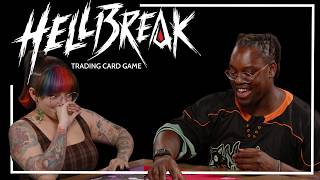
Hellbreak has captured the board game community's attention with its fresh approach to the trading card game format. Reviewers at Gen Con 2026 consistently praised the game for its polished mechanics, engaging pacing, and clever licensing of classic Universal Monsters. The game generated tangible buzz at the convention, with demo lines stretching across the gaming hall and word-of-mouth recommendations spreading throughout the weekend. While opinions diverge on the depth of strategic matchups between different monster decks, the consensus is clear: Hellbreak delivers a streamlined, satisfying head-to-head card game experience that appeals to both TCG veterans and newcomers. The one challenge players note is that certain monster decks, particularly Dracula, develop significant advantages in extended games, requiring careful deckbuilding choices for other franchises to remain competitive.
Core Mechanics That Define Hellbreak
Deck Building
Each player starts with a small identical deck of cards and gradually acquires new cards throughout the game to add to their personal deck, cycling through it repeatedly as it grows and improves. The central decisions revolve around which cards to purchase from the shared market and which to trash from your hand, transforming the deck itself into the evolving strategic engine. This system mirrors the best deck builders in the genre: initial resources are modest, but by carefully selecting which cards to add to your deck and which weak cards to remove, you can construct a powerful engine that generates resources and damage more efficiently than your opponent's deck.
Monster Flipping Between Lurking and Unleashed States
Hellbreak's monsters exist in two states, a mechanic that creates dynamic moment-to-moment decision-making. When lurking, monsters provide superior economic benefits, generating resources and blood tokens to power your strategy. When unleashed, they shift into an offensive posture, maximizing damage output to eliminate your opponent's health. This flipping mechanic is the heartbeat of Hellbreak's gameplay rhythm. Each turn presents the question: build wealth and resources by keeping your monster lurking, or pivot to aggressive mode and end the game? The dynamic between these two states, reinforced through card abilities and location control, forces players to adapt mid-game rather than commit to a single strategy from the start.
The Hellbreak Experience
Smooth, Fast-Paced Strategic Combat
Hellbreak delivers the intensity of head-to-head combat without the sluggish downtime that plagues many TCGs. Turns flow naturally, and the game reaches a conclusion in a reasonable timeframe while maintaining meaningful decisions. Players feel the momentum of building their deck, watching their economic engine come online, and pivoting to finish their opponent. The game strikes an elegant balance between approachability for new players and strategic depth for veterans. Nothing feels wasted or extraneous; every card matters, and every choice ripples through the rest of the turn.
Thematic Horror Fantasy Realized Through Gameplay
Spin Master and Ghost Galaxy have woven the horror theme directly into the mechanics rather than treating monsters as mere window dressing. Abilities reference classic monster tropes: vampires drain life, predatory creatures hunt for advantage, and supernatural beings trigger cascading effects when damaged through Jump Scare abilities. Playing as Dracula feels distinctly different from commanding Jaws, not just in card text but in strategic philosophy. The horror setting is not grafted onto the game; it emerges from the decisions players make and the creatures they control.
What Makes Hellbreak Stand Out
Licensed Universal Monsters Create Immediate Narrative Appeal
Hellbreak's licensing deal with Universal brings genuinely iconic intellectual property to the trading card game space. Dracula and Jaws are not generic card names; they carry decades of cultural weight and recognition. Reviewers noted that the booth at Gen Con was consistently packed, with long lines of players eager to try the game specifically because they recognized the monsters. The promise of future expansions featuring other Universal properties creates clear expansion potential without asking players to invest in unknown franchises. This is a significant advantage in a crowded TCG market where players often skip unknown properties.
Locations Transform Board Control Into a Live Gameplay Element
Rather than relegating board control to a secondary concern, Hellbreak makes location control a real objective that shapes every turn. These locations generate resources, provide bonuses to attacking creatures, and trigger special abilities when claimed. Fighting for control of locations creates a compelling third axis of play beyond just building your deck and managing health totals. Players are not merely playing cards in a vacuum; they are positioning their monsters, contesting space on the board, and leveraging environmental advantage. This location-control element prevented Hellbreak from feeling like a pure linear ramp game and injected genuine tactical positioning into what might otherwise be a straightforward resource accumulation race.
Potential Drawbacks
Dracula's Long Game Dominance May Skew Mirror Matches
Multiple reviewers noted that Dracula has accumulated tools and synergies that are difficult for other starter decks to overcome in extended games. One experienced player observed that while Jaws must commit to aggressive early strategies to stay ahead, Dracula's mechanics reward patience and allow it to weather attacks while building defensive value. This creates an asymmetry that, while not game-breaking, means players selecting certain monster decks may need to adopt specific winning conditions or risk falling behind in attrition-based games. Experienced players familiar with the meta will need to adjust their approach based on matchup, which is normal for TCGs but worth noting for players hoping for perfect symmetry between starter options.
Game Not Yet Widely Available at Review Time
At Gen Con 2026, Hellbreak existed as a demo experience with limited promotional sample packs and starter decks. The full product was not yet in circulation, meaning the community's evaluation is based on hands-on play at the convention and advance information from Spin Master. While reviewers were uniformly positive about what they experienced, the lag between demo play and retail release means the final product, packaging, and pricing structure remain unknown variables. Early enthusiasm is encouraging, but players will need to evaluate the full offering once the game ships to retailers.
If You Enjoy Hellbreak
Hellbreak's blend of streamlined deck-building mechanics and horror theming positions it naturally alongside several related games. Players drawn to Star Wars Unlimited will recognize Hellbreak's approach to resource management and hand cycling, though Hellbreak leans further into the role of locations and asymmetric monster abilities. Pokemon enthusiasts will appreciate the accessible entry point and iconic IP licensing, though Hellbreak's mechanics are more sophisticated than Pokemon's basic structure. Riftbound players will immediately understand the location-control elements, making the transition smooth for anyone already familiar with contested board space. Older trading card gamers who remember Call of Cthulhu TCG's asymmetric monster abilities will find echoes of that design philosophy in Hellbreak's unique creature mechanics. For those seeking a fast, thematic two-player card game with meaningful decisions and real horror atmosphere, Hellbreak delivers on all fronts.
What Reviewers Are Saying
"In this game it takes all of your favorite horror monsters and pits them in battle. And you're not just throwing blows, you got some really cool locations you can take control of."
— Good Time Society
"It's like 50% Star Wars Unlimited, 5% Pokemon. It's got maybe 10% Riftbound because there's locations. There's maybe another 5% of the old Call of Cthulhu trading card game. It definitely feels like a good soup of this kind of stuff and it was neat. I liked it a lot."
— The Dice Tower
"I think that you know, mechanically, Dracula has a lot of tricks that are hard to beat. It is a very, in the long game, Dracula wins. So with Jaws, I just got to keep eating."
— Good Time Society