







Dicequest Deep Dive
What the Community Thinks About Dicequest
Dicequest stands as a polished entry into the dice pool building space from Skytear Games. Reviewers consistently praise its visual presentation and engaging core mechanics, though opinions diverge on whether the solo and cooperative modes rival the competitive experience. The game attracts players across all three modes, with general enthusiasm about the quality of components and the speed of play. Most reviewers see it as a success for Skytear Games, though some felt it does not quite reach the heights of the publisher's other releases like Onward and Skytear Horde. The game's greatest strength appears to be its ability to appeal to different player counts and play styles, making it accessible while still offering meaningful tactical decisions.
Core Mechanics That Define Dicequest
Dice Pool Building
Dicequest centers on assembling and upgrading a personal collection of dice through hero recruitment and item acquisition. Players recruit apprentice heroes from a rotating marketplace, each offering a specific colored die with unique face symbols when rolled. As heroes level up, they flip to their master side and unlock special abilities or gain additional dice to the player's pool. The system creates a satisfying feedback loop: coin income from quest rewards funds new heroes, whose dice enable success on tougher challenges. Reviewers highlighted how different hero combinations create varied strategic paths through each game, with no single dominant build. The dice themselves are beautifully crafted, featuring iridescent finishes that make rolling them a tactile pleasure. This progression system transforms dice rolling from random chance into an expression of player choice about which characters to pursue and how to equip them.
Cooperative Adventure
Dicequest frames all three play modes around shared or individual victory conditions tied to three escalating acts. In cooperative and solo modes, players work together against the game system itself, facing scripted threat cards that impose constraints and adventure cards that demand specific dice rolls under time pressure. Each act ends with a boss encounter where the full party must coordinate their dice pools and abilities to succeed. The threat deck introduces uncertainty and forces adaptation, while the quest system provides intermediate goals that feed into boss preparation. Reviewers noted that the cooperative experience works, but shines brighter in competitive play when players actively contest quests and vie for limited resources. Solo players can experience the full campaign solo with minor adjustments to hero sharing rules, though some felt the cooperative mode's constraint system works best with multiple perspectives to coordinate tactical decisions.
The Dicequest Experience
Lighthearted Adventure with Substance
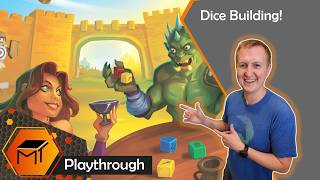
The game exudes what reviewers called a semi-cozy vibe that belies its tactical depth. The artwork features charming character designs that echo the style of Santorini, creating an inviting aesthetic that appeals to families and experienced gamers alike. Despite the approachable presentation, turn-to-turn decisions carry real weight. Players weigh hero recruitment against resource management, item equipment against ability synergies, and quest selection against boss preparation. Reviewers appreciated how the game refuses to outstay its welcome, completing most sessions in 45 minutes without feeling rushed. This balance of accessibility and meaningful strategy positions Dicequest as a rare game that works equally well as a casual family experience or a focused competitive showdown.
Dice Rolling Tension with Agency
While Dicequest relies on dice rolling for quest resolution, reviewers emphasized that the randomness feels manageable rather than arbitrary. Players can mitigate bad rolls through careful hero selection, equipment choices, and reroll tokens earned through failure. This creates moments of tension where players must commit to a quest without knowing whether the dice will cooperate, yet the outcome never feels entirely outside their control. Multiple reviewers highlighted that building the right dice pool and hero synergies genuinely improves success odds, making the game feel rewarding when a well-constructed team executes perfectly. However, some cautioned that bad rolls can still derail carefully laid plans, especially early in the game when dice pools are smaller and options fewer.
What Makes Dicequest Stand Out
Flexible Gameplay Modes
Few games execute three distinct play experiences within a single box as seamlessly as Dicequest. The solo mode provides a full campaign for the individual player against a threat deck. The cooperative mode scales that same campaign to any group size, with shared hero markets and itemization. The competitive mode transforms the game entirely, turning shared quests into a race and forcing players to outbid one another for rare heroes and powerful items. Reviewers noted that this flexibility means Dicequest adapts to the player's circumstances rather than forcing a play pattern. One reviewer specifically called out competitive play as a revelation after experiencing primarily solo and cooperative sessions, noting the dynamic tension of actively fighting over resources rather than simply coordinating against the game. This modularity ensures the game remains relevant across different gaming contexts.
Component Quality and Presentation
The crowdfunding deluxe edition that many reviewers received includes production touches that elevate the experience. Custom iridescent dice sit neatly in neoprene player boards, while beautifully inked metal coins replace cardboard, adding weight and tactile satisfaction to economic decisions. The game's neoprene mat and custom tokens reduce fiddly setup, letting groups jump into play faster. Reviewers consistently called out the metal coins specifically as genuinely valuable additions that make the game more pleasant to handle. The rulebook features cohesive artwork that matches the box, and the overall presentation suggests a publisher that cared about the complete unboxing experience.
Potential Drawbacks
Solo and Cooperative Play Trails Competitive
Several reviewers noted that solo and cooperative modes, while functional, did not capture them the way competitive play did. The threat deck adds variability but follows a scripted escalation, and quests feel less dynamic when players are simply coordinating against fixed challenges rather than negotiating table politics. One reviewer observed that solo play especially felt shorter and less impactful than they expected, with the game resolving faster than the full 45-minute estimate suggested once players understood the flow. The game offers expansions and suggested rule variants to adjust difficulty, but the base experience in these modes may not satisfy players seeking deeper solo campaigns or puzzles that reward optimal play.
Dice Dependency and Variance
Reviewers who played extensively with kids or at lower player counts mentioned frustration when die rolls refused to cooperate. While the game provides reroll tokens and ability synergies to mitigate variance, sometimes the dice simply do not cooperate, and careful planning can evaporate on a single failed roll. One reviewer discussed the challenge of playing with a 10-year-old, noting that brutal swings in luck sometimes discourage younger players. Another mentioned that certain hero abilities or equipment choices do not directly solve variance problems, leaving some players feeling locked out by probability. This is not a design flaw per se, but rather a tension inherent to dice-centric mechanics that will frustrate players who prefer deterministic strategy.
If You Enjoy Dicequest
Players drawn to Dicequest typically enjoy games emphasizing progression and character building. Skytear Games' other titles, Onward, Skytear Horde, and the upcoming Skytear Exceed, offer similar mechanisms in different settings. If the Dicequest aesthetic appeals, Santorini provides lighter spatial puzzles with comparable artwork and charm. Players interested in cooperative dungeon crawls with progression systems might explore other crawlers with hero advancement, though Dicequest's lightness distinguishes it from heavier offerings in that space. The game ultimately carves its own niche: a quick, scalable, charming dice game that respects playtime and delivers meaningful choices without requiring extensive rules overhead.
What Reviewers Are Saying
"You're going to see solo and co-op are going to be very similar. The goal of the game is we need to complete this adventure three as well as all of the threat tokens get that get placed on there. If we can't do that, we lose the game. Throughout the game, we're going to try and complete quest cards to gain rewards and then adventure cards in round three, six, and of course, round nine. That's when we have to win."
— Colin, Meet Me at the Table
"Dice Quest, this is a dice pool builder where you are getting different dice. You can have up to three heroes as you're kind of going through like three eras of increasing difficulty. So obviously in that first era you're kind of building up your first heroes, getting dice from them, powering them up with abilities and things you can get and going through in the second and third era, tougher and tougher challenges."
— BoardGameGeek
"It's got a nice, a nice appealing look to it. It was the same thing where I saw it pop up, I think in the hot images tab. Maybe the cover was in there, and I immediately was just like, I want to click on this. I want to see what this is. Whoever did the art and the graph design, good job, because it made me want to click on it. That's what you got to do these days. Catch people's eyes as you're scrolling by."
— BoardGameGeek