


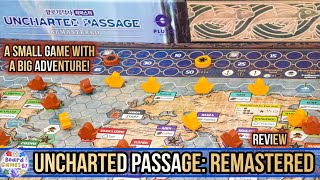

Uncharted Passage: Remastered Deep Dive
What the Community Thinks About Uncharted Passage: Remastered
Reviewers describe Uncharted Passage: Remastered as a compact adventure that packs a lot of tension into a short session. Designed by Bong Huanju and published by Pluto Games in 2026, this remastered edition of the original Uncharted Passage sends players sailing from Lisbon as Portuguese explorers who chart unknown waters and establish trade routes over the course of a year. Board Games With B7 calls it an epic adventure that feels surprisingly tense and thinky for its playing time, while Mike Delisio of The Dice Tower says Delisio has played it several times and wants to keep coming back.
The discussion centers on the solo game, which Delisio considers the main way to play. Board Games With B7 covers solo play alongside cooperative and competitive two-player modes, noting that the core gameplay stays largely the same while each mode brings its own differences. The overall impression is of a thinking game that rewards careful planning without outstaying its welcome.
Core Mechanics That Define Uncharted Passage: Remastered
Voyage Cards and Resource Allocation
Each month opens with a voyage card that sets a condition for the round, such as requiring a sailing speed of at least three, and describes how the pirates will attack. Players then split a pool of resources across sailing speed, crew stamina, and armament. Delisio demonstrates this by raising sailing speed to clear the condition and keeping armament modest, hedging that the pirates will roll low on their two dice. Board Games With B7 points to the same tension, noting that voyage cards, mid-event cards, and dice rolls all bring elements of luck that players must prepare for. Delisio describes the allocation as essentially an action point system, and values it because it forces you to accept some vulnerability in order to do what you want.
Mission Routes and Port Trading
Mission cards come in route, trade, and discovery types, and each asks for a different objective, such as sailing the Northwest Passage from Tacoma to Cohasset. Ports let captains gain prestige, buy and sell specialty goods, and collect one-time port cards, while discovery spots on the map can pay out prestige with a die roll. Board Games With B7 says that when several objectives line up along the same route, a captain can combine them and make the most of the journey. Delisio also highlights the wrap-around edges of the map, which let a ship leave from one side and enter from the opposite side instead of taking the long way around.
The Uncharted Passage: Remastered Experience
A Tense Voyage in a Short Session
Board Games With B7 describes the game as an adventure that feels huge without taking hours to play, and its reviewer says every minute spent sailing, planning routes, and managing resources was enjoyable. Delisio compares the feel to comfort food: the rules are simple, there is little upkeep, and most of the thinking happens during the planning phase. Pirate raids and scurvy checks keep the mood edgy, since a bad roll can cost ship durability or crew health, and a sunken ship erases all accumulated prestige. Delisio notes that the game plays about as quickly as a filler while still feeling like a complete game with meaningful choices.
Risk Management and Replayability
Both channels stress that the game is about making the most of what you are given while preparing for bad draws. Board Games With B7 credits the variety of voyage, mission, mid-event, and port cards with making each voyage feel different, since the routes you take can change dramatically depending on what you receive. Delisio considers it very unlikely that the same lineup of cards will come up twice in a game, which keeps the experience fresh over repeated sessions. The satisfaction comes from taking calculated risks: you can always play it safe, but there is something rewarding about pushing your luck through a month without taking too much damage from pirates or scurvy.
What Makes Uncharted Passage: Remastered Stand Out
Route Planning Around Mission Cards
Board Games With B7 says the map and iconography on the mission cards make it easy to see where objectives sit and to plan a path between them, and it compares this to the destination tickets in Ticket to Ride. Because objectives can be spread across the map or lined up along a single route, the planning changes from one game to the next. Competitive play adds public mission cards, which give both captains extra objectives to pursue and a way to adapt when their private missions do not line up well.
Compact Production and Period Artwork
Delisio praises the production as a nice package in a small box that still holds a fair amount of game, including a fourfold bowl board, sturdy wooden pieces, and good card quality. Board Games With B7 singles out the artwork, which captures the atmosphere of the Age of Discovery and draws on works by 26 artists from that era, and it describes the components as a compact package that still provides everything needed for the voyage. The map and iconography are easy to read, which makes navigating the world and tracking objectives smoother.
Potential Drawbacks
Iconography and the Learning Curve
Delisio's main criticism is that some of the iconography can be unintuitive, especially where pirate attacks are concerned. Delisio notes that the reference on the back of the rulebook softens the problem, but expects players to consult it more than they might like during the first two or three games. Delisio does not consider the issue overwhelming, but it is the one notable downside raised about the production. Newcomers should expect a few plays before the symbols feel second nature.
Luck, Scoring, and the Solo Focus
Board Games With B7 acknowledges that luck comes from the voyage cards, mission cards, mid-event cards, and dice rolls, and says the key is preparing for those possibilities rather than hoping for good draws. Delisio points out that the game uses a beat-your-high-score variant, a style Delisio does not always love, though it suits this design. Because Delisio's review centers on solo play, the two-player modes are unplayed, preferring not to face an automated opponent, so the head-to-head side of the game is less tested in that write-up.
If You Enjoy Uncharted Passage: Remastered
If you enjoy planning routes around objectives, Ticket to Ride is a natural comparison, since Board Games With B7 draws that link directly to destination tickets and how easily they let you visualize a path. Fans of the designer may also want to explore the other titles Delisio has covered, which are a good fit for the same kind of tight decision-making.
- Ticket to Ride: for route objectives and map-based planning that makes long-range goals easy to see.
- President Maker: for push-your-luck tension, a politically themed race, and the same designer's interest in unpredictable endgames.
- Magic Number 11: for players who want to see the same designer's sense of design applied to a very different theme.
What Reviewers Are Saying
"The map and iconography on the mission cards make this much easier, clearly showing where your objectives are located and helping you plan your route. It actually reminded me a little of the destination tickets in Ticket to Ride and how easily they let you visualize your routes."
— Board Games With B7
"I love that, right? You don't see that as much anymore. It seems to have been kind of replaced by other mechanical systems to drive the game, but it works really really well here because often times you're in this situation where it's like I'm having to leave myself vulnerable in some way to be able to do what I want to do."
— Mike Delisio, The Dice Tower
"Overall, Uncharted Passage Remastered is such a fantastic game. It's an epic adventure and exploration game that manages to deliver a surprisingly tense and thinky journey in a relatively short amount of time."
— Board Games With B7