




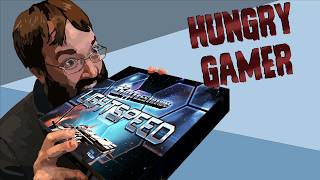
Battlestations: LightSpeed Deep Dive
What the Community Thinks About Battlestations: LightSpeed
Battlestations: LightSpeed is a streamlined cooperative starship game from Gorilla Games, designed by Jeff Siadek, in which players crew a modular spacecraft against game-controlled threats. Reviewers consistently place it beside the original Battle Stations as a faster, more standalone way into the same universe. Hungry Gamer describes it as a light version of the existing game that mixes in ideas from Battle Stations: Dirtside and fits them into a small box with a play time under an hour. UndeadVikingVideos refers to it as the lighter version of Battle Stations and runs it at conventions alongside the full game.
The praise centers on how snappy the game feels, how varied its scenarios are, and how its leveling system adds progression without slowing the table down. The critique is just as direct. Hungry Gamer is clear that this is not a deep game and will not satisfy anyone looking for the weight of Gloomhaven or Tales from the Red Dragon Inn. It works best as a taste of the Battle Stations series, and that framing is what makes it a strong pick for players who want a fast game rather than a long campaign.
Core Mechanics That Define Battlestations: LightSpeed
Crew Roles and Running the Ship
Nearly every action resolves with two six-sided dice. The color of the space a character occupies sets the skill being tested: red for combat, yellow for helm, blue for engineering, and green for science. Hungry Gamer explains that each character has a specialty, yet everyone can attempt everything, so the real decision is who is standing where. Players move crew around the ship to man cannons, the missile bay, the helm, the science bay, and the engine. Successful checks feed power into ship systems, and spending luck lets a player reroll one of the dice. Hungry Gamer finds that running around the ship from station to station is simply fun, and that the movement keeps the design engaging as scenarios demand different crew placements.
Leveling and Hull-Damage Escalation
Finishing a mission draws a card for each character, with an additional card for success, and the player then picks one to keep. Hungry Gamer calls the cards pretty powerful, with effects strong enough to change how a character plays. The same pressure runs through the hull track. Each time hull damage climbs, the ship must pass a two-dice roll against the new hull value, and a failed roll that luck cannot rescue destroys the entire ship. That threat is what makes crew positioning matter in every scenario.
The Battlestations: LightSpeed Experience
Retro Kickstarter Charm
Hungry Gamer sees the project as a throwback to where crowdfunding started: a designer making a game they like, with no massive production behind it and a track record that makes backers confident the game will arrive. That sense of a passion project gives the preview a personal, handmade feel, and it is a large part of why the channel came away enjoying the game.
Escalating Crisis Tension
The most memorable feeling is the crisis that builds as a session goes wrong. Hungry Gamer describes the moment a marine goes down and the crew has to scramble to protect them, weighing options from getting into the room to forcing a win by destroying the enemy ship. Because everyone can do everything, a path forward stays open even when things fall apart, so the pressure feels exciting rather than hopeless. Scenarios also force characters to keep moving, which stops the ship from being left to fall apart while the team sits still.
What Makes Battlestations: LightSpeed Stand Out
Quick Setup and Standalone Access
Compared with the original Battle Stations, LightSpeed is far easier to bring to a table. Hungry Gamer finished four scenarios in a single solo session of roughly two hours, because every check is the same two-dice roll. The Dice Tower describes the game as a faster standalone release, and Tom Vasel, The Dice Tower, sees real onboarding value if the game can deliver the feel of the series with very little rules overhead. Scenarios can also be played in any order, which lowers the barrier to a first night of play.
Strongest at One and Two Players
Hungry Gamer expects the game to shine most at one and two players. Solo, one person controls every character, and with two players each person runs two. That structure softens the lull a single-role character can face in some scenarios. Hungry Gamer's early pilot example shows the problem: a character who only has flying to do can leave a player bored during the rest of the mission. Shared control lets the team flex roles as needed, so no one is locked to a single seat.
Potential Drawbacks
Random Leveling Rewards
The leveling system is a highlight, but the card draws are random. A card that would be perfect for the engineer can come up for the pilot instead, and Hungry Gamer notes that this may bother some players and not others. Because character growth depends on what the draw happens to produce, tables that dislike luck-driven progression may find this the weakest link in the design.
Shallower Than Heavier Games
The game is light, and that is its intended trade-off. Hungry Gamer compares it to a tasting menu of appetizers, where players sample many ideas without the depth of a longer campaign. Players seeking the experience of Gloomhaven or Tales from the Red Dragon Inn will not find it here, and the reviewer says plainly that it is not the game for those expectations. Decision-making stays fast and readable, which suits quick nights but limits long-term strategic layers.
If You Enjoy Battlestations: LightSpeed
Fans who enjoy the quick feel should look to the original Battle Stations. UndeadVikingVideos describes it as part board game and part role-playing game, since crew members rank up and gain special abilities as the campaign moves forward, and the channel says it scratches that itch well for some players. Hungry Gamer points to Battle Stations: Dirtside and the second edition of Battle Stations for a deeper experience, and says the preview made them want to dig into those titles. For depth seekers, LightSpeed works as a starting point, while the larger Battle Stations releases and heavier games like Gloomhaven deliver more weight.
What Reviewers Are Saying
"The more things fall apart, the more interesting the game gets. And because everyone can do everything, you never feel like there's no chance, and I really, really like that."
— Hungry Gamer
"This is a light, snappy game that to me, I am almost going to describe this as a tasting menu of appetizers."
— Hungry Gamer
"If this manages to really give you that feeling in an hour or so with very little rules overhead, then that's cool. It's a good onboarding."
— Tom Vasel, The Dice Tower