



Green Gold Deep Dive
What the Community Thinks About Green Gold
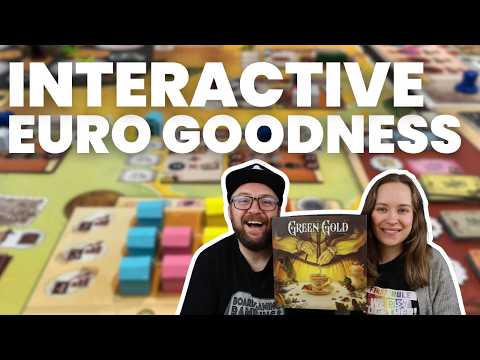
Reviewers describe Green Gold as a medium-weight economic game about tea trading in Victorian London, published by Ludonova and designed by the creator of Ada's Dream. The consensus across the discussions is that the game is more engaging than its box suggests, and that its strength depends heavily on player count. The Board Gaming Ramblings review, hosted by Johannes, found the two-player game underwhelming but came away much more positive after a four-player session. That reviewer's final verdict was an enthusiastic recommendation for groups, with the stock market and action layers working together well once more people are at the table.
The Board Gaming Ramblings monthly roundup placed Green Gold third on its September 2026 list, with the hosts calling it a fantastic game with a lot going on. The Totally Tabled preview was more cautious. That reviewer noted that pure economic games can be hit or miss, and said the tea theme and shorter play time were what sold the game. Across these perspectives, reviewers agree that the action system is clean and the interaction is meaningful, while they differ on how much the game needs a full group to shine.
Core Mechanics That Define Green Gold
Color-Linked Worker Placement
Green Gold uses a worker placement system in which the color of the worker you choose determines which company your action affects. Workers are placed into the first open row of their color, and reviewers describe the board as a rotating loop of actions that every player is trying to read. The available actions include buying shares, buying tea from different cities to fulfill contracts, building tea factories and trading ports, delivering tea to the royals, and negotiating in cities for new contracts and bonuses. Reviewers note that the system is looser than the color matching in Nippon. Players can pay to take a spot further along when the colors beside an action are not the ones they want, which gives the choice a cost rather than a hard restriction.
Reviewers also highlight the tension this creates around the middle of the board. Filling a row with a color returns those workers to the bag and grants a player power, and that can be used to block a rival's timing. In the Board Gaming Ramblings review, one reviewer described taking a gold space to deny others and then using the bonus action from that move to take a second gold, which left the resource out of circulation for several rounds. Publisher Ludonova's design gives this interaction real consequences without making it purely punitive.
Share Investment Tied to Actions
The second core system is the stock market. Each worker color corresponds to one of six companies, or five in a two-player game, and investing in a company buys shares whose value depends on how the rest of the game unfolds. Dividends push share prices up, so timing matters: a player may hold off on a move that would raise a price if the dividend would pay out to someone else. Reviewers stress that the game is not a pure stock game. Players who ignore shares entirely usually lose ground, but a player with fewer shares than an opponent is not instantly behind, because final scoring cards and other actions offer points elsewhere. Coins function as victory points, so every purchase and bonus contributes to the final tally. The game ends when three share spaces empty, a condition the reviewers say requires a heavy stock strategy that most groups do not pursue.
The Green Gold Experience
Tight Planning Under a Closing Clock
Green Gold feels like a race to fit the right actions into a limited number of turns. Each turn requires a different action than the last, which prevents players from repeating a favorite move such as buying shares or fulfilling contracts. Reviewers describe the moment when a player realizes the game is ending soon and has a list of planned actions that must be trimmed. That pressure gives the experience a sense of urgency that some reviewers found the most satisfying part of the design.
Meaningful Interaction Without Spite
Reviewers repeatedly contrast Green Gold with more confrontational games. The interaction is real, since taking a color can help a rival or hinder a stock you hold, but reviewers say most of it arises from players pursuing their own goals. Johannes of Board Gaming Ramblings said the interaction is not mean in the way that many multiplayer games are, and that the game can be a little mean without feeling like a pure attack on the other players. That balance gives the table a cooperative-competitive feel in which players watch each other closely while building their own engines.
What Makes Green Gold Stand Out
Interconnected Actions and Scoring
The most frequently praised feature is how every action connects to the stock market and final scoring. Moving a share price up or down through an action affects what that stock is worth at the end of the game, so a single decision can serve several goals at once. Reviewers describe this as a give and take in which players cannot invest in every color and must choose where their influence matters most. The Board Gaming Ramblings review said these elements are interconnected and interactive in a way that the reviewer particularly enjoyed, which the reviewers framed as a rare strength for a game in this genre.
Player Powers That Drive Replay
Reviewers consistently point to the player powers as the reason the game holds up over repeated sessions. Filling rows on a personal player board unlocks special abilities, some of which reviewers describe as very powerful in a positive way. Because the powers vary and change how each turn can be played, groups that return to the game find new combinations to explore. The Board Gaming Ramblings reviewers said the replay value comes from both the scoring and the player powers, and that it grows when the same group plays again and again.
Potential Drawbacks
A Weaker Two-Player Experience
Reviewers agree that Green Gold is at its best with three or four players. The Board Gaming Ramblings reviewers found their two-player game lackluster and felt that the box's 40 to 80 minute estimate could mislead buyers into expecting a lighter experience than the game delivers. Their four-player game ran around 105 minutes, and they believed it could be trimmed to about 90 to 95 minutes with experience. Players who primarily play two-player games should weigh this carefully before purchasing.
Refilling the Middle Row Is Fiddly
The most specific mechanical complaint in the discussions concerns the refill step at the end of each round. When a space in the middle of the board is empty, it must be refilled from a supply area, and reviewers found the physical movement awkward because the standing pieces must be shifted into place. The Board Gaming Ramblings review called this one of its biggest complaints, although it acknowledged that the arrangement looks attractive. Reviewers who value smooth table flow may find this step a recurring friction point during play.
If You Enjoy Green Gold
Players who enjoy Green Gold's color-linked worker placement will find similar satisfaction in Nippon, where the colors of workers determine which actions are available and players must think about who benefits from each choice. Players who enjoy the economic core of the game, including tea trading and investment, can explore more of the same designer's work in Ada's Dream, the earlier title from the designer of Green Gold that the Totally Tabled reviewer plans to play in a future video. Both recommendations are most useful for groups who want an interactive Euro with meaningful choices rather than a solitaire experience.
What Reviewers Are Saying
"Pure economic games can be pretty hit or miss for me. I really need a good hook. The fact that we're buying and selling tea is a bonus thematically, and the shorter play time seals the deal for me."
— Totally Tabled
"It has interaction with the other players in a way that isn't like mean, which I do enjoy. It can be mean. It can be a little mean, but you're doing stuff mostly because it's good for you, not solely to mess up the other player."
— Johannes, Board Gaming Ramblings
"The actions you do moves this up and down, which then at the end of the game will make those stocks go up higher. So everything is like a give and take, because you can't invest in all the colors."
— Johannes, Board Gaming Ramblings