


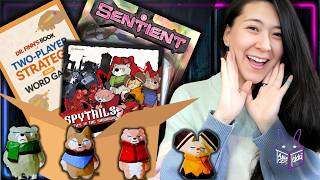


Dr. Finn's Book of Two-Player Strategy and Word Games Deep Dive
What the Community Thinks About Dr. Finn's Book of Two-Player Strategy and Word Games
Reviewers approach Dr. Finn's Book of Two-Player Strategy and Word Games as a compact, pencil-and-paper collection that delivers far more variety than its format suggests. Tabletop Tolson described the book as eight strategy and word games that each change shape from session to session, and the reviewer's enthusiasm carried through several days of play. Tabletop Tokki came away enthusiastic about several entries, calling Eloquacious a thinky, challenging game and praising the back-and-forth of Spell Track. Across the discussions, the shared view is that the book rewards players who enjoy word puzzles and abstract two-player tactics, while asking for some patience with its clue-driven and bidding-heavy designs.
Core Mechanics That Define Dr. Finn's Book of Two-Player Strategy and Word Games
Variable Boards That Reshape Each Game
Designer Steve Finn built each of the eight games around a playing surface that changes from one session to the next. Tabletop Tolson explained that every game offers eight variations on its map or board, which is the feature that makes the collection so replayable and so portable. In Detectorrists, players draw alternating lines that split a field of buckets into separate spaces, and the player with more detectors in each space earns the points, producing area control that builds slowly across the page. Speculators follows the same logic in a different form: one player cuts a set of monitors into regions, the other chooses, and only six of the eight monitors are used in any given game, so no two sessions look alike.
Cooperative Clue Giving in Eloquacious
Eloquacious is the only cooperative entry in the book, and reviewers spent the most time explaining its structure. Players work a crossword-style grid with some spaces blacked out and the word Eloquacious written vertically down the center. One player acts as the clue giver and offers three-word clues that lead the partner toward words meeting objectives such as a particular length, a corner of the board, or a fit between a wall and a black space. Tabletop Tokki noted that the challenge is demanding for both roles, since the giver has to compose a clue that points to the right word without spelling it out, and the receiver has to decode it under the same constraints. Tabletop Tolson summarized the goal as completing a set of tasks and reaching a dozen words before the team strikes out.
The Dr. Finn's Book of Two-Player Strategy and Word Games Experience
Thinky Tension
Several reviewers describe the book as mentally demanding in a satisfying way. Tabletop Tokki called Eloquacious a thinky, challenging game, and the tension is sharp whether a player is giving clues or solving them. The same reviewer described Quillseeker as a tricky word-capturing puzzle in which a player may take letters that make a weak word because doing so blocks the opponent from the good letters nearby. The feeling is less about raw speed and more about reading the other player accurately and deciding which pieces to take, which keeps each session engaging.
Playful Back-and-Forth Interaction
Reviewers also describe the book as conversational, with turns that keep both players watching each other. Tabletop Tokki praised Spell Track for its fun back-and-forth, explaining that because the game is drafting at heart, players must stay in tune with what the other person is building. Tabletop Tolson described sessions that were easy to fall into: the group started with one game, then played two in a row, and kept returning to the book through the week. Tolson noted that a second pass through each game is often more enjoyable because players remember what they tried before and can judge whether that approach worked. The result is a repeated cycle of short sessions in which each round sharpens the next.
What Makes Dr. Finn's Book of Two-Player Strategy and Word Games Stand Out
Portable, Tearable, and Quick to Teach
The physical format draws consistent praise. Tabletop Tolson estimated that each game takes roughly 20 to 30 minutes, and because the components are printed pages rather than a box of pieces, the book can travel on a plane or slide onto a bookshelf. Reviewers also highlighted the instructions. Tabletop Tolson said the rules for each game run one to three pages and are easy to follow, with only one game, Fishmongers, requiring a question to be resolved through the how-to-play video. Tabletop Tokki appreciated that each game comes with a video tutorial, which helps players who do not want to read through every rule before sitting down.
Eight Distinct Playstyles in One Book
Reviewers stress how different the eight entries feel from one another. Tabletop Tokki moved from the word capture of Quillseeker and Spell Track to the bidding of Fishmongers and described the set as a collection that covers word building, market games, and abstract strategy. Tabletop Tolson pointed to a tic-tac-toe game played on a grid of grids and to Speculators, a market game in which players invest in currencies, and said that a reader can choose a game to match the mood of the evening. Tabletop Tokki compared the nested tic-tac-toe board to 3D chess, a reference that captures how movement between sub-boards shapes every choice. The variety means the book rarely feels like eight versions of the same idea.
Potential Drawbacks
Pages That Are Used Up by Play
Because several games are meant to be played on pages that players tear or cut, reviewers noted that the book works best with a plan for keeping it intact. Tabletop Tolson advised tearing the pages rather than using scissors, which keeps the book portable but means each printed board is consumed by a single play. Tabletop Tokki planned to laminate the pages so they could be reused, and the book itself includes tips for laminating. Players who want to preserve the set for repeated sessions should expect to add sleeves, a laminator, or a spare copy to their setup.
Rules Clarity in Fishmongers
Some reviewers found one set of rules less clear than the rest of the book. Tabletop Tolson was the only reviewer to raise a question about the rules, and it concerned the bidding in Fishmongers. Under the bidding system, one player names an amount to choose between two trays, and the other player may decline, in which case they pay the bid and choose first. Tabletop Tolson described this as the one element that seemed to be left out of the rulebook, even though the rest of the games were straightforward to learn.
If You Enjoy Dr. Finn's Book of Two-Player Strategy and Word Games
Players who enjoy the clue giving at the center of Eloquacious will find familiar territory in Codenames. Tabletop Tolson made that comparison directly, noting a love of clue-based games like Code Names when describing the cooperative word game. Players who enjoy Eloquacious's mix of word construction and partner communication will recognize the same appeal of trying to convey an idea through a few carefully chosen words. Those who appreciate the book's variety of strategy and word games can treat Codenames as a sibling experience while still finding the pencil-and-paper format in Dr. Finn's Book of Two-Player Strategy and Word Games distinct.
What Reviewers Are Saying
"And each of those games offers eight variations on the map or the board that you play on to make every single iteration of that game different. And that's what makes this so replayable and so portable."
— Tabletop Tolson
"This was a thinky, challenging game, especially as the clue giver, but also as the receiver. And if you like word games and you are intrigued by the idea of a two-player cooperative word game, this is definitely one that you're not going to want to pass up."
— Tabletop Tokki
"Both players win or lose together. Try to complete tasks before getting three strikes. You have a clue giver and a responder. Oh, this might be my new favorite quick two-player game to play."
— Tabletop Tokki