



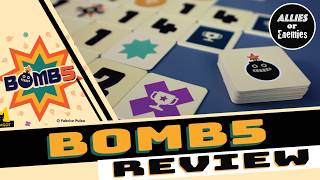
BOMB5 Deep Dive
What the Community Thinks About BOMB5
Reviewers agree that BOMB5 is a fast, approachable game that trades depth for chaos. Designed by Fabrice Arcolio and published by Matagot, it asks players to place numbered tiles so that adjacent totals reach five, then reward or punish themselves with a hidden bomb. The reviewers covered here treat that simple core as the point of the game rather than a flaw. Shawn, Allies or Enemies calls it one of the fastest how-to-plays they have done and says it sits alongside Sea Salt and Paper and Scout as a game they teach to almost anyone.
The disagreement is mostly about how much the randomness matters. Allies or Enemies places BOMB5 on a top-ten list of games from the year and credits its ease of teaching as the main reason it was played so often. The Dice Tower's Tom Vasel, reviewing it in a rapid-fire round of thirty-three games, is more lukewarm, describing it as a kind of Scrabble with numbers and saying it was an amusing little game that they would not want to play all the time. Both views hold up: the game rewards quick, lively tables, and it wears thin for players who want to plan several turns ahead.
Core Mechanics That Define BOMB5
Numbered Tiles That Must Sum to Five
The central action is placing a tile so that a connected run of numbers totals exactly five. Shawn explains that the tiles run from one to four, but the distribution is uneven, with more ones than fours in the set. That matters because a hand full of ones rarely completes a five, while twos and threes are easy to play. Shawn notes that this unevenness is the source of most of the frustration in a game, though the short turns keep it from hurting much. The total-to-five rule is what gives BOMB5 its name and its constant small puzzle, since each turn asks the player to read the board and the three tiles in hand at once.
Bombs That Flip the Board
Completing a five lets a player add one of their cups and then flip a bomb, which triggers an effect that can reshape the board. Shawn describes how a bomb can blow up everything on either side of it, and how a player can orient it to avoid flipping their own cups. Allies or Enemies adds that the bombs activate in different ways: some flip everything in their row and column, while others let the player choose any bomb or any trophy to flip. Because the bomb effects are hidden until they are revealed, the board is never fully predictable, and that uncertainty is what keeps a two-player game interesting from one turn to the next.
The BOMB5 Experience
Quick, Light Chaos
Playing BOMB5 feels brisk and a little anarchic. Turns move quickly, and the bombs make it easy for a single play to undo several turns of progress. Shawn says that everything a player does is hoped to help them while also hoping to hurt everyone else, and calls the result a lot of fun chaos. The reviewers describe a light, social tone that suits a pub table or a casual evening, where the swings of fortune are part of the entertainment rather than a source of frustration.
A Tense Race to the Fifth Cup
The end of the game changes the feel considerably. Once a player approaches the goal of five cups face up, the rest of the table begins to target them. Shawn describes how at five players the chaos is amplified and the leader is clawed back by everyone else, making the last cup difficult to reach. At two players, the game is more strategic, since players can see what the opponent is doing and plan a few moves ahead. Allies or Enemies also highlights the strategic side of the game, noting that the player who is more skilled still has the edge over a random hand.
What Makes BOMB5 Stand Out
Speed and Ease of Teaching
Reviewers consistently point to how little time BOMB5 needs to explain and to play. Shawn says that anyone can join in right away, and that a new player will usually understand the game by their second or third turn. Allies or Enemies describes the game as an abstract, pretty, and easy-to-teach experience that can be played with many different groups. For a party or a mixed crowd, that low barrier is the main reason reviewers return to it.
Scaling From Two to Five Players
The reviewers appreciate that the game changes meaningfully with player count rather than simply getting longer. Shawn notes that two players can plan around the numbers in their hand, while five players create a crowd of bombs going off before each turn. Shawn suggests that the two-player version may appeal to buyers who want a strategic duel, while larger groups will find the bigger table more fun. Both experiences hold up according to the reviewers, though they feel quite different.
Potential Drawbacks
Uneven Numbers and Stuck Hands
The most common criticism is the number distribution. Shawn explains that because there are more ones and fewer fours, a player who draws several ones can find that no legal placement makes a five. Shawn argues that this is the worst situation in the game, though the speed of play means it rarely lasts long enough to be a serious problem. Tom Vasel's review leans on a similar theme of randomness, which Vasel treats as a reason the game does not hold their interest for long.
Table Space at Full Player Count
Shawn also raises a practical concern. The compact box and thick tiles make BOMB5 feel like a perfect small pub game, but the layout grows quickly with five players. Shawn has run out of space on a small table and says a full picnic table is needed at that count. Two or three players avoid the problem, which is why reviewers suggest the game for smaller tables when space is limited.
If You Enjoy BOMB5
Reviewers who like BOMB5 tend to also enjoy quick, chaotic games that reward reading the table. Shawn places it alongside Sea Salt and Paper and Scout, two titles they regularly teach to new groups because they are short, clever, and easy to explain. Allies or Enemies compares the bomb effects to Bomberman and Mind Sweeper, describing the feeling of managing constantly shifting hazards on a grid. Players who enjoy that kind of comfortable, tactical chaos will likely find a good fit in these titles.
What Reviewers Are Saying
"This is a game though that there is some strategy to and you are going to win more likely if you're the better player. That said, there is also a lot of randomness that comes up in this game because you can definitely get a bad hand. You can get a good hand, you can get a perfect setup where one number is going to get you two cups plus a bomb."
— Shawn, Allies or Enemies
"I became enamored with this game early in the year because it's a really easy game to teach. You've got just this bomb. You got numbers around the bomb. You're adding numbers from your hand."
— Allies or Enemies
"It was an amusing little game. I don't know that I would want to play it all the time, but I was amused by it."
— Tom Vasel, The Dice Tower