



Microcosm Deep Dive
What the Community Thinks About Microcosm
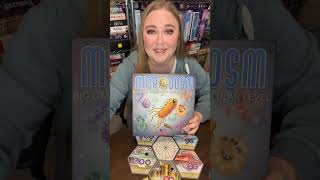
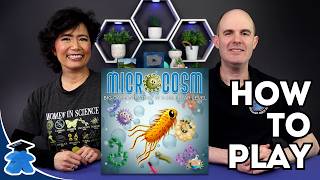
Early reviews of Microcosm, the 2026 science-themed game published by Microcosm Games, come from reviewers who looked at the game shortly after its launch. The Meeple University walkthrough treats the game as a teaching tool as much as a game. It opens with a short skit about the oxygen cycle, then explains how players build chemical cycles across a set of biomes. Tabletoptiktok takes a more enthusiast's view, describing a prototype that arrived before release and praising the way the game wraps familiar chain-building and multiplier ideas in a science theme.
The two reviewers agree on the core appeal: the science is the setting, and the chain logic is the game. Both emphasize that a player does not need a chemistry background to follow the play. They differ in emphasis. Meeple University presents a detailed, rules-first explanation and stresses how much structure sits beneath each turn. Tabletoptiktok is more concerned with how the theme lands for players outside the sciences, even while describing the underlying play as easy to recognize.
Core Mechanics That Define Microcosm
Chain Building Through Metabolize
Meeple University explains that the main primary action is called metabolize. A player plays a microbe card into any of the six biomes, provided the microbe can survive the biome's environment by matching at least one trait and the chemical it consumes is currently present there. The card takes the chemicals it consumes and the player places markers equal to its doubling time. Chains grow when a new card is played on top of an existing one and consumes a chemical that the card below produces. The reviewer also notes that each chemical can sit in only one cycle at a time, which forces players to decide where their growth goes. The system was designed by Fatima Foflonker, an assistant professor at Clark Atlanta University who teaches microbiology, and it is published by Microcosm Games.
Population Doubling and Symbiosis Scoring
Scoring is driven by the end of each round. Meeple University describes how the bottom card of each branch is checked, and when its last player marker leaves the center, the microbe population in that chain doubles. When a cycle is complete, every player with cards in it scores the energy value of each chemical equation multiplied by the cycle's population value. The returned microbes can then be evolved and returned to hand, or archived to a graveyard where they score points equal to their doubling time at the end of the game. This loop between growth, scoring, and recycling cards is the engine that the reviewers keep returning to.
The Microcosm Experience
The Tension of a Living System
Both reviewers describe a constant balancing act. Growth is rewarded, but growth can also go wrong. Meeple University lays out the collapse rule: if a single card or a biome's central tile reaches 16 of the same resource, the biome collapses and everything in it is discarded. Tabletoptiktok frames this as the main danger of the game, saying that players want to avoid total collapse because it is bad for everyone involved. The experience is described as one of watching populations swell while constantly checking whether they are about to overrun the system.
The Satisfaction of Closing a Loop
When a chain finally returns to its starting chemical, the mood changes. Meeple University describes the moment as the point where the microcosm stabilizes and every contributor scores. Tabletoptiktok says the pleasure comes from getting the most out of a piece with the best multiplier, and from seeing one play set up the next. Players who enjoy assembling a clever sequence and watching it pay off at round's end will likely find this the most rewarding part of a session.
What Makes Microcosm Stand Out
Evolving Cards Between Rounds
Tabletoptiktok singles out the evolution system as one of the most appealing parts of the design. When a biome completes a cycle, the cards return to hand, and a player can take one of two mutation magnets from the biome and add it to a card. Tabletoptiktok calls out that these mutations "lets you have an ability or an upgrade" when the card returns to play. Meeple University adds the rules detail that a card can carry at most two mutation markers, and that the harder third-tier biomes effectively require mutated cards because they demand matching two icons at once.
Science Wrapped Around Familiar Engine Play
Both reviewers praise the way the theme teaches without demanding expertise. Tabletoptiktok points out that the game draws on ideas players already know, such as chains, multipliers, and point engines, saying the real science in the theme is a bonus. Meeple University opens its explanation with a deliberately simplified sketch of the oxygen cycle, a choice that makes the core idea approachable before any rules are introduced. Reviewers agree that this gives the game a distinct identity among chain-building designs.
Potential Drawbacks
Theme Accessibility for Non-Scientists
Tabletoptiktok is candid that the theme can be a barrier, saying that for players who are not in the science fields, the game can seem confusing at first, and comparing the feeling to learning a Lord of the Rings game when the setting does not connect right away. The mechanics are argued to be familiar enough to overcome this, though the connection between the subject matter and the play may take time for some groups to build.
A Layered Rules Load
Meeple University's walkthrough makes clear how many moving parts a player must track. Secondary actions, a range of alternative discard effects, and a multi-step end-of-round sequence all interact, and the reviewer intentionally defers several alternative actions until the chain and round structure has been explained. Both reviewers also describe an early version of the game that was not final, so details of the rules and components may change before release. Players who prefer lighter rules may need a few sessions before the full system feels comfortable.
If You Enjoy Microcosm
Players who enjoy Microcosm's chain-building will gravitate toward it for the same reason Tabletoptiktok did: the pleasure of linking one small play into the next until a round-ending payoff lands. Those drawn to the doubling and symbiosis scoring will appreciate how Meeple University's walkthrough ties every placement back to an eventual multiplier, and fans of the mutation system will find the appeal in watching a card return from the graveyard with a new ability attached, upgraded rather than discarded.
What Reviewers Are Saying
"Play cards which can survive the environment they're in, and which will consume the current form of the given cycle chemical. Wait a long enough to watch your populations thrive and grow and chain cards together until they form a completed cycle. Once a chain cycles back to its original form, the microcosm stabilizes and everyone who contributed will score."
— Meeple University
"So, don't let the fact that you may not be a chemist or understand microcosms and micro environments and things like that confuse you. You are creating chains. You are building from one thing to the next."
— Tabletoptiktok
"Finally, there is a limit to the populations that your little microcosms can sustain. If at any time a single card within a biome has 16 or more of the same resource or the central tile has 16 or more of the same resource then that biome collapses."
— Meeple University