


1st CEO Deep Dive
What the Community Thinks About 1st CEO
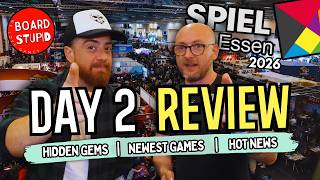
Reviewers agree on the central promise of 1st CEO, the economic strategy game from Good Game Studio in which every player runs a corporation by buying branches and shares in rival companies. The most detailed hands-on reactions come from Board Stupid, whose hosts Wayne and Matt played the game at Spiel. In their day two episode, they described playing a complete game with the designer in roughly 25 to 30 minutes, then bought a copy themselves. Their enthusiasm centers on how cleanly the rules deliver a market-style game in a short session.
TheGameBoyGeek approached the game from a different angle. Its Spiel preview named 1st CEO among the most anticipated releases of the show, but that assessment rested on the game's description rather than on play. The channel framed it as a pure economic game that looks streamlined mechanically yet carries layered scoring. Readers should weigh the preview read and the hands-on accounts accordingly, since the hands-on accounts are the ones that describe how the game actually plays.
Core Mechanics That Define 1st CEO
Share Purchases and Dividends
Stock trading sits at the center of 1st CEO. On a turn, Board Stupid explained, a player can buy a share of a company from the market or buy a share from another player, and the amount of money a player holds determines what they can afford to do. The cross-ownership is what drives the system. When a company collects income, that income is distributed as dividends to every shareholder, so a player who owns a rival's shares earns from that rival's success. Board Stupid also described companies moving up tracks over the course of play, so the final value of each share reflects how each company performed. TheGameBoyGeek summarized the loop as buying businesses, selling shares to other players, and collecting dividends while managing both companies and shares.
Branches, Headquarters Revenue and Combo Scoring
The second system centers on the companies themselves. Players spend capital to acquire branches, and TheGameBoyGeek noted that each branch introduces unique scoring rules and generates consistent revenue. Income from a company's headquarters is split proportionally among everyone who holds that company's stock. Because owned branches can change how a company scores in relation to the other companies a player controls, the scoring has two layers, one based on share value and one based on company performance. TheGameBoyGeek described the choice as whether to focus on shares, focus on company scoring, or combine the two into a scoring combo. That choice gives the mechanic its strategic weight.
The 1st CEO Experience
A Brisk, Never-Idle Tempo
Board Stupid stressed how fast the game moves. Because other players' income is paid out as dividends, a player is rarely waiting for a turn to pass, and the hosts described the flow as so smooth that they are literally never stopping. A session of roughly half an hour keeps the game light on the table while still absorbing. Board Stupid also found the rules very easy to explain and understand, which gives the experience a focused, brisk feel rather than a slow accumulation of bookkeeping.
Corporate Satire With Real Stakes
The tone of the game is playful. Board Stupid found the company names entertaining, calling them absolutely hilarious and pointing to names that stand in for familiar brands such as Amazon and Netflix. Beneath the humor, the stakes are serious. Because every player is buying into rival companies, a successful competitor can become a source of income, and investing in an opponent is a constant judgment about whose fortunes to back. The result is a lighthearted table that still rewards sharp business instincts.
What Makes 1st CEO Stand Out
Simple Rules With Depth Underneath
The most repeated praise is that 1st CEO looks simple but rewards study. Board Stupid called it a well-developed stocks and shares game that is very straightforward on the surface yet holds quite a lot under the hood. TheGameBoyGeek similarly described the design as streamlined mechanically while noting that the interplay between share scoring and company scoring creates real decisions. Reviewers appear to value this balance between a fast ruleset and a decision space that rewards planning.
A Full Economic Game in Roughly Half an Hour
Board Stupid returned to the play length more than once. The day two episode reported that a complete game took about 25 minutes with the designer, and the wrap-up episode described the game as one that plays in half an hour. That short runtime lets a group run through a full market cycle in a single sitting, which makes 1st CEO a practical choice for players who want economic depth without a long setup or a long commitment.
Potential Drawbacks
Abstraction Over Theme
Reviewers did not present 1st CEO as a thematic experience. Board Stupid called it a highly abstracted economy, and TheGameBoyGeek described it as a pure economic game. Those descriptions suggest the appeal lies in the financial loop of buying, dividends, and valuation rather than in narrative or flavor. Players who look for an immersive theme may find the experience more like a market simulation than a story. The reviewers in this material did not treat that as a fault, but it is a fair expectation to set before sitting down.
Layered Scoring and a Small Publisher
TheGameBoyGeek pointed to the layered scoring as something players must weigh during planning, describing two different push and pulls between shares and company scoring. Understanding how those tracks interact requires attention from the first turn. The game also comes from Good Game Studio, which TheGameBoyGeek described as a small company, and it has a narrower body of reviews than established titles. Board Stupid's own description of the purchase as a low-risk punt reflects that uncertainty, so prospective buyers may want to try a demo before committing.
If You Enjoy 1st CEO
Reviewers did not name a comparison title for 1st CEO, so the most useful guide is the kind of player they describe. Fans of stock-market and economic strategy games are likely to be drawn to the same features: buying into rivals, earning dividends from other players' income, and watching company values settle at the end of the game. Board Stupid's willingness to call it a low-risk punt suggests it suits groups who enjoy discovering a compact, unfamiliar title at a convention or demo table. Players who enjoy scoring that rewards building around more than one source of points, as TheGameBoyGeek described, should also find the design appealing.
What Reviewers Are Saying
"This looks really interesting because it's a pure economic game. It looks pretty streamlined mechanically, but the fact that you're that you're, you know, you're buying things, you're selling shares to other people, you're you're you're getting dividends, but you're also managing both companies and shares."
— TheGameBoyGeek
"Really fabulous little game that is very straightforward but has quite a lot I think under the hood. I think there's quite a lot to get into in such a simple game."
— Board Stupid
"This is a sort of a highly abstracted economy. It's a stocks and shares game. And I love me some stocks and shares."
— Board Stupid