






Junk 'n Gems Deep Dive
What the Community Thinks About Junk 'n Gems
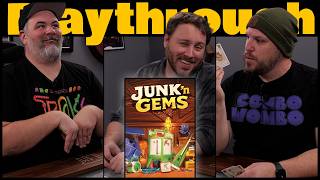
Junk 'n Gems is a card shedding game for one to four players, designed by Kim Sorensimo and published by Passion Project GG. Reviewers treat it as a deliberate step up from the lighter end of the genre, with more rules to learn and more decisions once play begins. The most detailed opinion comes from Chairman of the Board, who received an early prototype and approached the game without prior expectations. The channel argues that card shedding has become saturated with similar titles, so a game that adds more moving parts can stand out. It also suggests that the extra complexity is aimed at a niche of gamers rather than casual players, and it praises the cards and the overall polish of the prototype.
kovray teaches the game from start to finish, covering setup, the swap and set actions, the scoring banners, and the optional modes. Its walkthrough is the most complete picture of how the rules fit together, and it shows why reviewers describe the game as having several interacting layers.
Board Gaming Ramblings named Junk 'n Gems among the games it played in its October Game of the Month roundup. That segment only lists the title and gives no assessment, so this overview does not attribute any opinion to it.
Core Mechanics That Define Junk 'n Gems
The Point-Threshold Go-Out Rule
The goal is familiar: empty your hand before the other players. Passion Project GG adds a condition that changes the timing of the round. According to kovray, a player must hold enough points in their play area before going out, and that requirement rises from six points in round one to seven, eight, and nine in the following rounds. Reaching the threshold does not end the round by itself, because the player must still play the final card from hand. Chairman of the Board makes the same point by noting that a player needs to reach a points threshold before being eligible to go out at all. When someone goes out, that player scores all the points collected that round while everyone else scores half, rounded up. The game ends when a player reaches the overall threshold, which is 20 points with one or two players and 15 points with three or four players, or after four rounds. The player with the most points wins.
Swapping, Sets, and a Layer of Engine Building
On a turn, a player either swaps or plays a set. A swap places one card from hand into the attic, then takes one or two attic cards whose combined value is higher than the card placed but no more than twice its value. Chairman of the Board calls this swapping mechanism quirky, and it is the main way players reshape their hands. A set is built from same-colored cards that total a color-specific value: brown requires five, green and blue require six, and orange and purple require seven. Wild cards can stand in for any color. After a set is formed, all but one card are discarded, and the kept card enters the player's play area with an instant or ongoing ability. Chairman of the Board notes that these abilities can be game-breaking, such as changing the target points value or buying three cards with a single action during a swap. Dark-bordered cards can also be tucked under the player aid at round's end, where their ongoing ability stays active for the rest of the game. According to kovray, those tucked cards score only when their ability grants points. Chairman of the Board describes the result as a small hint of engine building, where earlier sets open up options for later turns.
The Junk 'n Gems Experience
Tension Around Going Out
Because going out depends on both the hand and the points total, a player can be ready on points and still be stuck with cards to play. That gap keeps the endgame open until the last card leaves the hand. Chairman of the Board says the swapping, the points threshold, and the engine building give the game more moving parts than most card shedding titles, yet the game remains "very easy to digest." The reviewer frames this balance as the main appeal, since the rules add decisions without making each turn difficult to follow.
A Slow Build Toward a Richer Engine
Chairman of the Board describes the progression as drip-fed. Every player starts from the same position, but each set played adds another ability to the table, so the options available late in the game are shaped by earlier choices. Each round also raises the points target, which pushes players to plan for a higher threshold as the game advances. The reviewer says the more sets a player plays, the more they can do with their previous efforts, which gives the game a sense of growing capability.
What Makes Junk 'n Gems Stand Out
Family Mode and Solo Mode
kovray highlights a streamlined family mode that removes the dark-bordered cards to simplify both abilities and scoring. This gives groups a lighter route into the same core system. The solo mode lets one player compete against the sheriff, an automated opponent controlled by its own solo deck that determines its actions each turn. Chairman of the Board also confirms the solo mode and says the game offers more substance than most card shedders, which tend to be breezy throwaway experiences.
House Rules and Polished Production
Chairman of the Board says the game gives players the freedom to house rule it. A group that wants a shorter session can play a single round, or score the most points after two rounds. The reviewer also praises the components, describing the cards as lovely and the prototype as fairly polished. The 45-minute playtime printed on the box may be shorter in practice, since the reviewer believes it can be trimmed.
Potential Drawbacks
- Complexity above typical shedding games. Chairman of the Board says the game is a step above most card shedding titles in complexity. The rules add swapping, set scoring, a points threshold, and abilities that can change the course of a round. kovray's walkthrough must cover many instant and ongoing abilities and refers players to the rulebook's card clarification section for questions, which shows how much rules detail sits behind the surface.
- May not suit a casual audience. Chairman of the Board suggests the design is aimed more at gamers than at casual players, and that the genre's breezy titles are a different kind of experience. The reviewer sees the niche focus as a potential advantage, but it also means the game may not appeal to people who want a quick, light shedding game with minimal setup and rules.
If You Enjoy Junk 'n Gems
The reviews do not name specific comparison titles, so these suggestions follow the genre signals in the discussions. The clearest audience is players who like card shedding games but want a little more depth. Reviewers describe the appeal as a shedding core paired with a scoring layer that rewards planning across several turns, through sets, scoring banners, and abilities that accumulate in the play area. Chairman of the Board says the game suits anyone who wants the next step up in card shedding, with a bit of set collection and a bit of engine building. Players who value a streamlined experience can start with the family mode, which removes the dark-bordered cards, before moving to the full rules.
What Reviewers Are Saying
"Now, this one is certainly a step above in terms of its complexity to a lot of other card shedding style games. And that may work in this favor in this particular and niche example."
— Chairman of the Board
"And as mentioned, simply reaching the requirement does not end the round. You'll still need to get rid of the final card in your hand."
— kovray
"For a more streamlined experience, you can play the family mode, which removes the dark-bordered cards to simplify abilities and scoring. There is also a solo mode, where you'll be able to compete against the sheriff, an automated opponent controlled by its own solo deck that determines the actions it takes each turn."
— kovray