




Max Miller's Tasting History: The Board Game Deep Dive
What the Community Thinks About Max Miller's Tasting History: The Board Game
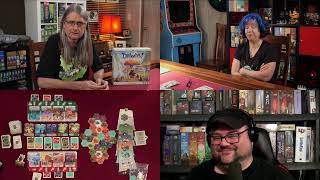
Early coverage of Max Miller's Tasting History: The Board Game comes from sponsored previews and gameplay sessions, and the reviewers approach it as a work in progress. Professor Meg, presenting the game on Professor Meg, BoardGameCo, showed a prototype copy and stressed that its rules, components, and other details were all subject to change. The game is published by Salt Games and is a crowdfunding project built on the Tasting History YouTube channel, where Max Miller cooks recipes drawn from different periods of history.
The overall tone is curiosity more than verdict. The BoardGameCo news and review segment describes the game as one about set collection and recipe fulfillment, and the reviewer believed the prototype would move from five rounds to four. The BoardGameGeek stream is a segment in which the hosts had not yet watched the game's previews. They were looking forward to learning it, but acknowledged that because the rules were not finalized, teaching it would be a challenge. Taken together, the community reads Tasting History as a thematically distinctive design whose final rules and depth are still to be confirmed.
Core Mechanics That Define Max Miller's Tasting History: The Board Game
Worker Placement With Advancing Locations
Worker placement is the engine of the game. Each round, players take turns placing a chef, which Professor Meg also calls a meeple, onto a location on the shared board. Workers are not blocked by one another, so several chefs can occupy the same space. Each location grants a resource such as meat, milk, spice, or fish, and some locations offer chained actions, such as trading a fish and a spice for the special ingredient garum. Events played at the start of each round add temporary resources, usually knowledge, that are removed at the end of the round, and those events help guide where chefs are placed.
The advancement system is what gives the placement its long-term weight. On rounds two and four, players add an advancement token to each area, so a location that began with a single resource gains a chain of options. Professor Meg described the locations as growing stronger as the rounds progress, which means that an early placement can look very different from a late one. Players also have a feast card that provides starting ingredients and three goals, and completing all three unlocks a special ability that adds another place for a chef.
Specialization and Challenge Cards
Each player begins with a specialization, a hidden card gained in round one. Professor Meg explained that a specialization might score one victory point for each fruit icon in a player's completed recipes, which pushes the player toward particular ingredients and recipes. In round three, players draw a challenge card, such as Grand Cuisine, which scores two points for each completed recipe that contains six or more basic ingredients. Both cards are secret until the end of the game, and Professor Meg characterized the points they provide as crucial to determining the winner. Completed recipes go into a personal area where they count toward these cards, so the scoring rewards a steady plan that gathers ingredients for the right recipes throughout the game.
The Max Miller's Tasting History Experience
Cooking Through a Historical Menu
The game's theme is strongest in the details that change with the historical setting. Professor Meg showed an ancient Roman layout in which the recipes are based on foods from that period, including Caligula's golden pork belly and a Roman hamburger, and the board's locations change to match whichever era players select. Feast cards, such as the final feast of Commodus, shape each player's starting resources and goals. The result feels less like abstract resource gathering and more like assembling a historical menu one dish at a time.
A Tight Race for Recipes and Ingredients
Recipes sit in a shared market, so the play has an edge of competition. Professor Meg noted that if a player is working toward a recipe that needs many ingredients, that player must complete it quickly, because anyone else can complete it on their own turn. Each turn also involves a balancing act across ingredients, worker placement, insight cards, and the feast card. Professor Meg described the game as a constant effort to balance those resources, and the need to track many systems at once makes each turn demanding.
What Makes Max Miller's Tasting History Stand Out
Multiple Historical Eras
The choice of era stands out as the feature reviewers keep returning to. Professor Meg confirmed that the game includes Ancient Rome, Medieval Europe, and the American Frontier, and singled out the time-period structure as the feature that makes the game unique. Because the setting changes what locations, feasts, and recipes are available, each era is expected to produce a different game. Because the eras are presented as distinct settings, they point toward replayability, although the coverage has not yet shown how much the eras differ in long-term play.
A Tie-In With the Tasting History Channel
The connection to Max Miller's YouTube channel is the second feature reviewers mention. The BoardGameCo news segment introduced the game by noting that Max Miller runs the YouTube channel Tasting History, and that the game comes from Max Miller. The BoardGameGeek hosts were curious about the designer after learning that Max Miller is a YouTuber who made a game, and they planned to watch the Tasting History channel as a reference point before the publisher's visit. For viewers already familiar with the channel, the game extends a series they know into a tabletop format.
Potential Drawbacks
Prototype Rules and Components
The clearest concern raised in the previews is that the game is not yet finished. Professor Meg presented a prototype copy and stated that all rules and components are subject to change. The BoardGameCo segment described the game as still changing, with the round structure possibly moving from five rounds to four. The BoardGameGeek hosts also noted that the rules were not finalized, which made preparing to teach the game more difficult. Reviewers therefore cannot yet judge how the final rules will affect balance or clarity.
Depth That Depends on Gameplay Footage
The game has many interacting systems, and reviewers suggest that some of them are easier to understand in action. Insight cards can be played during a turn for bonuses, some recipes unlock extra rewards when players pay additional knowledge or special ingredients, and the chained advancements grow more complex as the game moves on. Professor Meg explained the basics and then recommended the separate gameplay video, noting that many of the ways players use insight cards are best seen during play. Viewers who are not interested in watching gameplay may find the rules density harder to absorb from previews alone.
If You Enjoy Max Miller's Tasting History
The transcripts do not draw a direct title-to-title comparison, so these suggestions follow the genre features reviewers described. Players who enjoy worker placement will recognize the core loop, in which chefs claim spaces that become more valuable as advancements arrive. Players who like set collection and recipe fulfillment will find the shared recipe market and hidden end-game scoring familiar. Fans of cooking and history themes will appreciate that the setting shapes the rules, not just the artwork, which makes Tasting History a good choice for groups that want a theme with real mechanical weight.
What Reviewers Are Saying
"But, what's going to make it extremely unique is that you are playing within these different time periods. So, in front of me I do have ancient Rome which you're going to be able to see with all of these different recipes of foods that they had back then."
— Professor Meg, BoardGameCo
"Although prototype, I believe they're actually changing it to four rounds. But it's a game about trying to set collection and recipe fulfillment."
— BoardGameCo
"I'm actually intrigued by the tasting history. I want to know what that means. I need to watch the videos and I might know more about them."
— BoardGameGeek