Stonespine Architects - How To Play
Games in This Video
1 game is featured in this video — it unlocks as you watch.
Transcript
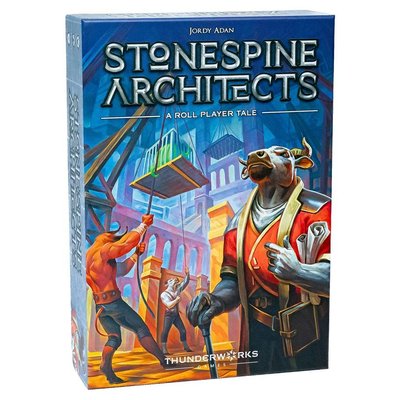
hi and welcome to watch it played my name is Rodney Smith and in this video we're going to learn the one to five player game Stone spine Architects designed by Georgie aen and published by thunderworks games who helps sponsor this video as a minur architect in the Queen's employee you've been tasked with building a dungeon worthy of challenging the most ambitious Heroes and the one amongst you who can prove yourself most capable will earn the title of Master architect so grab your Blueprints and tools join me at the table and let's learn how to play to set up put this tracking board in the center of the play area the side for solo play has this single icon in the corner so flip the board over if you have two to five players in this video we'll assume that we have three each player now collects two dungeon frames a set of double-sided player reference cards and the tracking markers and doorway pieces in their chosen color assemble the frame like this and then collect one of each player's markers mix and randomly Place one from left to right onto the empty spaces of this priority display found on the tracking board then using this table found in the rule book which is also here on your player reference set each player's other marker onto the indicated spaces of this gold track based on each player's position on the priority track blue which is in the first position starts on zero while green and yellow both start on one stacked in any order
the cards with this back are the goals which you'll Shuffle dealing one face up onto the space here returning the rest back to the Box the cards with this back are the challenges which you'll Shuffle dealing a number of them face up based on this table in the rule book and also found here on your player Aid so in our three player game we would deal four of these cards face up and the rest we leave in a face down deck nearby also nearby create a supply of these Market tokens ensuring they're face down mixed thoroughly and sorted by shape here I'm using the games included trade to organize them next find the deck of Market cards which have this back Shuffle these and using this chart found in the rule book and here on your player reference deal a number of them face up based on your player count so two in this case since we have three players the rest of the deck you'll keep face down nearby now draw and place face up Market tokens from the supply that match each of the shapes found on each of the market cards so that it looks something like this when you're done the cards with this back are the blueprints Shuffle and deal one to each player which they'll set face up in front of thems once each player has been given one the rest you'll return to the Box your blueprint will be made up of four Columns of squares which match the four sections of your dungeon frame and one of these columns will have a doorway
icon above it you'll now Place one of your doorway markers into that position on your dungeon frame your other doorway you'll use later finally Shuffle the chamber cards which have this back into a face down deck and deal each player five cards from it you can always look at your own chamber cards but keep them a secret from the other players and that's the setup in ston spine Architects you and the other players will be constructing dungeons filled with traps monsters and treasure all in an effort to score points in a variety of ways that we'll learn about as we go have the most points by the end of the game and you'll win at the beginning your dungeon is empty but by the end it will look something like this containing exactly 16 chamber cards arranged in a 4x4 grid grid with an entrance and an exit and several tokens placed throughout before we get into the main rules I'd like to provide you with a tour of some key dungeon features your dungeon will be made up of several chamber cards these always show a picture of the chamber in this area and below that you'll find its name and a gold value each chamber will come from one of two possible types caves like this one will show this symbol in the corner and have a brown shade to its chamber art work and the other type is Stone like this one which shows this symbol and has a bluish gray art style Chambers will have doors within their artwork which look like this as well as
paths that connect the doors or in some cases like we see here paths that just come to a dead end finally each chamber has between zero to four elements printed on it elements can be different traps like we see here or you may also find a variety of monsters like these Chambers show you can also find treasure chests scattered around and finally what are known as reputation Stars which can be either positive values in gold or negative values in Gray your player reference cards will show you what each symbol in the game represents so if you need a reminder just refer here when playing for now though the important thing I want you to remember is that each chamber will have between Zer to four printed elements for example this one here has two and this one has has three either way those elements will always be found in some combination of these four positions within the chamber we'll see why all of this is important soon enough but for now the tour is over stonespine Architects is played over a series of four rounds known as years and each year is divided into three phases starting with the construction phase here each player privately examines their hand of chamber cards and picks one they wish to add to their dungeon placing it face down in front of thems once everyone has chosen a card players will reveal them simultaneously placing their chosen chamber into their dungeon during a year or round as it's also
known all chamber cards you place must go into a single Row the top row right below the dungeon frame in the first year but each one can be placed in any open position there for example I could place this one I revealed right here we'll learn why might want to put Chambers in certain locations a little later just know once placed a chamber can't be moved so during the construction phase each player picks a card to reveal and place in their dungeon however in a two-player game and only in a two-player game each person picks two cards from their hand one that they'll reveal and add to their dungeon and the other that they'll add to a shared discard pile by the draw deck no matter the player counts after adding a chamber to their dungeon each person passes the remaining cards in their hand to the next player in clockwise order so that everyone receives a new hand of cards now here again there is an extra step in just a two-player game after passing both players each draw a new single card from the deck to add to their hand either way after cards have been passed players again repeat the steps of this phase picking and placing a card face down and then when everyone's ready revealing and adding them to their dungeon and don't forget in a two-player game You' be picking two cards one to add to your dungeon and one to discard either way then players pass their hands to the next player in clockwise order you'll gain some new
cards and again you'll pick another one to put into your dungeon pass pick another one to put into your dungeon until you've placed four rooms in your dungeon leaving you with one card left over which everyone will then discard so this means during the construction phase you'll be filling your current row with four cards you'll remember that these will show doors and paths and I'll point out paths are considered connected if adjacent cards have doors printed on their shared sides for example this path is connected through these doors here and these as well and it's okay that this is a cave chamber and this is a stone chamber these are still considered connected also this piece is considered a door so this path with a door here here connects to this entrance just be aware you don't have to connect your paths for example this door here leads to a wall so it's basically a dead end and that's allowed this door leads off the edge of your dungeon going nowhere and that's okay too you'll often want to create connected paths but why that's important will be easier to understand once we've learned later a little more about how dungeons are scored that said after everyone has completed the row for the current year and discarded the remaining card we move to the Improvement phase of the round which is divided into two steps starting with counting gold here every player totals the gold values shown on the bottom of their current row of chamber cards so 1
+ 3 plus 2 + 2 which is 8 you then add to this one gold for each of these treasure chests found anywhere within your dungeon so I would gain two more gold for a total of 10 however if it was the Improvement step of the second round our dungeon might look like this and I'll point out when placing Chambers in each New Year you fill in the next row of your dungeon so the second row in the second round the third row in the third round and so on and you'll notice cards in future rows are placed so they cover the gold symbol of the previous rows Chambers like I've done here so if I was adding up my gold in the second round I would total all of these values and add one for every chest in my dungeon not just the current row so this time I'd have 1 two three four more chests of gold to add to my total and with that understood let's go back to the first round where I had calculated my total gold value as 10 whatever your total Advance your marker here on the gold track that number of spaces I had a total of 10 so my marker advances to here and we'll say the others Advanced to here and here to end this step move each PL priority marker to the space directly below that track without changing the order with the gold counted the next step of the phase is to visit the market here turns are taken by the player who has the most gold in this case it's me as the blue player and I
have two options I can either buy tokens or pass to buy tokens I examine the cards here that make up the market each card is divided into two sections and you pick any one section showing a gold C cost value you can afford let's say I picked this one with a cost of five I then spend that five gold by reducing my gold marker by that amount I then collect the tokens from that section and must immediately place them in my dungeon no matter what round or year you're currently in tokens can go into any chamber of your dungeon divide it as you like for example if this was the second round I could combine or divide these tokens among any of the eight Chambers i' currently have either way these tokens represent elements as we mentioned earlier Chambers will have 0 to four elements already printed on them representing Treasures traps monsters and reputation Stars these tokens allow you to add even more elements to these Chambers but keep in mind a chamber can have at most four elements so by adding this one here no more tokens can be placed in this room as it's already full and you can never place an element so it covers another one that said you can have more than one of the same element in the same chamber there is however one type of token that works differently a secret passage token like this one it isn't an element and doesn't take up an element space instead you always place
it on any edge of any chamber so it overlaps the chamber next to it if it has one when here the paths in these two Chambers are now considered connected again we'll see why paths are important during final scoring but without this token the chamber here doesn't connect to this one because they don't have doors on their adjacent sides but with a secret passage here their paths are now considered connected this even works if there isn't a door on either side with a secret passage token here these two paths are now considered connected you can also place these to connect a path to your door piece or so that they overhang the edge of your dungeon you can even place it so it leads into the row below your dungeon and then in a future round when a card is placed here these two Chambers will be considered connected okay so that's how you buy tokens and remember I said turns in this step are always taken by the player with the most gold that means after a purchase is made you check again to see who has the most gold in this case it's still blue so blue goes again meaning they'll either buy more tokens or pass now if two players are tied for having the most gold break the Tie by checking the priority track the tied player with their marker furthest to the left breaks the tie in their favor and takes the turn so even in this situation blue would still go again instead of
buying tokens you can pass and you can pass even if you could buy something from the market that said if you can't afford anything in the market then you must pass when you pass first move your gold marker to the zero space because you don't get to keep any of your leftover gold for the next round then you pick any one of the revealed challenge cards by the board and set it face up beside your dungeon this is your card but anyone can examine it at any time and these will come into play during final scoring so we'll discuss them at that time finally after passing you move your priority tracker from below the board to the leftmost open space on the priority track in this way after everyone has passed the order of these tokens will determine how ties are broken in the next round so during the visit the market step the player with the most gold is the one who takes the next turn meaning the same player could take more than one turn in a row as long as they continue to have the most gold and on your turn you either buy tokens or pass once all the players have passed it's time to move to the cleanup phase of the round first return the market cards and to tokens on them back to the box then replace each card removed with a new one from the deck and refill their spaces with random tokens from the supply so it looks like this since each player will have claimed a challenge card from the previous phase there'll be just one left over which is discarded
and then you reveal a number of new ones equal to the number of players plus one so you deal four in our three-player game during the cleanup phase at the end of round three don't reveal any new challenges because players don't gain a new challenge in that following final year of the game to finish the cleanup step deal five chamber cards to each player and begin the next round also known as beginning the next year and you do that with the construction phase again picking and playing cards into the next row of your dungeon the only change is that during the construction phase when passing cards you change the direction as it shows here in the rule book during year 1 and year three you pass clockwise but during year 2 and four you pass counterclockwise you'll find a reminder of this and all the phases of around right here on your player Aid during each year you'll complete a new row of your dungeon until the end of the fourth year where everyone will have four full rows in their dungeon and a collection of three challenge cards that said skip the cleanup phase of the fourth round instead after the fourth rounds Market step you move right to final scoring first examine your Blueprint Card and note which column your second door icon is sitting under and then place your remaining door piece in that position this is known as your dungeon exit now using the included score pad and steps on your player Aid calculate the points
everyone has earned which we'll go through together points are represented by what are known as these reputation stars begin by checking the priority track the player in the leftmost space now earns these Nine Stars the player in the next space over gains six and the player here gains three and in a two-player game no one scores these three points next check the goal card on the board here earning points as shown for the person in first second and third place based on the condition shown here at the bottom in this case you check to see who has the most Goblin monsters showing in their dungeon remember goblins are a monster element and you include all matching types printed anywhere in your Chambers and on tokens you add it I should mention anytime you're scoring cards and have a tie break the tie using the priority track so let's say that blue had the most goblins they'd get 15 Stars if green and yellow were tied for second most green would win the tie and Get Nine Stars and yellow would get five just keep in mind if a goal is about having the most of something then in order to qualify for any of its points you must have at least one of that something or you won't be able to score any points from that goal however if the goal is about having the Fest of something like we see here then having nothing still qualifies you to earn points from it next each player
should check the challenge cards they collected you score points from your challenge card each time you satisfy their conditions within your dungeon we're not going to go through every challenge card in the game as how they work is explained on them but let's go through a few examples together with this one you earn three reputation stars or points for each unique trap in your dungeon there are five different traps as you see here on your player Aid so if you manag to gain at least one of each you could score a total of 15 points from this challenge ignoring of course any duplicate traps you might have sometimes a challenge will refer to specific Chambers in your dungeon here you earn two reputation stars for each individual trap no matter which type found in the far left and Far Right Columns of your dungeon with this challenge you gain two reputation stars for each ooze monster within any single cluster of chambers within your dungeon so let's learn what a cluster is remember Chambers come in two types caves and stone a cluster is any group of Chambers from the same type that are adjacent each other on at least one full side not including diagonally and it doesn't matter if those chambers are connected by paths or not you ignore the paths and only consider the chamber types and a cluster can end up being any size even just a single chamber for example here's a single chamber cluster of stone here we have a cluster of 1 2 3 4 5 6 7 eight caves here's a cluster of
three stone and so on Just note you can't divide divide a larger cluster into smaller ones so this 8 cave cluster here can't be broken into two clusters of four it's all considered connected and part of the same cluster so for this goal I'd pick whichever single cluster in my dungeon has the most oozes and then I'd gain two reputation points for each of them the last example we'll go over is this one it says you gain two reputation stars for each slime on a single path in your dungeon a path continues from one chamber to another if they both share sides with a door or secret passage this here is a very short path it comes from here reaches a dead end on this side and then goes through these Chambers but comes to a dead end here this path is much longer it branches off in multiple different directions and keeps going when a challenge refers to a single path like we see here it means a path that you follow ignoring any of the branching off paths instead you'll just follow one single path throughout your journey for example if I'm checking for the most slimes along this path I would follow it like this but when I get to the split here I pick one of the directions and keep going not including slimes along this branching path or instead I could have gone in this direction and ignored this Branch after scoring all your challenge cards it's time to check your
chamber reputation here you add together all the gold reputation stars in your dungeon and subtract the values in all of the gray Stars which could leave you with a negative total moving on each player now checks The Blueprint Card they were dealt during the setup this shows the 16 chamber grid of your dungeon with what are known as demand icons on eight of them to meet a demand at least one of the element or indicated chamber type must be located in the matching position of your dungeon for example this says the top left chamber must contain a treasure chest mine does so I've met that demand as we see here the chamber below this one should be a cave but mine is Stone so I don't meet that requirement and just so it's clear this symbol here means having at least one reputation star of either type gold or gray within that chamber check how many requirements you satisfy and find that value in the small circle at the bottom earning the reputation Stars shown below it if you met only three or fewer of the demands you'll score nothing from your blueprint the final step of scoring is to calculate the reputation points you've earned from your dungeon paths one by one check each chamber of your dungeon if you can trace a connected path from it all the way back to your entrance it scores you one point if you can trace a path from it all the way to your exit it also scores you one point in this way each chamber
can score you up to two two points if it connects to both your entrance and exit if it only connects to one of them it will score you a single point and Chambers that can't connect to either your entrance or exit score you no points when tracing a path from a chamber to either your entrance or exit it doesn't matter how many turns twists and branching paths you have to follow as long as it ultimately leads you to the door piece you're checking for with that in mind you'll want to be careful not to put a chamber next to one of your door pieces that has no path and door connecting to it for example this door is connected to the path here but if this chamber was in this position instead then none of the chambers in your dungeon could score a point for connecting to your exit because your exit isn't connected to any path in the first place that said if a secret passage was here now this door is considered connected to this chamber okay with that we've covered all the ways to score reputation stars and once you've calculated all the points gained by each dungeon the player with the most points wins in the case of a tie as usual break the Tie by checking the priority order the game also comes with rules and components for solo play but those I'll leave for you to discover on your own otherwise that's everything you need to know to play Stone spine Architects if you have any questions about anything you saw here feel free to put them in the comments below and I'll gladly answer them as soon as I get a chance you'll also find forums for discussion pictures other videos and
lots more over on the games page at Board Game Geek and I'll put a link to that in the description below and if you found this video helpful please consider giving it a like subscribing and clicking that little bell icon so you get notification anytime we post a new video and if you'd like to support us directly you can join our patreon team which I'll have linked below but until next time thanks for watching