Moon Colony Bloodbath: My Favorite Mechanism
Games in This Video
1 game is featured in this video — it unlocks as you watch.
Transcript
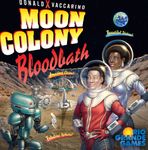
Hey, I'm Jamie from Stonemire Games and today I'm going to talk about my favorite mechanism and mechanisms in Moon Colony Bloodbath. I played this for the first time at three players at Geekway Mini in 2026 and I absolutely loved it. Uh I'm not reviewing the game. I'm not a reviewer, but uh I think it'll be very clear in this video how much I enjoyed my first my first play of this game. And I went out and bought the game afterward and waiting to get it from my local game store. So that's an ind indication of how much I really really enjoyed this game. This is a competitive game where all players are doing kind of two things. One thing is that they are trying to not lose all of their people, but they're trying to get as many people as possible in this moon colony, but a lot of things are going wrong throughout the game in the moon colony. And uh it so in a way it is a crisis mitigation game which is not a typical that's actually the style of cooperative game that I usually stay away from but in this competitive game I think it works brilliantly and you were trying to have as many people at the end of the game when one person loses their last person which I think is really really clever.
Um that's an interesting thematic hook at the very least with a little bit of a mechanical twist to it. While you're doing this all players are building a deck together. They're building a single deck together. And some of this is happening automatically. The game is just building this deck itself without you having to really do anything. But players are also putting cards into this deck impacting how this deck changes shape over the course of the game, which I think is brilliant. And that really is my favorite mechanism of the game. I'll talk about a few other things about Moon Colony Blood Bath, but I really like that all you are doing turn to turn is you are one player, any player can do it, but you're revealing the top card of the deck and you are doing what that card says. And some of the cards will say things like add another event to the deck or they'll say add a robot to the deck and the robots are bad. The robots go haywire and and kind of mess up things for your your moon colony. And some of the cards just say work and they let you choose. And that's what I'm showing here. If you have a work card, then you can choose one of the five actions in the game. You can get more people. You can get more resources. You can play a card. Um you could choose one of those things. So ideally, you'll see those work cards. You really like those.
You can also uh add these perk cards to your deck uh to the to the deck. Not your deck. The deck. There's only one deck. So every now and then you can there's a way that you can there are ways that you can play perk cards. Um, and when you play a perk card, you just add it to the top of the deck. Uh, and this way the game is fully simultaneous, but you are still interacting with other players. You're you're actually having a pretty significant impact on what other players are doing by those cards that you are adding to the deck. Uh, there are also some development like cards. I'm not sure if that's the official term, but there are some development cards that you are adding to the deck as well that impact all players. Uh, so you're building the share deck and just turn by turn, you're revealing a card and all players are doing that thing on the card. And then you do that again and again. It's such a simple streamlined system. Like we had this up and running within minutes. And uh we were I don't know that that's impressive for a game that has so many different choices like Moon Colony Buglath to be up and running within just one or two minutes. A few other things about this game that I really appreciated. More nuanced things.
One, there's no default way to get people in this action system. These are ways to get more cards, to play cards, to get more resources, to um uh there's one other one uh to uh to get some some of these crates on cards that can activate cards, but there's no action that just says get people, and people are essentially your victory points in this game. Uh that there's a little bit of nuance to that because you trying also not to run out of people. That triggers the end of the game. But uh but I really like this idea. It's a subtle thing, but if you want more people, you have to go get them. You have to build structures because structures come with people included. There are also structures where you activate those those structures, those buildings, those cards, and that gives you more people. But there's no default way to get people from turn to turn. I think that was a good design decision. I really like that that endgame decision.
And I like that that is fully simultaneous. And one other little thing, I really like that this game lets you build up fairly quickly. Like early on in the game, you are doing a lot. there's a very small deck and you're you're doing a lot. You're you're building up structures rather quickly. You're getting more stuff rather easily. Um, and then as the game progresses, you are losing some of those buildings because those buildings are also have a people value to them. And when bad things happen and you don't have people tokens to spend or citizen tokens, whatever they're called, to spend, then you have to lose a building to supply those people. Like those people are are lost instead. Um, so it actually gives buildings multiple types of utilities throughout the game. They're engine building early in the game, but later in the game you're trying to build buildings so you can get a bunch of people all at once. Uh, so I really like that element that the buildings are still valid even when the engine building aspect of the game is no longer as relevant late in the game.
There was one other thing I wanted to add. Oh yeah, also the uh at the beginning of each game, you put two twist cards in the deck. These are events that uh that trigger throughout the game. They're usually good things, but they can have bad they can also have bad things associated with them. It's a pretty big deck of twist cards, and there there's this asymmetrical pairing because you're getting two random twist cards in this deck at the beginning of the game. And the deck is very thin at the beginning of the game. There's only like six cards in the deck early on. And so, you're going to see these twist cards early and often. They have a significant impact on the game. And you know, I actually didn't mention this, but you were gonna you go through this deck and then you reshuffle it and then you go through it again and again. We went through it like six times in the game that we played. So, you're going to see the cards of this deck a lot, including these twist cards, and they really I thought had a pretty significant impact on the game and made me want to play again with new twist cards to see what they did to the game.
Yeah, overall I I am just so impressed with this design. Like it gives me a lot of food for thought as a designer, especially working from a single deck where all players are simultaneously doing cool unique things and also impacting that deck and how that deck changes shape over the course of the game. I yeah, I'm I'm kind of blown away by this design. I really really enjoyed it and I look forward to hearing your thoughts and your favorite mechanisms in Moon Colony Blood Bath in the comments. Thanks.