7 Games I Played So You Don’t Have To - with Tom Vasel
Games in This Video
6 games are featured in this video — they unlock as you watch.


Transcript
Hey everybody, I'm Tom Vassel and today we're taking a look had seven games I'm reviewing so you don't have to. These are seven games that I do not think particularly fondly of. But you know what? That doesn't mean that they're bad. They just aren't games that I like. Well, I think a few of these are pretty bad regardless of that. But hey, again, it's all opinions. And if you have different opinions, let me know in the comments and let other people know. But here we go. Let's take a look at all seven of them. Spring is in the series from Dvere. This is the third one. And I think I played winter and autumn and I did not like either one of those, but I keep hoping. Now spring is not only Yeah. Well, let's take a look. This game has 18 cards and they have different variations of white and pink flowers on them. One card's in the middle of the table. I'll place a card on that as I'm I'm the first person to go. And you can cover up a card, but you you can only have the card in 180 degrees like this. It has to be the same. You can't put a card like this.
And it must cover up the same color. So I could put this card like this. Let's say I put it like this. As soon as I put that down, the other player then picks what color they want to be. So they say, "I want to be white." So they take white. They'll get two white flower pots and a long and a short fence. And then they go and we will continue to do it. When you place a card, you may put a fence on it short ways like that. Or when I place a card, maybe I place one like this. I could put a long ways fence on it. You can also put down a flower pot to cover up another player's color with your own. So maybe I would do this on a turn like that. Once all the cards out, players have finished the first half of the game. You then will count the number of different flower areas that you have. So white has one, this giant one here, two, three, four, five, six, seven, eight. So white gets eight points, pink gets points equal to theirs. Then in going back and forth, you will take cards and put them in front of you in your own personal area.
This time though, you are trying to make a group of your color as big as you can. If you take a car with a fence on it, you'll get it, but that's going to be minus points. And if you take a car with a flower pot, you get that flower pot regardless of the color. Again, at the end of the game, let's say this is your final thing. You would get points equal to your biggest group 1 2 3 4 5 minus the groups of your opponents and groups of your own color minus some fences and this is added to your score from the first half. The biggest score is the winner. So spring is really a simple game and it's just so it just feels so nothing. At the beginning of the game, you draw a card and you place it and it seems pretty obvious where to place the card. You're going to place it to make another group of your color or to combine two groups of your opponent's colors if you can. But because you have to place them on top of the color that's already out there, it feels a little like your options are very small. So you build it, you score points, then you're taking cards off slightly bit more interesting, but just one that I really can't get behind. I I I it's just so nothing and so boring and so kind of a two-player back and forth should be a little interesting. And you got fences and these flower pots. And at the end of the day that the the second one feels like this weird math problem like that's okay count these and subtract these these and these and I got three points plus the six I got initially is nine.
I know the argument is hey it's small it's inexpensive but you still shouldn't get it. So for me a spring is just not it's pretty cover. It's not terrible game play. It's pretty bad though. Four out of 10. I don't like it. Yum yum trouble gum is from Lucy Goosey and they make the weirdest games that sometimes are a stroke of genius. Sometimes they are a bag of butts and I don't say that to make fun of the game. That is the name of the game. Um so I played some really fun ones from them. So I was kind of excited about Yum Yum Trouble Gum. Let's take a look. You have two jails in the middle of the table and then you're going to shuffle these cards and deal them out to players. depending on the number of players is how many cards you get. And you're trying to get rid of cards from you. When it's your turn, you may draw a card. And if you draw a card, you then may play a card.
If you don't draw a card, you must play a card. So, when you play a card, you can play a card next to a bank. You can play this bubblegum. And if he's there, you can play the banana. You can play this bubblegum. And if he's there, you can play the bomb. If they're both there, you can play a heist. And you can play a heist on top of a heist if you want to. You can also play a licorice cop. Oh, no one likes them. But if you do play a licor licorice cop, then you put the whoop whoop uh symbol here, one of them, in front of another player. It's now their turn. They're going to go to jail and turn this over to show that they've gone to jail. That will end the round unless they also come play a police card, which will then pass this badge to the next person and keep going. or if they play a getaway card, which washes all these and you continue.
Um, when someone does go to jail, that ends the round and they have this in front of them. When you get a second one in a future round, that will end the game. You lose, everyone else wins. Yum, yum. Trouble gum is complicated uno. What? You got to place a guy next to a bank. Then you got to place the thing, and you got to And if you don't have a card that you can play, you draw a card. And so you keep going till you can play a card and then someone plays a police card which could happen like a few turns in and then everyone just keeps playing police cards or getaway card and it's just so mind-numbingly boring. Where is the game? You also have it takes a while for kids to remember what goes on top of what goes on top of what has some cool components and some fun artwork and it just wasted. This is a really bad game.
There's no interesting decisions here. There's there's not even a reason. You just play a card because you forced to play a card. I have a banana. The guy who holds a banana is there. I guess I'll play it. What the Uno, a game that I don't think particularly higher is much better than Yum Yum Trouble Gum, and that's a problem. So, for me, three out of 10. Just cannot recommend it. Little Kingdoms is a two-player game from David Ouse, whose games in the past I've not been particularly fond of. He is a person who designs his own game, does art, and I have not really enjoyed his art on his games either. Uh, but this one, the art did not look bad on the cover, and I love the idea of a lane game where you're placing cards on both sides. So, let's check it out. In this game, there are four kingdoms that you're fighting over, and there's going to be a queen in one of those kingdoms. There's also a portal that's moving clockwise around these. Players are going to have some cards in their hand, and there will be another set of cards that they can draw from. And what players are going to do is they're going to be looking at their hands and you're playing a creature card in front of you at one of these spots.
Now, when you play a creature card, it's going to cause a few things to happen. But the first thing you do, is there a creature from the enemy over there? If so, the higher creature exhausts the other one. They become exhausted. You then will look here. This says it moves the princess here three spots. So, she moves like this. One, two, and lands here. If there are any exhausted creatures where she lands, they are discarded out of the game. Then the the portal moves one clockwise. Now here it lands on red. If either player had red, let's say this person had a red on this side, I have a blue on this side. Red is the color that goes off. They have one, I have zero. So they knock me down one point. You're trying to knock your opponent down to zero. If they had two reds there, they would knock me down two points. Although if I had a red on my side, then they would simply it would be two to one. they would knock me down one. And if we both had red, two reds, they nobody would move either. So, you're going to keep doing that. When you play these cards, they all have special abilities. The healer can unexhaust people when played. The sneaky imp can move it in a different direction. The moon witch lets you put shields on people, which stops them from taking you out. And then after you're done, you will draw one of the face up cards over there. The game will end.
Like I said, when someone gets to zero mana, they lose. Or when we no longer have enough cards there, then whoever has more mana is the winner of the game. Wow. The rule book for this game is horrific to the point where there's a written correction in my book because if that written correction was not there, the game would be unplayable. But even with that, you keep looking going, "What is going on? I play a card. There's a fight, the higher card wins. And and and then the rules aren't particularly clear. Like there's, for example, the one says a wolf, and the wolf's like, "The wolf always wins all fights, even against another wolf." Like, wait a minute, what? The wolf wins all fights, even against another wolf. But then that wolf also wins all fights against another wolf. So, I'm assuming it means on the attack only. And I did that because I read at the top it says when you play it, you can use its special ability. So, I'm assuming that that Ken special ability means on the defense, anything beats a wolf. But on an attack, a wolf beats everything else.
Fine. But when you beat something, you turn it sideways, it's exhausted. What does that do? It's absolutely boring. It's nothing. There's like four cards, one in each suit, that let you untap a card. But when those are out, and those are going to be drafted quickly, I promise you. Also, when the other card is higher than yours, why do I want to put a card there? So, we fight and I automatically lose. It's so bad. So boring. And then the card moves the queen who then moves the other token. And then there's a scoring. And that's a little interesting because you look at the card and go, if I do this, it will move here and she'll move. Nope. That gives a point to my opponent. So not that card. This card. I'll move there. She'll move. Nobody scores points. This one. I'll move there. Oh, that one. I get a point. I'll play that one. That's not a game. That is just bad. Three out of 10. I really despise this. Weave is a game that is uh you're trying to get four in a row. Oo. If you know me and you know abstract games, you know I tend to like that sort of thing. Let's take a look. In this game, you're going to have 16 tiles randomly put out on the board.
Each of these tiles has two sides to it. And there's little pips that show you what color the other side is. You'll place some gems out like I did here. The gem can't be on the same color at the beginning of the game. If it is, let's say this is randomly put out, you just flip it to the other side. On your turn, you have some actions that you can do. Uh, you may grab a gem. You take any gem you want, put it on your side. You can see players have room for three gems. If there's an empty spot on the board, one that a tile that has no gem on it, you can flip that over. You can also put a gem out. If you put a gem on the same tile that it is, that is now considered to be magically bonded, and you get to do a special action responding to the color. In this one, I get to take another action, so I might take this one. Uh, the red ones let you take a gem from another player. The yellow ones let you flip a tile, even if it's not empty.
The blue ones let you move a gem to an adjacent tile. And purple lets you change the color of a gem between purple and another color, and there are extra gems for this purpose. If at any point on your turn, you make a row of four magical bondit gems where they all match the bottom like this, then you get one of these crystals. Ooh, the the prismatic gems. And the first person to get three of those is the winner of the game. Oh boy, there are so many problems with weave. the bad component quality. The the the gems are nice, but the tiles are not very good on that board. But where's the game? I take a gem. I will then turn that tile over so I can put that gem back on top of it. But here's the problem. Why do I want make three in a row? I'm setting you up to make four in a row. So, the only reason I'm going to make four in a row is if I can set up a three in a row and then I get an extra turn to do a fourth in a row or if I can do some weird thing and slide a piece and you know that. So, the game is all about maybe making one in a row, maybe making two in a row, but that is it. And then you both sit there and keep going until you think you can make a play to make both, but you also take three gems and then you can't do anything as a gem.
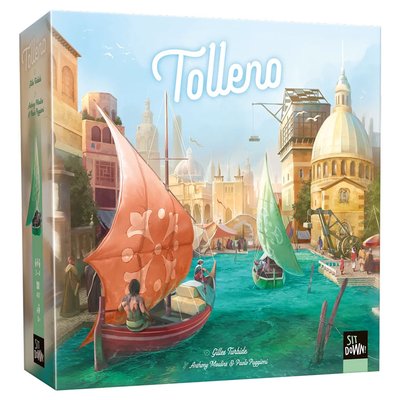
So, you have to put them back out. And if you put them back out another color, they don't activate their special power, which is boring, and you take them back again. And the rules aren't particularly strong about what happens when you make a group of four. Does they all go away? What happen? It's just messy. It's just messy. The concept is interesting. I like the idea of flipping tiles. I like the idea of putting out these gems, but I just can't I just can't recommend the rest of it. There's take that stealing gems and doing this and I'm not even like slamming this one. I'm giving this a five out of 10 because I think deep down there's an interesting idea there, but I just can't recommend it beyond that. The flipping the tiles and taking back and forth, it just feels like a very dead dud of a game. So yeah, I'm not particularly fond of weave. Tino is a is a beautiful game from Sit Down about building out canals and building next to those canals. I really like how this one looks. Take a look at it. I'm going to be a little highle on how this game plays because honestly, it's not a particularly easy one to teach. Some parts of it are easy. On your turn, you're going to be putting a tile out on the board. You're going to be connecting these tiles together. When you place a tile out, you make a canal and you'll place a floor. So each person has this whole board with all their colors. And here's the other three colors in the game. You'll place one of your buildings next to that canal. If you made two canals longer, you can go next to either one. And if you already have a building on that spot, you can go on top of it
one if you want to. Then you may do a second building, but that one must be on a canal that is perpendicular to the first one. So, I can come down here, put a building here, or I can put out one of these contract tiles, which will score you points in various ways. Not a single contract tile makes any sense, but fortunately, there is the back of the rule book, which explains how they all score points. After you have put out your sixth tile, you will then get a boat, which you'll be moving around. And once you get to a certain spot, it can move and curve. And these boats can pick up buildings and drop them on other spots. And at the end of the game, whoever has the tallest building on each tile will get the points that's there. You'll score points from this. You'll score points from your special player power.
And you'll have scored points from all these different contract tiles. These points are kept like this. They look like coins. And whoever has the most is the winner. Well, Toino is definitely one of those games in which it is so non-intuitive. I promise you that even if you understand the game, you will be teaching this so many times. Like, okay. So, I put this tile here. Now, that tile extends this canal and this canal. So, I can place down here next to this canal. And then your second one is to a canal that is perpendicular with one of the two that you just put out. And I know some people who watch this or have played it go, that's so obvious. I'm telling you from personal experience that people say, what? What? What? Huh? Huh? The whole time. And then the fact that every single one of those scoring tiles, you do not know what it does. And you have to look at that sheet. And then at turn six, the game's like, "Now we're going to get complicated. Woo! We're bringing in a boat." And the boat moves around, picks things up, and it's not even that interesting of a game. You're kind of moving around, dropping cubes off, and you try to control areas, but because you're thinking so much about where can I build it, it just ruins the fun. I'm really surprised at at this one. and how how it just it's it it it like it's like an example of a beautiful game that might even be good that is ruined because the rules are non-intuitive to an average game player and then plus symbology which you don't know what it means but you're tempted by those pieces
and you're tempted by I mean this cover is gorgeous the whole thing looks good unfortunately the game itself is not so this is another four out of 10 for me. I just it it's it's a game where the the book is better, the cover is better than the book. Builders of Balders's Gate. Now, that's a game that has me interested for a few reasons. One, it's Whiz Kids. Their production is pretty good. Two, it's designed by Matthew Dunston, a a designer I think quite highly of. Three, it's about Balders's Gate. I love the video game for Balders's Gate. And four, I'm a big fan of Dungeons and Dragons board games because Lords of Water Deep brought many people into the board game hobby because they said, "Oh, it's a game about Dn D." And they played it and enjoyed it. Will this do the same? Spoiler, no. And in fact, I don't have an overview here for you folks because um Brian Drake already has done uh this on our channel, so you can go watch his overview. But I I'll give you a little bit of an idea of how this game works. you have a a city that you're building up and and this is the the first the biggest I mean this game could have been builders of blah blah blah blah blah blah blah blah blah blah blah because it has nothing nothing to do with Balders's Gate and I've played all the Balders Gates games. Um this could have been about anything but let's take that out of the equation that it's not about anything. There's some really cool concepts here, but there's a lot of problems with this game. There is a lot of luck involved as to the tiles that come out as you're trying to
control different areas on the board. And you're building these really cool buildings. There's wood in here. There's catapults. There's plastic. There's all sorts of things, but the board itself is messy. It's hard to see what attaches to what. Every time you build something, other things go off. So, there's this this kind of area control, but then there's these cards that you get in this line. And the biggest problem I have with this game, and here's the thing, I went into this game, we started playing. The first time I played this game, I was like, "This is pretty good." And then the game spiraled into almost broken territory because people just kept dragging it out and dragging it out and deliberately dragging out because if you don't think you're winning, there's no reason to push towards that end. And it just kind of got boring. Now, the game will eventually end. it will come to an end um mercifully, but it gets worse as the game goes by. And as you control these different areas on the board and towers and there's there's a lot of complication to the game. The game here is not a particularly long rule book.
What is it? It's 15 pages with a lot of different things, but it feels like there's just a lot of I need to do this to get money. And also, that's was another problem in one of the resources. you can just have so much of this resource that you're just over swimming with it and not this feels like a cool idea for a game that had a theme slapped on and didn't have a lot of play testing done and I mean I'm no no offense to the play testers there's only a few of them very few of them that are written in the book here and there's attacks that don't really seem to be a big part of the game there's building which is cool but there's just so much it's such a perce procedural game of take this, build this, put this, do this. And I never felt any real sense of accomplishment at the end of it. There's some cool cards.
There's really neat stuff as the game goes by. Doesn't seem balanced. Seems like there's broken cards. Seems like there's good areas in the board. It's hard to see which areas attached to which. That's a real big mess. And overall, this one was a miss for me. Not horrifyingly bad. I give this a five out of 10. And I got to wonder sometimes how much of that five is me just liking everything about it. I like the production other than the board that you can't see, but I like the buildings, but the concept of it, it's hard to see the what you're doing through the mud. It's just not one that I like much at all, unfortunately. So, five out of 10. Builders of Balders's Gate. Royal Hospital is a game theme that I can definitely get behind. And boy, some of the components in this game, some of the coins in this game are beautiful. This is an engine building game about healing people. Great. Let's take a look.
Realize that there's a good chance I'm going to get a rule wrong because this is straight up one of the worst rule books I've ever read. Uh, in fact, uh, here is setup for the game on page 10. You know, they tell you what all the things are. They start explaining things. And by the way, there's some pretty key critical rules that are hidden in some of these things that are mentioned nowhere else. And it's pretty pretty big deal. So, I'm not 100% sure I've gotten everything right, but the general gist is each person's going to have a hospital in front of them. And over the course of the game, you're going to get patients that come to your hospital. You're going to need to diagnose them. There are different resources in this game. And clipboards is the resource that you will diagnose patients with. So, at the end of every round, you can diagnose a patient. You turn them over. Then you're going to need to heal them in which you need a heart resource. And then you will get some bonuses which will often be you moving up on these tracks here. And I think you're also keeping track of how many patients you've healed over the course of the game. If you don't heal patients, they can get sick and go away and your reputation will suffer. You'll be keeping track of your reputation on this track here. This is going to matter because the game revolves around a giant deck of cards. think Race for the Galaxy or um Terraforming Mars. And you'll be getting these cards at the beginning of the game. You get a certain amount of them. You can discard them. And then players are going to be getting resources every turn based on the tracks here, getting science resources, getting
clipboards, getting these doctors here, which are basically a wild clipboard or a heart, and getting hearts, and then getting money. And so you want to move up these tracks. And you have all sorts of cards that you can play. Some of them are instantaneous like I get two of these research things for each outpatient clinic you have in play including this one or immediately get three of those doctors. Others are going to be ones that you can use once per round and some are going to cons a lot of them move you up on those tracks. Some move you up on these insurance company tracks where they all have bonuses next to them. A lot of them are money. Some things move the ambulance and when you move the ambulance you'll get all the bonuses here. So, knowing to play these cards, the thing is when you play a card, cards have a cost in money. This one here costs five money, but many of them are quite pricey. For example, this one's 20 money, and it lets you move up immediately on two of those tracks there. This one here is 39 money. Some of them don't cost money. They might cost research instead. This one cost two of the research tokens. The cards are usually going to cost money or research tokens. And any card can be discarded for three bucks or a research token for that. And so there's all sorts of cards.
So that's really the game. You're going to take turns playing all these cards, moving up the tracks, and then you're going to have to diagnose and heal your patients or bad things happen. And then you go to the next round, and you will continue through the seven rounds. In each round, you'll get more more patients that you're going to have to diagnose, but you also get more of these cards that you can play. and hopefully your resources have gone up so you can play more. Most points on the outside is the winner. All right, I'll start with my rating. Five out of 10. And I I want to say that initially because I want there's different things I want to talk about here. First of all, I I do like the concept of this game. It's an engine building. It's trying to be games like, you know, Terraforming Mars and other games where you have a card that moves you up on these tracks to produce more resources, move on their tracks. And if you know me, you know that this is a style of game I love. But there's a couple things that cause such a beatdown on my rating. First of all is that rule book. That rule book's just atrocious.
There are these little orange pieces that you get when you they're scattered all throughout the board. When you pass certain piece on track, you get them. And I finally I could not figure out what they were. They're the same as doctors, but they're orange. It's a throwaway line, I think, in setup area where it explains what they do. I was like, what? What? But I I mean I this rule book I searched through it dozens and dozens of times to find rules. So that's a big problem. This game I'm still not sure I'm doing the patience correctly. The symbology is weird for things. There's those two tracks. The one track is like your reputation and when you're high on that it can move up on the points track. And it took me the longest time to figure out how you were supposed to be getting resources. And that's the other problem I have with this game. The the the second problem I have with this game is the luck factor.
So there's two big factors of luck. One are the cards that you draw. You might get a handful of really expensive cards. Well, guess what? You are not having a good day because even if you discard a bunch of them to get one in play, getting a bunch of cheaper cards that get your tracks up a bit are going to give you those for the rest of the game. It's really good for you to have uh incremental movement up those tracks at the beginning because that lasts the whole game. So to that end, that I think can be solved by drafting. Although that's not particularly the best way to solve the problem, especially for a first game. But man, that deck is so huge. There are so many different cards. You might say, "Oh, I'm going to get a lot of research and I can build the research cards and then never draw another research card." Drafting might solve that issue, but a bigger problem are the patients. You might get harder patients to heal than me, which could be good or bad because you get harder patients to heal, but hey, you got the resources, then you get great rewards and I get lesser patients and so my reward is not nearly as good or you can't heal them, in which case your reputation takes a hit. And because this is an engine building game, unlike many other engine building games that are out there, this one definitely has the feel of if you fall behind, you ain't catching up. The rich get richer. H maybe it is a doctor themed game. I applaud that this game was attempted. I think this game I think in here is a really good game, but those issues brought it down a lot for me. The bad
rule book and the propundance of luck and just also the symbology. It's just a hard game to play. But I think Somewhere Trapped in Air is a pretty neat game because I like moving on tracks. I like the ambulancing. I love all that, but it's tricky. You're not sure what you're doing. It's a game that wants to be terraforming Mars. Boy, does it ever want to be terraforming Mars. What a terraforming Mars that you're healing patients. Well, it's not quite there or anywhere there, but it could be maybe in the future. So, don't really look. All righty, folks. Well, like I said, even though I was not a fan of any of these games, perhaps you are. So, let me know in the comments. Let other people know. And or maybe you had the same opinion as me. Let us know in the comments on that, too. But there you go, folks. Seven games I played so you don't have to. Thanks for watching at Dice Hour. I'm Tom Vasel. We'll see you next time.
Hey folks, thanks for watching another one of our videos. If you like our videos, if you like our channel, you would love to game with us at one of our conventions. Check out Dice Tower Cruise, Dice Tower East, and Dice Tower West. fantastic inventions where we play games with wonderful people, a humongous library, and lots of other events and stuff. Also, don't forget to check out our channel, like and subscribe. I'm Tom Bassel.