Galileo Galilei, Metro X, Busy Beaks, Kokoro, Knit Wit - Ranked & Reviewed
Games in This Video
5 games are featured in this video — they unlock as you watch.




Transcript
Hey everybody and welcome to another Chairman of the Board ranking video. This is where I take a look, rank, and review the last five new to me board games that I've played. Uh before I get started on these five games, I want to give a shout out to the show sponsor, kienda.co.uk, who are my go-to online retailer. And if you use the link in the show notes or the QR code, then you can get 5% off your first order. And number five, I have Kakoro Avenue of the Kodama. So, uh, this is the reworking or I think a straightup reprint of uh, Avenue, which is actually a wellrespected flip and right game and I think one of the pioneers of the genre. Um, a game that I never had the chance to play, but again, I believe this is a carbon copy of the original, but in that Kodama universe with those cute little forest spirits.
Uh this one very straightforward stuff. Uh you're just flipping a card from this deck which will have a particular path orientation on it. And what you're doing is you are trying to uh connect these I think it's flowers and bugs to these different sanctuaries by placing these little pathways on each square on your playerboard. Now straightforward stuff, you know, the more things that touch those sanctuaries, the better. Um, but the twist of this game is that if you don't exceed the amount of points you got from the previous round, then you score negative five points. So, you always want to be um building on your roots and scoring more points than the time before. Uh, but doing that is very difficult because of course you are restricted uh by which cards and which paths that you draw from that deck. And it's particularly difficult uh because uh first off the rounds themselves are usually pretty short um because as soon as you draw a fourth uh yellow card and basically those yellow cards are scattered through the entire deck then um you you end the round. So it's quite rare that it lasts say more than six seven cards or so. Um so you don't really get much chance to to actually orienteer yourself around that map. Uh but additionally all of these different pathways um are just one route. So they're either straight up vertical, straight up horizontal um or just a corner as in like you know the top side to one of the edges. Um there's no crossroads in the deck at all. So you do
not have that flexibility to get yourself out of sticky situations. um you it's going to take you a lot longer to do these kind of long turns, these wide turning circles to get where you need to go and to connect those routes together. And I have to say I think that was actually a negative with the game. I think there should have been a few crossroads scattered into that deck because it just felt like it was too cumbersome and too slow to maneuver around uh the board. and it's extremely difficult because you can't really um connect your roots together, meaning that it's almost inevitable that you're going to spend at least one or two rounds scoring negative points. Now, there are a couple of different things you need to consider as well because there are these kind of corner pieces where if you create a chain from this like princess character and I believe a lion, um like the lion wants all of the um all the flowers for example to touch him. So, that's something else you can go for. Um, but it doesn't really change the game too much and it just felt like it was almost I don't think punishing is the right word. It's just too restrictive and you just can't get anything done. Yes, it's fast. Yes, it's clean and simple, but I don't think there was enough for you to really take control of the game. The game kind of plays you more than you play the game.
So, I'm not going to say I was disappointed with this game because I wasn't really sure what to expect. But I will say that I was underwhelmed with the game, especially with there being so many great root building uh role and flip and right style games out there or even board games. You know, I think of games like uh Karuba. I think it does that route building mechanism that's very similar to Kakoro. Uh it does it way better. I think I'll definitely play Karuba 10 times out of 10 over choosing this one. Um, but also games like, you know, Trails of Tucana or Railroad Inc., they all do that route building stuff way better than Kakoro Avenue of the Kadama. So, I think this one's almost rendered obsolete for me. Maybe someone's going to love that purity of it, but for me, it just feels like it's just been improved in every way by other games. So, that is Kakoro Avenue of the Kodama at number five. At number four, I have Nit Wit. So this is a word association game where you are basically creating this enormous like ven diagram with multiple categories uh synergizing with each other or overlapping each other. Uh each category has a different colored string and you're placing these kind of clue markers in different places on that ven diagram. Some of them are going to touch two categories, some are going to touch, you know, three, four, even five categories. um where you need to try and find a particular word that fits in all of those different
categories. And as you can imagine, it's very difficult um especially when it comes to several categories at the same time. But I do like the way that the game rewards those clues more. So if you, you know, if you think of a word that associates to only two of the categories, then you've got two points. But if you do one that does all five, then you're going to get five points, which is quite a cool little selfcaling thing or self-balancing thing going on. Now, um I tend to really like these word association games. You know, over the years I've highly praised games like Just One, games like So, Clover, uh games like Crossed Words. Uh love those games and I, you know, I tend to be quite good at them and I I do enjoy them. This one gameplay as good and no problem at all. I I really do enjoy everything about it and you can imagine what the game play is like. My issue with it is more practical issues. So, the game itself is is very messy uh to look at because there are just pieces of string everywhere. You can't quite tell where these little clue markers are, how many different things they're touching.
Uh and because the game's based on a timer, um I found myself sp wasting a lot of my time trying to work out which categories these clues were actually falling into rather than trying to solve the puzzle myself. So, it felt a lot more fiddly than it needed to be, and I think other games have just done it to a more refined state. Yes, I love the potential of having to find a word that needs, you know, several categories rather than just two or three like a lot of the other party games. Um, but I think the game became too messy in the process. Uh, the production is wonderful. It goes for this really kind of rustic hobbycraft aesthetic which looks great, but from a practical standpoint, it really hurts the game.
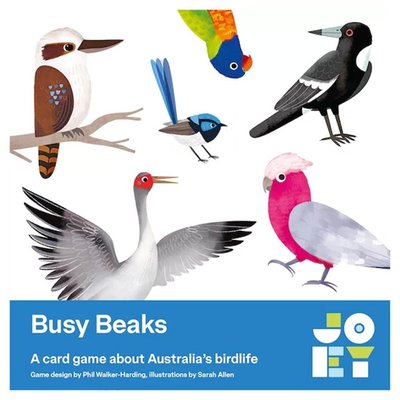
Um, and sadly, I think with being spoiled with so many other options, this one is going to fall down the totem pole. I'd rather play games like So Clover that are just that much cleaner still. But gameplay's fun. Um, I think maybe a little bit too much too much repeat because some of these categories are very similar to the others. Some of them are almost way too hard to find clues for. Um, but still with so many options out there, I think this one's going to fall to the wayside and has been improved upon. But still good effort, but didn't quite reach the heights of some of its competition. So, that is Nitwit at number four. At number three, I have Busy Beaks. So this is a barely known about little card drafting little set collection game by the great full walker Harding. So he's made tons of hugely successful games and I think this one was almost self-published or definitely published by a much smaller uh company and I think the availability is is quite um scarce to say the least.
So I was quite fortunate to get a copy this year at the at the bring and buy sale at the UK games expo. Um, but this one you're going to have this big central display of cards which depicts three different branches, essentially rows of cards of these different bird types. Each game there's going to be a different setup of these birds. So, I think the game comes with like, you know, 15 or so different bird types. And each round you only or each game you only use like eight. So, there's good replayability. Um, and all you do on your turn is that you'll play a bird card onto one of these branches, use its ability, and if you have five or or at least five birds of a certain type, you can play them, which will essentially score you the next highest um amount of eggs, which are your points basically.
And as the game goes on, those eggs are going to depreciate in value. So, you want to be quick uh if you can. Now, the actions or the powers of the birds themselves, you know, are all things we've seen before, but I do like the way that they start to combo with each other and all playing the right thing at the right time. So, some of them might say, well, if you discard a card, then you only need four birds for your flock. Or some might just simply say, well, draw three cards from the top of the deck, or swap this card with this card, or you can take any two different birds from the display. So, all very straightforward little pickup card drafting uh mechanisms, but normally what you do will affect the next player. And of course, you might be playing cards into the central display, making them available um and obtainable by the other players, which will contribute towards their sets that they're racing to collect as well. So, still nothing revolutionary here, nothing terribly um creative, but it's a sharp and strong example of a genre. Um, I'm definitely going to be playing with some quite a bit more trying to see those different setups and different birds to see if I can find the perfect setup of cards that I like. Now, some of them are a bit more nasty. Um, some of them are a bit more chaotic, but some of them are a little bit more cerebral where you can be bit more clever and use some guile to try and get um well, maximum efficiency out of your turns so you can grab those eggs before your opponents do. Uh, clean system, very fast, only about 30 minutes to play. I can see this one being a wide
hit, you know, especially in the shadow of games like, you know, Wingspan. There's clearly a big market for these bird style games, and I'm sure this game tried to to capitalize on that. Yeah, the game play is less engine builder and just more card collection, but it works. It looks nice and it's clean and it's fun. So, that is Busy Beaks at number three. At number two, I have Galileo Galile. So, this is a mediumweight Euro that came out last year to reasonable success to to my understanding. Finally being made available here in the UK. Um, and I suppose I want to come out the gates saying I'm not quite sure what the unique selling point of this game is or what the standout mechanism is. Um, it seems to be a lot of Euro tropes blended into one game and obviously being at number two, it does it to a very high standard, very polished, well ironed out. But it's quite a difficult game to talk about because it just does a lot of track climbing, a lot of contract fulfillment and stuff we've seen, you know, to nauseium really. Um, but why is the game ranked so high and why is it so, you know, well thought of? Uh, I think a big part of it is because how clean the system is. So, the action selection system is very nice as you have your little telescope, and you can choose the next three actions almost in like a a rondelle system, but there's a fixed action and also a variable action that's going to shift round after round.
So, the pairings are always going to change. Now, what you're essentially doing is you're collecting and leveling up dice, which are essentially your currency to cash in against these uh planetary contracts, which will get you your victory points, as well as increasing your personal little player track on your board, which will get you bonuses. Uh along the way, you're climbing another independent track or tracks, which will get you bonuses, as well as unlock endgame scoring, increasing your multipliers in a bunch of different categories. Um, and you are also trying to fend off or manage the Inquisition as much as possible because normally passively whatever you do in this game, you will pick up interest from the, you know, the Inquisition.
They'll come onto your playerboard and will be starting off as a really high detriment of negative points. So, you want to try and shift them up this other track as quickly as possible by taking this other action. Um, but whenever you move one of these inquisitors, uh, depending on the total sum of their position on these tracks, you can slide up and down this other track, which can really hurt you or help you at the end game. So, this game has quite a cool arc where initially it feels like you're in a hole that you can't get out of, but through careful management, maybe avoiding inquisitions and so on, you can start shifting them up and then they'll start giving you positive like reputation, meaning that you can slowly start trickling up the other board, which will hopefully give you a leg up at the end uh of the game. Uh the actual contract fulfillment part is is pretty standard fair. As as I said, you don't have resources in this game. you have um dice instead. Dice are three different colors and you're leveling them up.
You're drafting new ones or taking new ones and then cashing them in against these contracts. Some of them are pretty straightforward. Just get x amount of points and maybe a resource, whatever. Um but some of them, well, in fact, all of them require um a hybrid mix of the two as well. So, some of the contracts might say, well, you need 11 in orange, meaning that you need at least one red dye, at least one yellow dye with a total sum of 11. But you can actually chip away at that by placing these comets down as well, which is something you need to kind of a side mechanism of the game. So, again, there's a there's good competition to get to those contracts before the other people do. Um, I like the way that everything kind of slots and fits into its place. You know, when you do this, it's a new track here. And when you climb this track, it will relate to this thing you did over here, racing to other objectives as well. As I said, it's hard to really put my finger on the standout mechanism here. But everything is blended together wonderfully. It's held together through that central action selection system really well. The turn structure is clean. Just again move your microscope or telescope. Uh do the action and the cleanup phase is also very straightforward. you know, sort out your um inquisition position and then shimmy your um your action tile that you've selected to the bottom of the queue, meaning that it's not accessible now for a few more turns. That's pretty much what the game is. Just rinse and repeat that until the deck of cards is burned through. Um but still
prioritizing actions, doing thing in the right way, uh using these kind of auxiliary actions um to unlock further potential to take these huge grandiose turns. Um it's a very satisfying game and if you like your combos, um this game has that in spades. So I really liked it. Um my only concern is that I feel like once I've played it a couple of times, I've kind of seen everything. It doesn't really have anything to really master, especially if you're really familiar with lots of euros. I'm not sure this one does anything distinct or unique enough to stand out from the pack. You know, the the gaze of those Euros that have mechanisms that almost are self-defining are over. It's not like this game does anything original. Um, but at the same time, it does everything to a very high standard, which seems to be the status quo of a lot of these Euros that come out now. They they're all very good.
They're all very polished, but they do nothing uh innovative. And that is where we are with Galileo. Galilei looks great. I mean, the visual appeal is fantastic. Iconography is crystal clear. Um, all the artwork on the planet cards is stunning. Um, and I think a lot of people are going to like it. Um, especially if you want that again that medium medium lightweight euro in your collection and you do have an interest in the subject matter, this is a great option. But I've almost played so many euros now that it's a detriment. I played so many that everything's a comparison and everything feels like it's been done before. And for that reason, it's difficult for me to get passionate about a lot of these euros now because I think another game's always done it better or done it so similar that I don't need to replace it.
But still in a vacuum in isolation, this is a very welldone euro that I think is going to be um very wellreceived and it's a lot of fun and again it's something to um well the decision space here is very strong and I think the best player is always going to win. So that is Galileo Galilei at number two. And finally at number one I have Metro X. This is a pretty unusual flip and right game as you are extending your multiple little metro lines throughout the game. You're trying to reach the end of those independent lines before the other players do to score more points. Uh you are encouraged to fill in as many boxes as you can to avoid taking negative points, but you're also trying to get numbers in the most congested junctions to score points that way. Now, it's a difficult game to explain and initially is quite an overwhelming looking game because the board is so busy. But it's definitely one of those games where the penny is going to drop and you're going to think, "Oh, I should have done that.
I should have done this." And I can really see what the game play is now. But turn structure, very simple. Just flip over a card. Um, you're going to write the number in one of your little um metro lines, bearing in mind that each one has a strict capacity. And then you're going to tick off the next number of spaces equal to the number you've just written. So if I wrote a five, the next five, say on that blue line, will be ticked off along the way. Meaning that when I write the next number in that spot, I'll continue from where I left off. Now the twist in this game is though that all of the different lines do merge into each other and they cross over each other, meaning that you can almost piggyback off your previous efforts. Um, and that's so important because again each line has a capacity and you cannot reach the end of the track without piggybacking on another track that you've already uh contributed to. But there are further complications that come into play um because if there's ever a gap, you cannot actually continue until you um well basically you're blocked. So say I had done really well on my blue line but then my orange line gets to a point where I can no longer pass because the blue line's blocking it. then all the rest of the space is wasted movement. And waste movement in this game is kind of your death now. You don't want that at all.
But there are a few special cards that let you skip over those blockades and continue your route to be much more efficient, but the numbers are normally much lower value. So it kind of goes hand in hand. Um again, a very difficult game to explain verbally. You do have to kind of play this one to understand what I mean. Um, but as I said earlier, um, when I started playing this one for the first time, I thought, I'm kind of just going through the motions here. I'm not sure what I'm doing. I'm just writing random numbers in random spots and hopefully it'll work out. Um, and then you soon start to realize that, oh, I shouldn't have done that. I should have done this. And all your decisions are highly important. And again, it all goes down to not wanting to waste anything. And of course, the race aspect comes through as well because you want to be first to complete each line before the other players do. It feels definitely distinct to all the other little flip and right games I've played. I can't really think of a direct comparison, but my favorite thing about it is again all this little cross-hatchings, all the crossover between all the different lines and how they interact with each other. And sometimes, you know, you can finish a line or almost finish a line without even adding on to that particular line because you've done all the other ones that cross over with it, which is a really cool touch. I also like that that pressure of waiting for the exact right card to come out. I really like the way that the deck of cards is nice and thick. Um, but there's only like a couple of or maybe even one reshuffle card in there. So, sometimes that reshuffle card might be right at the top. Um, and you just won't see certain cards. You cannot bank on
certain things. you. So, you have to act tactically uh in that respect. Uh thoroughly enjoyed this one. I think it's going to improve in my ratings as well. I'd love to see what some of the other maps have to offer and I just think the system is super innovative and it feels cool and different. Now, I don't think it's going to be for everybody because I think the again the the decisions and the the strategy is a little bit murky at times again, especially during your initial plays. Um, and it again it does feel a little bit daunting and the board's a bit busy, but I think the nature of the game, you can't really help that because there needs to be a lot of cross, you know, pollination uh with those different train routes. But I personally think it's great. It suits my taste really well, plays in a great amount of time, scales extremely well, too. Um, and tons of replayability because you are again reacting tactically to the cards that come out. So, that is Metro X. Big surprise for me at number one. So, there we have it. That concludes another ranking video. Now, hopefully you have enjoyed this one. If you have, please be sure to hit like and subscribe to the channel and check out my other content, too. But for everybody else, I'll see you next time on Chairman of the Board.
Bye-bye.