A Few Korean Board Games To Talk About
Games in This Video
3 games are featured in this video — they unlock as you watch.


Transcript
Hi everyone, I'm Luke Hector and this is the Broken Me, a show where I devote my time to ranting and raving about board games. But usually more the ranting part, let's be honest. Today is a compilation review video. I was sent a bunch of review copies from career board games who do some interesting quirky stuff every now and again. And I decided, you know what? I wanted to try some of these out. You know, a couple I've never really heard of before, but Coffee Rush was definitely on my radar, but I knew ahead of time that they were all going to be in Korea. Yeah, these are entirely in Korean, these coffees. So, I also wanted to test out just how language independent these were at the same time. Well, I can tell you right off the bat that these two, Perfect Place and the original coffee rush, work perfectly well. They are language independent. Yes, you got to use the QR code to get the rule book in English and that or go to their website. But the actual game is entirely pictures, icons, whatever. So, you don't need to worry about um you know the language.
Unfortunately, the expansion to Coffee Rush has cake cards which have text on them. So, you uh have a bit of an issue there. And the Rhino Canitio's Shellwe, as it's called, is mostly language independent, but there's some ways that you can tweak the setup of the game with these tiles. There's about eight of them and they have text on them. So, you can kind of get around that. But yeah, you've only really got two things here that are language independent. Otherwise, you're going to have to make concessions. That's if you happen to get Korean copies of this game. If you're able to get English ones, you ain't got this problem. So, basically, rather than do a video for each, I am basically going to just review them very quickly in turn. So, we've got Perfect Place, a little filler, Coffee Rush, you know, very light little game here, the expansion to Coffee Rush, I think it's called Piece of Cake. I have to double check cuz after all it's a Korean. Um and Shel from Rhino Canitier. So some of these have been out for a couple of years. I think one of I think Shel's re relatively recent, but I'm just going to give my thoughts on them fairly quickly and let you know. Wingers Dingus, listen up. So we're going to start off first with the little filler Perfect Place.
I'm not doing these in any order of ranking or anything like that. This is just literally what I'm picking up in front of me. This is perfect place which has very cutesy little cat artwork which kind of reminds me a bit of the artwork of the cat from cat in the box. You remember that little bezier games one? But this is basically a first person to win two rounds affair. So you got these cool sort of cat in the bottle meeples to basically simulate that I've won the round or won two rounds. And the idea is depending on the player count, you're going to have so many cards face down in front of you. There will be a deck of cards and then there will be a discard pile as whoop. bring it back there so you can actually kind of see as such. And the idea is is that you're trying to get rid of your cards in order to end the round. And it's one of those games where you want the fewest points possible and all the numbers on here are points. The cards are numbered 1 to 11.
And the idea is is what you're trying to do in order to get rid of your cards is basically get the same value in the column that there is. So I've got a six here. I need to get a six in this particular card here, which at the moment is a 10. So these won't go away. But basically, if I can't get the numbers to match, they'll stick around and they're worth points. You're trying to get rid of them. The way you do it is that you've got a couple of actions that you do, like drawing a card and exchanging it with one in your grid, taking the top one of the discard pile, you know, um putting one available for someone else to have in order to flip one of yours over. Just very little simple actions like that. But the idea is is that I might be able to, for example, let's uh let's say, all right, let's grab a couple of cards here. For example, let's say this was my setup here and I had an eight and a six here.
Well, there's an eight on top of the pile. I can take this eight and, you know, exchange it with the six and then that creates two eights. They go away. You know, very simple stuff like that. The one little quirk is that you're able to stack certain cards. So 11 is kind of like the magic number here. If you can get it so that your cards can basically add up to 11. So here I've got an eight and 11 here. You know, at the moment that's worth 19 points. That's pretty dire and horrible. But if I'm able to find a three somewhere, like on top of the discard pile when it's my turn, I can basically stack it on top of the eight to make 11. The column now has two 11s. They all go away. And if you do stack a couple of cards, you'll get an extra turn. So you'll, yes, you are technically adding more points to your pile, but you that extra turn might allow you to get rid of it in a minute.
So you're kind of doing a little bit of a high-risisk, high reward strategy. And that's kind of the gist of it. You just carry on until somebody's got rid of their cards in front of them, I think it's six or eight, depending on the player count. And then at the end of the round, you see who got the fewest points of which any cards that you did get rid of, so the ones that go aside here, they're worth minus one point, these are all worth positive points. And you want the lowest points, a bit like a no thanks. You remember that little filler. And then you just keep going until someone's won two rounds. This is a very simple micro filler. It's got very easy rules. I like the cat artwork. It's very cutesy. It's just like a, you know, um, even though there's the the numbers come in like colors, it's still basically the numbers. You don't have to worry about color blindness or anything. But there's not a huge amount to this game really. I mean, it's only meant to be a 30inut filler. Yeah, it's, you know, if that. I mean, it could even be less time than that, but there's not a huge amount of decision space in this game. And you know, we'll talk about that a bit more a little bit later, but basically all you're really doing is drawing a card and saying like, "All right, do I want to exchange it with one in my grid? Do I want to take it from the deck or do I want to take it from the discard pile or do I want to just flip one over so I can flip one of my cards over?" There's not a huge amount of like I mean, there's certainly no real strategy in this game.
And even tactics wise, there's not a great deal of that either. I mean, you're at the mercy of what other players shove in the deck. And so you find that some players just kind of win by blind luck really. And yeah, I know, you know, light little fillers only take about 20 30 minutes to play, don't tend to have a huge amount of skill involved, but let's face it, I have more decision space in something like Love Letter for a game that only takes, you know, like five minutes to play a single game because at least I'm making deductive reasoning over what I'm, you know, what other players might have. Even though, yes, there's a lot of luck in that game. But here, I don't feel like the better player wins ever. It's just, you know, the the card on the top of the deck just happens to be exactly what I need to make these two columns go away. Well, lucky me, it just happened to be that way. You know, I draw a card off the top of the deck and it's like, oh, it's a it's an 11. I can put this here and then suddenly I've got, you know, I can exchange it with this and then all of a sudden I've got two 11s. And the other bit of luck that's kind of annoying is that when you get to the end of the round, let's say somebody's got a bunch of cards, um, you know, let's say I've got a little setup like this. Okay, so yeah, we've got the discard pile here.
I've done pretty badly and these are the only two I got rid of. Okay, so I'm left with these. You have to flip over all your cards at the end and then if you've got columns that match, they'll go away at that point. So I could flip over these three cards now, find out that they are just conveniently 28s and two 11s, they go away, and I don't have any problem with points. But I didn't do anything there. I literally just had blind luck as to what was in my piles at the time. So, somebody could literally like trigger the end of the game, be in a good position, and still lose purely because somebody had a lucky draw. That just doesn't sit well with me, even for a filler. So, this one was a little disappointing. I was kind of hoping there'd just be a little bit more cleverness. And like I say, Asia tends to put out a lot of cool, quirky fillers. There are some really good stuff that comes out of Asia. I mean, I've, you know, I was talking a lot about vegetable stock. I mean, love letter, I believe, originated um in Asia as well. Uh there was Hannah, well, Hannah, I mean, you know, that's a fill of a two-player, isn't that originated over there, I believe. But there was another one um Kobe Kobaya, sorry. It's like this tiny little uh little card game that Z Garcia really liked. Um, you know, there's a few of them that are like, you know what, these are pretty cool little quirky card games and this one just doesn't feel that quirky, which is a shame because it's got simple rules and it's easy to read and it's got these cool sort of purple like round counters and but that's kind of all it's got going for it really. So, this one's like it passes the time, you know, you get a
little bit of fun out of it, but this is kind of like five out of 10 territory. It's It's average. It kills the time. It's easy to learn. It looks nice and it's cheap, but there's just not a huge amount of decision space in it. And I kind of want just a little bit more cleverness out of my little fillers. Okay, we're going to move on to Coffee Rush. Now, I've been very interested to try this one because it came out to Essen in the previous year. Um I think actually prior year, not 2024, I think even 203 in fact. I don't know. I lose track of time. And I didn't really get a chance to look into it. And by the time I even thought, "Oh, yeah, I might want to give Coffee Rush a look." It sold out at Essen. I didn't feel like trying it at that point. And ever since then, I never really saw the game until this opportunity arose. So, it's like, "All right, cool. I want to try this out." So, this is effectively kind of like a light almost kind of gateway level game, I'd say. It's kind of like a It's not a speed game. It's not real time, but it's all about basically serving different types of coffee to in your shop as fast as humanly possible because the orders are coming in quicker than you can kind of handle them. Essentially, it basically all revolves around a little grid of ingredients. So, let's take a bunch of stuff there. First off, I will mention the component quality in this game is off the freaking chain. And I know I use that phrase a lot, but I mean it here because wow, for a game that's not that expensive. I mean, you have got an insert here with little plastic, you know, I mean, you'd think they were glass first, but little plastic coffee cups like this. Oh, they look so cool.
It's such a cool thing to like have those. But then you've got two component trays with, you know, decent looking resources for things like coffee beans and like steam and and chocolate and like like coffee leaves and caramel blocks and, you know, u that's cream on ice. The only thing that was missing from my copy was the water droplets, so I've had to substitute blue cubes in there. Yes, I have a few spare, but you know, that blemish aside, that's they'll send the replacement soon. But these are really nice little components for a game that is not that expensive. This is relatively cheap to buy and it staggers me how they've managed to, you know, do deal with this production quality. I mean, go go go you guys. But the game is very straightforward. Basically, you have a board with some upgrade tiles that you can have. I'm just going to put four here at random. Yes, you have them like colorcoded basically. And you have three of these little coffee cups. And the idea is is that there's a deck of cards with all these different orders.
So, I mean, you've got all your famous coffees that you know, cocoa, uh, mochino, iced chocolate latte, green tea. I'm okay. Not all coffees. Espresso, dopio, uh, cafe latte, uh, Americano, milk tea, Ein spanner. I'm not even sure what that is. Americanos, cold brew. I mean, I'm partial to, every time I go to a coffee store, I'm partial to a cappuccino. I do particularly like those. And I'm very much into iced coffee. I mean, with the fact that it's getting hotter in the summer when I go to my weekly sort of I've got a voucher on free mobile that lets me get cheap coffee every week at Caffeine Hero. I go there every Monday pretty much at work. And as it's getting hotter, I'm ordering more iced coffees. I just find it great to just sit in there, relax, a little bit of jazz music in my in my ear on my earphones just to kind of get into the mood and it's just like and try to forget work. Anyway, I'm supposed to be talking about this game. And the idea is is that with these three cups, you'll have a bunch of orders. So, here we go.
So, we'll take a a restretto and a few of these, you know, as the game goes on. And what you do is that you are able to move your mele on this board and you're restricted to how far you can move it and what directions. But basically, every space you pass over, you get the ingredients. The ingredients have to go in these cups, and you have to decide at the time which of the three you're going to put them in. So, I mean, we'll put a chocolate in there. We'll put a caramel in there. We'll put a coffee bean in this chocolate one here. And the idea is is that you've got to make these match the orders exactly. You cannot have them contain other stuff. You know, if you're serving me a cappuccino, I do not want, you know, if I don't want it iced coffee, I don't want ice in my coffee. You know, I didn't ask for caramel syrup. Therefore, don't give me caramel syrup. You know, so you've got to make these match the orders of which they're pictured as they want. I mean, like, for example, a caramel cafe Fredo wants coffee, caramel, and ice. Well, go figure, you know? And the idea is is that as you complete these, they go above your board and they count as points basically. But the problem is that after every turn, you're having to basically move these down and if they fall off your board, they go into a penalty pile, which is not good. But these orders are coming in pretty quick because as other players complete orders, it basically spams orders on other players. So, you're getting orders constantly as people are getting stuff done. And you can only do so many of them at once. And you've only got free cups to micromanage your little resource gatherings. Not to mention, you've only got, you know, typically free space places to move this guy. It's like, hm, how are you going to keep up with all these orders and how many of them are going to go through? Hence the term
coffee rush. It is very much trying to rush these orders to completion to the best of your ability, but you're not going to be able to do them all or if you do it insanely hard. And as you go through the game, you're able to exchange like, you know, uh, coffees that you've completed to flip upgrade tiles, which basically give you more ways to move your mele. So, I can get two ingredients if I go on a space. I can share a space with a player and, you know, get two of theirs or I can move it multiple space. I can move it diagonally now. You know, little simple things like that. And that's kind of the whole point of the game really. You basically just carry on until the endame trigger and see who scored the most orders, you know, and and lost points from penalties. It's very straightforward and it's just a nice light game. I mean, it is pretty much a gateway game, you know.
There's not a lot of complexity to this. I mean, you move this guy, you get the resources pictured, you try to match them to the order, and you try and do it as quick as possible. The upgrade tiles are really easy. There's nothing complicated about these. I mean, most of them are pretty self-explanatory from the symbol, you know, and that's it. That's all the game is. You just basically do that. And you might think, well, that kind of makes this game a little bit too light, doesn't it? And yes, it's light. This is not really a gamer's game. I I would say that for someone like me, I can get a little bit of a laugh out of this, but there's not really enough here to keep me personally entertained, like game after game after game. But for families, for a game cafe, I mean, this is perfect for a game cafe to have something that looks like this and it's so easy to learn on your table or on your shelf. But, you know, I think for families, you know, when you got younger players or brand new players, you just want something light. And to be honest, even for me, as I say, as a gamer, I can only get so much out of it.
But I like coffee. I like going to coffee shops and just relaxing with a nice coffee and this sort of thing with like really nice components. I got to give them props where it's due. It's very light, very simple, very well produced and it's just like a nice little giggle and doesn't take very long. I mean, by the time you start playing that, you're done in 30 to 45 minutes. So, it is a short game as well. It's just lovely and pleasant really. That's all I can really say. It's not going to blow your doors off, apart from the production quality. That is pretty impressive actually to be honest. You know, it's just nice, calm, pleasant, just like going to an actual coffee shop. I give this one a seven out of 10. Honestly, it's good. Not amazing, not fantastic, but I think for the right setting and the right group of people, I think this is going to, you know, hit home quite well. And I'm just very impressed on how for a relatively cheap price and not the biggest box ever, they've managed to produce it in such a nice way. So, yeah, say I am pretty impressed with this one overall. So, while we're on the subject, let's talk about the expansion. A piece of cake.
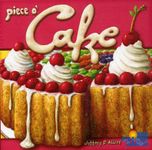
So, this one comes in its own box. And basically, this does what a typical expansion should add a little bit more to the game without adding too much complexity. So, in piece of cake, you effectively have cake cards. Let me get the uh box off here. And this one is not entirely language independent. So, um, you know, I've got a separate like the cards are separated out, but I've basically got the backup schedules here for the actual cake cards. And the idea with this one is basically it replenishes you with some of the components you already had, which I find kind of weird. I mean, you've got new player boards, which are supposed to replace the old ones, but literally the only difference between the two is the fact that you can see it's people going around a cake store rather than going around a coffee store. and a tiny little symbol down there which is a rush token.
Basically, you get rush tokens in the original game and it allows you to do more movement with the meatball. That's literally all it is. It's just not printed on the board in the original. It's not that difficult to remember that rule, frankly. And honestly, I prefer the look of the original one with the coffee and the baristas than I do this pinky one with the cake uh like you know cake people running around. So, honestly, this just feels like a bit of a waste. And then it gives you two more component trays just so that you can spread them around the table more. Honestly, I never really felt that was a problem with the original one, but uh you know, you know, fair enough if you want it. So, really all you're really paying for with this expansion and with this box is a small deck of cards, which gives you a few more coffee orders, but for the most part, it essentially gives you the cakes. And the cakes are basically just one-off abilities. So, as you go through the game, as you deal more orders, and as certain ones come out of the deck, you get cakes that you can do, which allow you to have these cards that might just get you a resource. They might let you do some shenanigans with the game. They're basically just one-off special abilities. But man, blummy, if you thought the original was produced, well, look at these. Oh my god, look at these things. These are multi-layered little plastic cakes. And I kid you not, the only reason these are in the game is that when you actually get an order that has like a cake attribut attributable to it, whatever that relates to it, you basically put the cake on the card. So, if I've got a card here, here we go. Cake goes on the
card. That's literally it. They're not differentiated or anything. You know, there's all these different types here, but there's no reason for me to put this little like, you know, creamy sponge one on there, or this pink gate wedding cake one, or this chocolate death by chocolate one here, or god damn, I just want to eat some of these. They just so tasty. Do not eat them. I I recommend. Um, but god, they look so amazing. And they're basically just a placeholder marker. You know, most games would not create something as nice as this for something that was a vital component. I've got sweet mess behind me on this shelf. Remember the one from Per Games I talked about a couple of years back? How nicely produced that is. That's all about baking. That is entirely all about baking. And they don't have anything like this. And this is just like from career board games. I'm really impressed. I just wish there was a bit more to them than that. And that's kind of the thing with this expansion. I mean, you have a few different upgrade tiles. So, you can kind of have some more complex upgrade tiles that are a bit more interesting. That's nice. You know, not really added complexity, but yeah, there's not really in that many extra rules. I mean, it is mainly just these cape cards. That's pretty much what you're getting. And the abilities on them are fine, but they're not exactly groundbreaking. They're just nice little things to help you along and just add a little bit of variety to the game. So, as an expansion, it is non- essential by any means. There is nothing that this expansion does that fixes the old one. If anything, it causes a few like one or two other storage problems because you've got the two trays that you didn't really need. You've got these four boards that I didn't really care about. And you know, but you can't
really easily fit these in the insert for the original game. So, you've got to take the insert out of the original, which is, I remind you, holding your glass cuts very nicely and stuff in order to get everything in the original box. I don't know that just feels a little bit annoying from the expansion to do that. But, it's a nice expansion. It's fine. It does the job, but it's not essential. it. But it, you know, so I don't think you need to rush out and get it. But if you really just wanted a little bit of an extra gimmick or a little bit of an extra like, you know, brightness to go with your game, then it will do the job and it won't over complicate things as long as you're willing to take the storage needs out. And obviously bearing in mind it's not language independent, so you will have to deal with the text on card if you end up with a Korean copy. So this expansion is fine. I give it a 6 out of 10.
Overall, it does the job. It's nice. is pleasant, but it doesn't really add a ton to the original game. It's just a good thing that it doesn't add too much either. So, it's very much just a if you feel like it, then by all means, go for it. So, now we move on to Shellwe. This is the new game for 2025. And I had to look this up on BG. This is a re-implementation of an old um rhinitzia game called start 11 which was already a reimplementation of something called alpha rouse which I believe is the original name. Now normally I don't pay a lot of rank attention to board gamegeeek particularly with the top 500 games but start 11 is ranked 16,000 on board gamegeeek and elf for Rouse you know 1925 that's how old the game is ranked 28,000.
That's kind of worrying because if you're going to reimplement a game, you might want to reimplement one that's uh popular. I don't know. But I figured, you know what? Let's go into it. It looks bright on the cover. Let's see what it's like. Well, basically, you have got a bunch of tracks with these shell numbers on them. And it looks like they've got weird number settings. It's just face. It's just so it faces both perspectives, which is quite a nice little touch. The box doesn't exactly give you a lot. I mean, it basically gives you some setup tiles, which are not language independent. It gives you four of these um like stands in order to place your shell dominoes, shall we say, cuz it is very similar. And you've basically got a bag full of the things. So, they basically are very thin um shells with the numbers on them. So, it kind of does have that sort of dominoesque feel. But the idea is is that you will have a bunch of them on your stand, like 17 odd. I've just got a few here. And the object of the game is to get rid of all your tiles. And then everybody totals up the points of their tiles, see who's got the lowest, then do another couple of rounds, then total up the points, see who got the lowest. You know, that kind of thing. But the idea is is that these rows go from zero to 17 in the different colors. Player count will determine what colors you use. In the basic game, you just use it as it is. In the more advanced games, you can flip the board over to have a slightly more weird janky setup of the rows. Or you can use those message in a bottle tiles, which are these things here to basically make the bonuses on certain rows different for different games. But basically what it boils down to is your turn is to draw a couple of tiles or to play up to two tiles. And drawing them
just means taking them out of the bag, shoving them on your board, which is obviously adding more points for you to end the game with. And playing two tiles is just a case of placing them on the board in the required spot. But tile placement rules is that they must be placed to another adjacent tile. So some of them are going to be on the board already. And so let's say if the 12 orange is here, well, I could play the 13 orange and that's fine. If you're able to play two tiles in ascending or descending order, you get to pass one of your tiles to the player on the left. So you basically get to get rid of another tile as a kind of bonus. And that's kind of the whole game. Yeah. I'm not joking. That's it. What exactly is this? You know, I mean, I don't know anything about the original games, Alpha, Rouse, or, you know, Star 11 or whatever it was called, but you remember I made the little joke about decision space when I was talking about Perfect Place. Where's the decision space in this one? This just feels like nothing. It's a two to four player game, 30 minutes, so it's meant to be short. It's meant to be light. But you don't feel like you make any decisions in this game. You basically have a choice. Put tiles out if the numbers are there or don't put the tiles out and draw more. That is your decision the whole game. Every turn is just that.
There is no way you know what other players have. It's impossible. I mean, there is one shell, I believe, for every single number on this board. So, you know that everything's unique. But you're not showing your numbers to other players. So there's no way that you can, you know, gauge what other people have. So there's no point caring what the opponents do. It would just happen. But if you can put tiles out, you put tiles out, you know. I mean, are you really going to draw tiles endlessly until you can draw two of the same color and number ascending and hope you do that? I mean, again, that's just blind luck of the draw of drawing them out of the bag. But that's all the game is. It's just literally that. So, I've got these, you know, shells here, and I go, "Right, well, I can't place any of those. So, I'll draw a couple of tiles." I draw two tiles out of the bag. One of those happens to be a 10 orange. I can't place a 10 orange. I'll leave it there.
Eventually, somebody puts down the 11 orange. I don't know. I'm just going to put down the 11 green just to showcase here. And you know, now you're like, "Oh, I can now conveniently put down the 10 and the nine, and that means I get to pass one tile to the person on my left." There's no decision making. You just basically do what the tiles let you do. I mean, this is a Rhino Canitzia game. Rhino Canitio is meant to make a bunch of these really clever games that have little little quirks. Maybe I'm going deathd and blind with this one. I don't know. But Rhina Canitzia is not the, you know, the god of board games like some people make him out to be. He has made a ton of board games. Give the guy credit. He's a hardworking person. But when you make that many games, you're going to make a few that are really, really great. You're going to make way more that are garbage. You that are really bad games. This one, it feels bad to call it garbage, but there's just nothing here. You know, you might think, well, it's meant to be a light game that you can play with kids, you can play with family, but again, you're not making decisions here. There's a couple of tiny little quirks with, you know, if you put stuff on the pearl spaces or whatever, but that's really kind of nothing. The only thing that like makes the game a little bit more interesting is that when you get like the bonus of like giving a tile to the one on your left or something, you can basically vary what those bonuses are by setting up these message in a bottle tiles before the game starts, providing you've got the English language of them. But that's the only thing that varies this
game up. Nothing else does. And so when I've shown it to people and we've played it, we've just been mostly bored. you know, we're not like hating the game or anything like that, but we just don't feel like we're contributing anything or doing anything that requires mental capacity. I'm pretty sure that, you know, I gave it a sort of comparison to Domino's earlier. I mean, it kind of does feel a bit like Domino's, but I swear even Domino's probably has more of a thought process or something that you go through. Perfect place. I said that, you know, there's only so much you need to think about in this one. I think this one has more decision space than this one. It just, and maybe I'm being a bit harsh on it, you know, because it's not meant for me. I mean, this is definitely not meant for gamers at all. And I think that's something you got to bear in mind. None of these games are really meant for gamers. I mean, we got a little filler. We got the light coffee game, but even that one as a gamer, I can see the merits of that one. I can't see the merits of this. If you think like, oh well, I'm going to play it with, you know, people that are really young, you know, like my 8-year-old, I feel like your 8-year-old will be able to handle something a little bit more interesting than this. We've got loads of different gateway games. I mean, Ticket to Ride, one of the best gateway games in existence, still has you make more decisions in terms of what you do with your cards, where you go, whether you block someone else off, whether you get onto a different route and such, especially with the expansion maps that are thrown in every, but even just the base set USA ticket to ride will have you make more decisions than this one does. So, why would I play this one? I mean, rating this one is kind of annoying, really. I mean, it is very
quick to play. It is It is quick to play. It's quick to learn. It's produced well. You know, the standies work and that and you know, it's it's a very light game that you can play with anybody, but it's just fundamentally quite boring. So, it scores points for production and ease of play and, you know, for the target market it's suited for, it will work, I think, all right. But, I just think that the target market can do better with games that make them think a little bit more while still being fun. unenjoyable and simple. This one for someone for something that is done by Rhina Canitio of all people. I feel like this was his off day, you know, while he was creating this really clever, quirky little game that's like, oo, that's a little bit tougher than you think, you know, and then sort of thought, oh yeah, Lost Cities, you know, this, you know, simple card game, but then there's a little bit of tug of play there, a little bit of like get in your opponent's head type thing, you know, little clever games like that. This one just feels like he was I don't know on an off day, on holiday, on drugs, I don't know, but something. But I don't get the appeal of this one. I just think it's going to look nice on the table, but it's not going to leave you with a satisfying, you know, playthrough. I give it a four out of 10, below average.
You know, it's produced well, simple, and it's not like an angerinducing game. There are games I've given like a two, three out of 10 that are like, you know, for what effort you have to put into them, you know, their components are horrible or the for all the rules you got to learn, the gameplay isn't fun or they're too punishing. This is a light little Domino's game, so it's like whatever. But I'd still think you can do better, you know, honestly. So, not a big fan of this one either. So, yeah, there you go. There's a few little games from Career Board Games. Not exactly glowing statements, I'll admit, but you know, you can't always win them all. You know, Perfect Place will suit you okay for a light filler. If you just want this in your game cafe and you just want something that you can just sort of chuck on the table for a bit and you like cats, this will do the job. It's fine. It's just nothing spectacular. Um, but you know, Coffee Rush, I think, is like your winning one here. So, I don't recommend Shell Weed, honestly. But I think Coffee Rush is worth a look. You know, seven out of 10. It's good. I don't think you even need to worry too much about the cake expansion. I mean, if you really like the game, then by all means, grab that expansion. But I think this on its own is a perfectly fine game. You know, it's produced immen immaculately well. It's simple rules.
It's a bit of a laugh. It gets you thinking, you know, it gets you in that kind of coffee shop mood. I mean, hell, you can take it to a coffee shop and play it there, you know, and it will certainly get some interesting looks from people. But yeah, I think this on its own is a perfectly fine gateway game that, you know, is the recommended out of this bunch. Maybe I'm missing something with Shall we? By all means, let me know in the comments if I am, but I just don't see it. So, that's it for me on this episode of The Broken Mele. If you like what you see, then please thumb it up on YouTube. This won't be going on Board Game Geek because it's one compilation video and that just doesn't tend to work. Well, if it does, maybe I'll put it in the coffee rush session. We'll see. And if so, please by all means thumb it up. But also, let me know your comments down below. Have you played any of these games? What are your thoughts? Do you agree with me on the pros and cons, particularly with Shall we? I mean, am I just missing something?
By all means, if I'm missing something with this game, then let me know because at the moment, I just don't quite see it. Um, but like I say, keep it civil, keep it brief. So, take care and remember, regardless of whether your preference is kitty cats, seashells, or iced coffee, it's still only a game. So, bye for now.