The Hungry Gamer's Everstone Mini Review
Games in This Video
1 game is featured in this video — it unlocks as you watch.
Transcript
Ooh, that looks tasty. Welcome folks to the Hungry Gamer is back with another mini review and today we are talking about Everstone: Discovering Ignis. Now, this is one of those games that have been on my reviewer shelf of shame for a bit. And it's one of those that what sometimes happens is I'll get asked about covering a game and I'll know that I can't get to it soon. And often that's okay, but then what happens is stuff starts coming in over and over and over again that has deadlines and stuff gets pushed and pushed and pushed and pushed and pushed and to my shame and my apologies to the publisher and designers I simply didn't get it played enough until now.
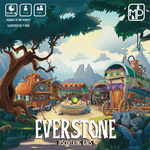
And so here we are. Now, what this game is is this is a worker placement tableau building game in which you are finding and repairing and then selling or keeping these relics from the land. And to do that, each turn you're going to take one of four actions. You're going to do an explore, which means you're going to move to a different location on the map and take whatever action is there. You're going to barter, meaning you're going to basically go to the market and get new relics. You're going to harvest, which means you're going to go out and find a whole bunch of gems and you're going to use these gems to do all the fixing. And then the last action you can do is a repair action, meaning you are going to fix these relics. Now, the key thing about these relics is you have multiple choices of what you're going to do with them when you fix them. You can keep them, which means you're going to slide it under your player board and it's going to power up those actions that I was talking about, or you can sell them.
And then each one of the relics is going to have a different power that it does when you sell them in that moment. And you're going to play around and around until one of you hits the reputation cap of 10, at which point after that round whoever has the reputation will win the game. How do you get reputation? There's a few ways to do it. There are these global conditions that you can try to do, which are have X number of relics, get X number of resources in a single round, put all of your influence out, which I didn't really mention influence. And there's a few ways to put influence on the board. The main one is when you build a relic, you're going to put influence out on the spot. And what's interesting is every time anybody takes an action where you have influence, you're going to get some kind of little benefit. Now, the last thing that I need to point out here is almost all of the worker placement spots around the board are going to change every time they get used. There's a little river, it's called the outer limits or outer region, something like that. And every time you use a worker placement spot, that tile's going to come off the board and the next one in this river is going to come out and that's what's going to be there moving forward.
And that's basically how the game works. So, with that said, what do I like about the game? First off, this game is about making relics and I love the look of the relics. Some of them are shiny, some of them are not shiny, and they just look really good. At the same time, I like that they're multi-use cards. I like that you can do different things with them. There's even ways to discard them. It's really cool how you can build up your tableau and get well, whatever it is that you want it to be. But figuring out how you want to use those cards when you build them is really, really clever and just all the options that you have. And it's a pretty healthy stack. So, no game's ever going to be the same as far as the tableau that you're building. Next thing I'll say is the one of the last things I mentioned was the way the worker placement spots are going to change as you're playing through the game. They're going to cycle through different tiles and that is cool.
It makes the game interesting in a few ways. One is it's a little of a time crunch for you to get these things done because if you don't do it now, it might not be there. Or if there's something that you're really hoping to do, you can see it coming up, then maybe you ways to kind of delay a little bit until someone else does a thing, then they are able to swap the spot out. So, there's some interesting things with the way that that works, and it's makes for the game again feel like it's always changing, always evolving. That's pretty cool. I also really like the way the influence works. I love that if I put an influence out on the second turn of the game, if you five turns later go and use that spot, I'm going to get something. That always feels really good when that happens. And then the next thing I'll say is there's really a lot of ways to get the influence points that you need, whether it's doing the personal quests that I didn't talk about, but you do the little quests with little certain missions that you have to do. It might be sell four It might be something like sell two blue relics in the same turn, or have a relic under every spot of the board, something like that. They're always going to be different, but you can get relics like that. Sometimes there'll be worker placement spots that come out. You can just buy influence. Doing the constant goals at the top. It's in It really does work as far as that goes, because there's And I just really appreciate how that works. There's are lots of different ways that you can get points. So, with that said, what are my quibbles with the game? The first thing is there's a bit of blocking going on, and it's not just the idea that it's blocking because on some of the spots it's not community spots where everyone
can go, and you can kind of camp out there for a while, and you do camp out there for a while, cuz sometimes you go you do an explore, and then after that you go and do a repair, so you're not going to be moving. You're kind of locking down that spot for a little while. That can be frustrating, but also what can be frustrating is as those tiles keep changing, because if you really need one thing, there's a perfect tile for it, but someone else gets there first, and then it moves off the board, you're going to have to wait until several more people have done things before you're going to be able to use that thing. By the time you get to it, you're not going to want to do that anymore. So, that can also feel frustrating in certain circumstances. Next thing I'll say is even though there are ways to get lots of resources in the game and you can hold lots of resources if you build up your tableau correctly. But, it does feel, at least in the games that I have played, like you are constantly gathering resources. I feel like I'm doing that harvest action all the dang time. I'll do one thing, go harvest. Fix one thing, go harvest. Do this, okay, well, I can't harvest now because I just harvested last turn, so I'm going to move them and do a harvest again. And it can feel like a big chunk of your game is just harvesting. Now, it's kind of cool the way harvesting works, you're chucking three dice and you're going to use two of those dice to pick the number of what color track you're going to harvest and the other dice how many of those you get, which is pretty cool.
Also very random and that might also bother people because it does happen to where you're like, I need red. I have to have red, you roll those dice, just don't get the number combination to get red. Or you do get combination, but you can only get one gem. There is some mitigation, but you might have blocked that mitigation on your player board. And so, harvesting I think is very fun and cool, but you're doing it more than anything else, at least in my experience, and sometimes the dice just don't play and then you've kind of wasted that turn. Next thing I'll say is the personal quests are a bit of a luck of the draw. In some ways, it feels like the end of the game of Ticket to Ride and you just say, you know what, last turn, I'm going to draw some tickets and hope I've already fulfilled one. And it's not that bad in this, but there's definitely times where you spend an action and you spend resources to draw a quest and it is next to impossible to do, at least for what your setup is. And that also can be a frustrating thing.
The last thing I'll just point out is the solo mode is not playing against a bot type thing. It's not even a beat your score because this is a game where you get to 10 and the game's over. It's a race. It is a clock that you have and the other and the robot player kind of move around, it'll do some stuff, move over some tracks, but it's it's just a clock. And so that may or may not be exciting for you. So there you have it, folks. That is Everstone. I think it's a clever game. I think the things that it's doing that are different really make the game unique. I think the tableau building is super satisfying as you're playing through. I had a lot of things that I called out as stuff that might bother you. And to me it doesn't really bother me. However, because of the amount of change that happens on the board every turn or most turns, the amount of luck that goes into things just to well, I need to get this right card needs to come out of the relic deck or I need the right numbers on the dice or I need to be able to get to this spot. Oh, I can't get to the spot. That is the core of will you like this game? If you're looking for a tableau builder and that idea that this constant flux and you might not be able to get to what you want or maybe you're just going to luck into the perfect thing. If that sounds exciting to you, then I think you'll really enjoy this game. If you're looking for a more traditional Euro experience, this ain't it.
This ain't it. So, there you have it, folks. As always, if you found this video useful, please like, subscribe, share, maybe become a channel member. As always, thank you so much for watching. Have a wonderful, wonderful day.