/pic7704995.png)
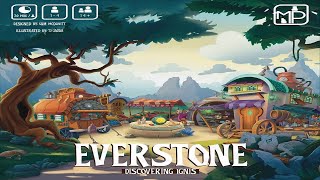
After miles of travel with no other noise around you but your own, you see for your own eyes what all the murmurs have been about—the city of Ignis. You thought it would be bigger, based on all the whispered conversations you overheard, but you guess that means you’ll have a better chance of getting your story captured in the history books.
In Everstone, you will take on the role of one of the first pathfinders to arrive on undeveloped land. Your goal is to be the most reputable of them all. Travel the area, Influence and Trade with other pioneers, Harvest the land, and Repair the Relics that have been long forgotten to become one of the most influential members of Ignis.
Players in Everstone will take turns moving their action pawn to a new location on their player board to perform its action. Everstone is packed with action chaining and discovery. Game play continues with players taking turns until one player has gained ten reputation points.
-description from designer


- Solid Euro game with good mechanics that work.
- Relics are multi-use and offer interesting strategic choices.
- The 'first to 10 reputation' end-game trigger is liked.
- The game ramps up and offers satisfying combos.
- Good insert and component storage.
- Solid start for a first-time designer.
- Contains a decent amount of content for a self-contained box.
- Mechanics are familiar and not exciting for the reviewer.
- Theme is not strong or engaging.
- The beginning of the game can be slow.
- Minimal player interaction.
- The 'Leroy's Looking Glass' alternate win condition might not be to everyone's taste and can feel like a race.
- The rulebook formatting is a bit odd and can be difficult to reference for nuanced situations.
- The order of placing influence tokens feels unnecessarily complex.
- The location bonuses are not very impactful.
- A caravan trying to find relics
- Scythe
- Dead Reckoning
- Space Base
- Almanac's Peak
- Dragon's Road
Mechanics (from transcript analysis)
- action selection — A hybrid action selection system, similar to Scythe, where players choose one of four actions and then proceed top to bottom.
- Dice Rolling — Used in the harvest action to determine relic discovery, with mitigation options available.
- Engine Building — Players build an engine by discovering relics and slotting them under actions to enhance their effects.
- Modular Board — Outer limit areas with actions cycle out, changing available options and preventing spamming of specific powerful locations.
- Resource Management — Players manage three main resources: different colored gems.
- Set Collection — Collecting specific sets of relics or achieving certain conditions can lead to reputation points.
- Track Advancement — Players can move up influence tracks, with reaching the maximum on a track granting reputation.
- Variable player powers — Caravan upgrades and specific relic abilities can provide unique benefits and influence player strategies.
- Worker Placement — The game features a hybrid worker placement system where players choose one of four actions.
Video topics + discussion points
Quotes (from this video)
- Well, nothing here is glaringly bad. Everything works, but because it's a bunch of different mechanics from other games, it's like, well, I've seen this before, so nothing is truly exciting for me.
- This is a very, very solid Euro game.
- I'm just kind of like eh.
- It is kind of multiplayer solitaire.
- I really don't have many complaints other than well, I have specific Euros that I like and all the ones that I've seen in this game I've seen in other games and I already have those other games and I like those more.
- I'm going to give Everstone a seven. I think it's a good game.
References (from this video)
- Love the look of the relics.
- Relics are multi-use cards with interesting options.
- Satisfying tableau building.
- Clever card options when building the tableau.
- Worker placement spots changing as you play is cool.
- Makes the game interesting and always changing.
- Love the way the influence works, getting benefits from others' actions.
- Lots of ways to get influence points.
- Appreciates how the influence system works.
- Lots of different ways to get points.
- Clever game with unique elements.
- Tableau building is super satisfying.
- Blocking can be frustrating.
- Players camping on spots can be frustrating.
- Tiles changing can be frustrating if you miss a needed spot.
- Feels like you are constantly gathering resources.
- Harvesting action can feel like a big chunk of the game.
- Harvesting is very random, dice don't always cooperate.
- Personal quests can be a luck of the draw.
- Solo mode is just a clock, not against a bot or beat your score.
- finding and repairing and then selling or keeping relics
- the land
- Ticket to Ride
Mechanics (from transcript analysis)
- Dice Rolling — Harvesting involves chucking three dice to determine the color and quantity of gems.
- Objective Completion — Players gain reputation by completing global conditions or personal quests.
- Resource Management — Gems are gathered and used to fix relics. Resources can also be gathered in large quantities.
- Set Collection — Implied through gathering specific types/colors of relics and resources.
- Tableau Building — Players can keep relics, sliding them under their player board to power up actions.
- Variable player powers — Relics kept in the tableau power up actions, creating unique player abilities.
- Worker Placement — Players take one of four actions each turn: explore, barter, harvest, or repair. Many worker placement spots change after use.
Video topics + discussion points
Quotes (from this video)
- This is a worker placement tableau building game in which you are finding and repairing and then selling or keeping these relics from the land.
- Almost all of the worker placement spots around the board are going to change every time they get used.
- It makes the game interesting in a few ways. One is it's a little of a time crunch for you to get these things done because if you don't do it now, it might not be there.
- If you're looking for a tableau builder and that idea that this constant flux and you might not be able to get to what you want or maybe you're just going to luck into the perfect thing. If that sounds exciting to you, then I think you'll really enjoy this game.
- If you're looking for a more traditional Euro experience, this ain't it.
References (from this video)
- Strong engine building possibilities, leading to satisfying combo turns
- Multi-use cards create interesting strategic puzzles
- Engaging card management puzzle with placing relics on the board
- The 'repair' action is a core and interesting mechanism for upgrading actions
- The race to 10 reputation points creates a constant sense of efficiency and drive
- Theme is not super strong, feels more like a mechanical race
- Pathfinders arriving in an undeveloped land, hoping to become influential members of Ignis.
- Undeveloped land called Ignis
- Scythe
Mechanics (from transcript analysis)
- Action Pawn Movement — Players move their action pawn to a new location on their player board to perform one of four main actions: barter, explore, harvest, or repair.
- Card Placement Puzzle — When purchasing relics (cards), players place them in a workshop area, which is an interesting puzzle as placing a card may cover up certain abilities on the board.
- Card Tucking (Engine Building) — The 'repair' action allows players to pay resources to either sell a relic or 'tuck' it under an action slot on their board, which then activates its abilities every time that action is taken, leading to combos.
- Dice Rolling — During the 'harvest' action, players roll three dice, combine two for influence, and use the third for resources, creating a puzzle to optimize outcomes.
- Multi-Use Cards — Relics (cards) can be used in various ways: sold for a reward, tucked to upgrade actions, or used to offload to gain resources.
- Reputation Track Advancement — Players gain reputation by placing influence tokens on specific symbols (global achievements, influence track tops, personal quests, certain relics, or discarding cards), racing to reach 10 reputation points to trigger the end of the game.
- Resource Storage Management — Resources are stored on a personal player board, and there are limited spaces; clearing stacks of resources unlocks more storage, and certain cards can expand space.
- Tile rotation — When exploring, villager tiles on locations are always shifting and rotating; once an ability is activated, the tile is removed and replaced by the next in rotation.
Video topics + discussion points
Quotes (from this video)
- "If you like engine building games you are going to really enjoy this one I think."
- "The repair action is kind of like one of the core core core mechanisms um and foundations of this game."
- "This is very much a prototype copy of the game that I have in front of me."
- "For me it's it it literally just feels like a mechanical race to 10 points."
- "I do not mean that this game is like Scythe because it's not like Scythe but I do have similar undertones."
References (from this video)
- Does some very interesting things.
- The reputation track is the most important part of the game.
- Players get actions from tucked relics.
- Selling or tucking repaired relics.
- Upgrading actions provides additional benefits.
- Influence tokens on the board grant bonuses when opponents use those spots.
- The dice rolling system (roll three, pick two for track, third for resources) is a good concept.
- High replayability due to different relics and game paths.
- The game has a solid Euro style with fun elements.
- Generic fantasy art and description.
- Going for the artifact from dice roll can feel random.
- Potential for downtime with more players.
- The title and cover art might make people think it's an Everdell expansion, causing them to pass it by.
- Discover lost relics and become the most reputable traveler in the land.
- Everdell
- Dune Imperium
Mechanics (from transcript analysis)
- action selection — Players choose from four available actions, but cannot take the same action twice on their turn. Actions can be upgraded by tucking relics underneath them, providing additional benefits when the action is taken.
- contract fulfillment — Players can fulfill personal quests for extra reputation points.
- Dice Rolling — The 'Harvest' action involves rolling three dice. Two dice determine movement on a track and the third determines the number of resources gained. Dice can be manipulated with tools.
- Set Collection — Players collect relics and gems to perform actions or fulfill objectives.
- Track Advancement — Players move up on various reputation and resource tracks, gaining bonuses and potentially reputation points.
- variable board setup — The game uses tiles for exploration spots, suggesting different board layouts and actions each game.
- Worker Placement — Players move pawns to action spots on the board. Some spots can be influenced by placing tokens, granting bonuses to the owner when others use the spot.
Video topics + discussion points
Quotes (from this video)
- Is this a sequel to Everdell? No. They called it Everstone. I don't know why.
- But let me let me not bury the lead here and tell you I really do like this game.
- It's almost like I I I call this the Dune Imperium system because Dune Imperium was the first one who kind of did it where everything was about moving up and getting those points.
- The worst part of the game, like I said, is the title of the name.
- This is a solid Euro style game with a lot of fun things.
- I'm giving it an eight out of 10.
References (from this video)

- Engaging solo mode with strong quest system
- high replayability via relics, upgrades, and AI variety
- clear progression with meaningful choices
- Rulebook complexity and occasional streaming hiccups (audio/OBS)
- visual readability (glare) on camera during play
- learning curve for new players
- city-building, exploration, resource management, and reputation
- Ignis, a town in Everstone being discovered and developed
- solo quest-driven progression and narrative flavor through personal goals
- Ark Nova
- Cascadia
- Calico
- Red Cathedral
- Honey Buzz
- Next Station London
Mechanics (from transcript analysis)
- caravan_upgrades — upgrades to the caravan preface before actions, affecting options and rewards.
- Card/Chit Market — market cards discarded from the right; board shifts and new cards flip.
- explore_and_locations — explore to locations for relics/quests; Nim’s position gates options.
- influence_tracks_and_reputation — advance tracks to gain reputation and unlock rewards; AI occasionally mutates tracks.
- market_discard_and_refresh — market cards discarded from the right; board shifts and new cards flip.
- quests_and_achievements — personal quests and one-time achievements drive goals and scoring.
- Resource Management — gather and spend colored resources to advance tracks and buy relics.
- resource_management — gather and spend colored resources to advance tracks and buy relics.
- set_relics_and_repair — relics can be kept, stored, repaired, or discarded for rewards.
- solo_mode_and_ai — Nim as AI with four variants; countdown-based end and market/track disruption.
- Tableau Building — build a larger action by tucking relics and upgrade cards under actions.
- tableau_building — build a larger action by tucking relics and upgrade cards under actions.
- Worker Placement — place influence to take actions and influence location outcomes.
- worker_placement — place influence to take actions and influence location outcomes.
Video topics + discussion points
Quotes (from this video)
- this is Everstone I'm just going to call it Everstone but it is full name Everstone discovering ignis
- genuinely that is a great game
- it's not insanely complex I think it's like a 2 point something
- I love solo achievements
- this is sick honestly I'm enjoying this so far