Kavango : Lodges Expansion - How to Play. Complete, Clear, Concise Board Game Tutorial
Games in This Video
1 game is featured in this video — it unlocks as you watch.
Transcript
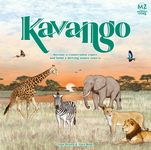
The tourists are coming. So now you have to manage ecoourism lodges in the conservation region of Kafango in Kafango Lodges expansion
and today we'll be teaching you how to play the Kavango Lodges expansion game designed by Matt Brown and Zara Reed and published by Maza Games.
And hi everyone, it's Stella
and Tarant. Welcome to Mabel University.
And hey, if you enjoy this video after watching, like, subscribe, and comments. You know what to do. Right now, let's get to the classroom.
In the base game of Kavango, players were conservationists, drafting animal cards to create a thriving food chain of animals in their own personal nature reserves, gaining points and money to invest in protections and conservation. Now comes the lodges expansion and lodges adds three new mechanisms which you can incorporate into your play. These are the personal lodges, cards with new sets of animals as objectives to get your points scoring lodges into play. The golden lodges, competitive objectives which players will race to achieve, and community protection and solar where you manage the balance between the space in your nature reserve and the needs of the local community.
I will assume that you know how to play the base game of Kavango. And if you don't know or need a refresher, check out the link to our how to play in the video description below. In the video, I'll explain these three modules separately. But do note they're not completely modular, and you can't just mix and match them in any combination. Once I've taken you through how each of the three new mechanisms works, I'll give you some easy, medium, and difficult combinations of rules which you can put together for your play. There is also one change to the general rules of the game, and you should use this with any of the expansion content or with the base game if you wish. From now on, the maximum number of money cubes that any player may invest in climate protections three plus box is three. Yellow would no longer be allowed to invest in climate protection due to having reached this limit.
No longer can you win the climate award by letting other players do the hard work at the start of the game and then coming in and doing all of your investments at the end. The first new mechanism is the personal lodges. And in setup, each player takes the six lodge pieces in their color. These come in three types based on the openings level one, two, and three. Separately shuffle the decks of orange level one, two, and three lodge cards. During setup, at the same time as dealing goal cards and conservation experts, deal each player three cards from each lodge deck. Considering all 13 of the cards they've been dealt, players choose one conservation expert and two of each lodge type to keep.
You reveal your conservation expert as well as your lodge cards. Lodges are dealt only during setup, so remainders can go back to the box. And it's only after the choice of conservation experts and starting lodges that you resolve the starting CC card draft. Lodges introduce a new placement puzzle to the game of Kavango. They provide six possible opportunities to score. And in order to score one, you must place four animals matching the icons on the lodge into a 2x two grid configuration in your reserve. Once you've achieved this, place one of your lodge tokens of the matching level onto the center of that 2x two grid.
Each completed lodge scores you eight points at the end of the game. And each lodge card may be completed at most once, even if you make the same configuration multiple times. Each single animal may contribute to multiple lodges across the course of the game. For example, these animals now meet this lodge condition, and therefore I can place here, doubling up the Galago and Dikker as being visible from two lodges. You may complete your lodge immediately as a free action during the player card step of your turn. When using lodges, you may always freely rearrange animals within your reserve, unless they already have a lodge placed on them. This lets you plan and optimize your placements based on the animals you get. Once there is a lodge on an animal, it is fixed in place.
You're allowed to hold back animals in your sanctuary, even if you meet their requirements. And you may choose to do this if you want to see which cards you get before committing something to a lodge. Remember that you are allowed to discard an animal from your sanctuary, but you may never discard an animal that's in your reserve, nor can you move one from your reserve back to your sanctuary. Otherwise, follow all standard rules of play. And at the end of the game, in addition to standard game end points, each player gains eight points per placed lodge. The second new mechanism is community protection and community solar. With this, you'll use these 12 pieces in your player color, and you will always be using the lodges as well. To begin the game, all of these pieces are flipped over to the community protection sides and are arranged in some of the empty spaces of your reserve.
There are a couple of different starting configurations you can use. This one here is the full and most difficult setup. Each space, which is marked with one of these community protection markers, is locked at the start of the game. You will not be allowed to play or place an animal card there until you've paid to remove that marker. You unlock these spaces by paying money during the research and invest money step of your turn. This is now a new option that you have in addition to investing in protection or climate. You spend the money back to the supply to take off tokens that match that value of money. You can invest in community protection multiple times in the same round and can take the markers in any order.
Once you've collected these markers, flip them over to the community solar side. The main reason for investing in community protection is to clear up the space that you need to play animals and to create the 2x two grid configurations you need to build lodges. However, in this game where money is usually tight already, you need to be thinking about where you might get up to 18 extra cubes to completely clear your reserve. For this, the community protection mechanism adds three new ways to earn money. The first is by building lodges. Each time you build a lodge, you gain an amount of money equal to the level of that lodge. And this is in addition to the eight points that the lodge will earn at the end of the game as well. Here, this level one lodge gave me one cube, while building this level two lodge would give me two cubes.
Lodges yield cubes only if you're playing with community protection. Never gain this money if you're playing with lodges alone. The second new way to gain money is to discard unwanted lodges from your hand. Choose any one of your lodges, gain money equal to its level, and then remove it from the game. You'll never be allowed to complete this across the three rounds of the game. You can do this at most once per round in rounds one or two or as many times as you want in round three. Likewise, this option is not available in a game which lacks community protection. You must be using this module to gain any money from your lodges.
The third way is to invest in community solar. And this is another new option available to you during the invest step of your turn. Once you've paid to remove and flip these tokens, you can return them to the community to gain money equal to the value on the solar. This will always be the same amount you initially paid to remove the token from the board. So, doing this has a net zero effect on your total money. However, once a space in your reserve has solar on it, then neither the solar nor its community protection marker can be removed. Again, you have now permanently locked that space of your board. Each space can hold only as much total value of solar as the value of the community protection marker currently on it. So I could put two value of solar here or atmos one solar here.
This mechanism is all about giving you a puzzle to try to optimize what space you need to create your reserve. It introduces no new ways of scoring. The last new mechanism is the golden lodge. And unlike the personal lodges where the card belongs to the player and you'll be trying to achieve it yourself, the golden lodge is a competitive objective players will be racing towards. In setup, shuffle the golden lodges and draw three of them face up. You'll reveal these before players choose their conservation experts and personal lodges. Completing a golden lodge is more difficult than a personal lodge. You must still arrange the animals of the necessary types in a 2x2 grid, but the sum of all points on the four animals must also meet or exceed this value in the corner of the card.
This set has a total points value of only 25. Not enough to claim this golden lodge, while this set meets the minimum 30 I would need. And thus, let me claim it. It's only the first player to meet any one of the three golden lodge requirements who gets to build this lodge. If multiple players meet the requirement on the same turn, then it's whoever has the highest total sum of points on the lodge they qualify for who breaks the tie. If still tied, then it's most personal lodges previously built. And if still tied, then both players get to build the golden lodge. Find a suitable alternative component as there's only one with the game.
Unlike most other ties in the game, you never use the hand card numbers to break this tie. The Golden Lodge is worth 10 points at the end of the game. You never earn money from building it, even when playing with community protection. And so those are the three new mechanisms which the lodges expansion brings to Gavango. The personal lodges, community protections, and golden lodge. The designers offer three different levels of difficulty with which you can incorporate these into your game. In the easiest mode, you do not use community protection. Simply play with the personal lodges and optionally with the golden lodge.
In the intermediate mode, you'll use personal lodges and the golden lodge and a reduced version of community protection. Beginning with your six two cost markers in these spaces and a pair of one cost markers here, leave your other four community protection out of the game. This leaves you a good amount of space to build your early lodges. For maximum difficulty, add your other four community protection markers into these four spaces, giving you a really tight placement puzzle in the early part of the game. Thanks for watching. And if you like this video, maybe you'd like to watch this next one. Have a great day.