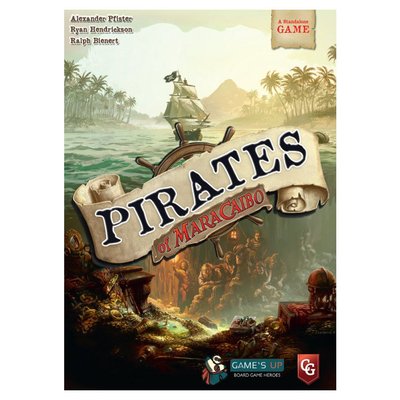
How to Play Pirates of Maracaibo
Games in This Video
1 game is featured in this video — it unlocks as you watch.
Transcript
Hi, and welcome to Friday how to play with Salomé. I'm Salomé Martínez. Have you ever wanted to sail the Caribbean, explore islands, and build your legend as a daring pirate captain? Well, now you can in Pirates of Maracaibo. In this adventurous strategy game for one to four players that plays in about 25 minutes per player, you'll move your ships around the Caribbean, complete quests, upgrade your crew, and chase fame and fortune across the seas. Do you think you can become the most legendary captain before the final scoring? Well, there's only one way to find out. Come grab a seat with me at the table and I'll teach you how to play Pirates of Maracaibo.
To begin playing this adventurous pirate game, we must start with the setup. First, place the exploration board on the table in between all the players. Now, let's build the Caribbean. Let's start by separating the tier one cards into locations, residences,
and improvements. Shuffle the residence cards and place four of them on top of location pile. Then, shuffle the improvement cards and place 15 on top of that. Give the entire deck a shuffle and return any unused cards back to the box without looking at them. Now,
draw cards from this deck and place them face up next to the board
in columns from left to right along with these three treasure island boards. This becomes the Caribbean you'll be sailing through. This layout is recommended for first-time players. You can also use alternative card layouts to create the Caribbean, which you can find in the rulebook. If too many location cards are clustered together, swap a few out with improvements to break them up. Next, place four matching marker cubes on each island starting from the bottom spaces. Place the remaining treasure marker cubes and the upgraded marker cubes along with the doubloon tokens and the rating dice within reach of all the players. This will be your general supply, so make sure it's accessible to all players. Then, randomly place the treasure value tiles onto the matching location cards. Next, shuffle the tier two deck and place them face down nearby. Now, take all the figurehead tiles, give them a good shuffle, and place a number of them face up near the exploration track equal to the number of players plus two. We'll be setting up for a three-player game, so we will be setting up five figurehead tiles. This will create the figurehead market.
Any remaining tiles can go back to the box. Now, each player takes a ship board and a hideout board along with their ship, explorer, and scoring tokens, their black market tiles, and player tokens. Place your ship on the starting space, your explorer at the beginning of the track, and your score marker on zero. Next comes the black market setup. One player flips all of their black market tiles randomly. Then, everyone else matches those exact sides. Shuffle the quest deck, deal each player two cards, choose one to keep and return the other to the bottom of the quest draw deck. Then, reveal two cards to form the quest market. Now, we'll determine the starting player. You can choose randomly however you like. Can roll a die, pick the last person who saw the ocean, or just agree as a group.
Once the starting player is chosen, distribute the starting doubloons based on turn order moving clockwise. The first player takes 10 doubloons, the second player takes 11, third player takes 12, and if you were playing with four players, they'll take 13. Finally, the last player in turn order, that's the player sitting to the right of the starting player, takes one of their player tokens and places it with the 50 victory point side down on the Maracaibo space. This token is important because it shows who will take the final turn when the end of the game is triggered, ensuring everyone gets an equal number of turns. And just like that, everything is set and you're ready to begin your adventure on the high seas.
The object of the game is to earn the most victory points by completing quests, building powerful improvements, constructing residences, and collecting treasures during your voyages. When the final round ends, the player with the most points wins and becomes the most legendary pirate captain of Maracaibo. Pirates of Maracaibo is played over a series of three rounds, and during each round players take turns sailing their ships and performing actions along the route. Every turn is nice and straightforward with just two simple steps. First, you'll move your ship, then you'll perform actions. Let's drop anchor for a moment and break this down before we drift too far off course. On your turn, you'll start by moving your ship. You move your ship forward one to three spaces, always ending one column closer to Maracaibo than where you started. You can move through and even stop on spaces with other ships. They don't block you. These seas get crowded, but there's always room for one more pirate. If you end your movement on a card space with other players, you must pay each of them one doubloon if you can. Think of it as a a little docking fee. If you can't pay everyone, you choose who to pay, and there's no penalty for the rest. You don't pay anything in the Gulf or Maracaibo. After finishing your movement, you'll take the next step in your turn and resolve the space where your ship stopped.
Depending on where you land, you'll follow that space's specific action. If you land on an improvement card like equipment, crew, or ship card, you have two choices. You can ignore it and take five doubloons, or you can buy the improvement card by paying its cost that's located on the upper left corner of the card to gain that card's improvement ability. Once you buy the improvement, place it face up near your ship board. Its ongoing effect, represented by this infinity symbol, are now active for the rest of the game. If the card shows a lightning bolt symbol, you immediately perform all of the actions that are on the card in any order you choose. Then, refill the space by drawing the top card from the tier two deck and placing it face up where the improvement was. If any ships, including your own, were on that space, just place them right on top of the new tier two card. If the tier two deck ever runs out, place a face-down tier one card there instead.
And if you land on that face-down tier one card, the only thing you can do is collect five doubloons. If you land on a residence card, you may also choose to ignore it and gain five doubloons, or you can construct a residence there by paying the cost to construct price located on the upper left hand corner of the card. After paying, place one of your player tokens on an available spot on the card. If you're the first to construct a residence, you'll gain two points by placing your player token here. Placing your token on a residence card will allow you to score the shown scoring condition at the end of the game. If you land on location card, you get no choice. You must follow these four steps and in this order. First, if there's a treasure value tile on the location, you will increase the treasure value by placing a matching cube from the supply onto the depicted island that's on the tile. Second, if you have one of your black market tiles on the location, you get to activate its effect.
Third, you may upgrade your ship, and we'll sail into how that works in just a moment. And the fourth and final step is to perform the actions shown on the card. If there's a slash, you must choose one or the other, not both. Now, let's break down the different type of actions you might see on these location cards, because this is where your pirate life really starts to take shape. First up, raiding. When you perform a raid, you follow a few steps. First, you'll roll all three raiding dice. After seeing the results, you may reroll all of them once if you'd like. Then, choose one die to keep. The number on that die is your raiding power. That's how many swords you have to spend. The color also matters. Yellow is gold, green is emerald, and white is pearls. If you gain treasure this turn, it must match the color of the die you chose. Next, add any bonuses to your raiding power from your improvements, ship upgrades, or figureheads.
Some bonuses may depend on the dice color. Now, spend your raiding power on actions. Each action can only be done once per turn. You can spend one power to gain one victory point, two power to gain three doubloons, or five power to gain one treasure from the matching island. If you've unlocked additional raiding actions, you can use those as well. But remember, each action can only be done once per turn. Any raiding power you don't spend is lost to the sea at the end of your turn, so use it wisely. No hoarding your swords like a buried treasure. Next up is gaining treasure. When you gain a treasure, you'll take one marker cube from the matching treasure island, removing it from top to bottom, and place it onto your hideout board in the matching storage area for that treasure's type. If there are no markers left on that island,
just take one from the supply instead. When placing it, you'll put it above the shovel line of the storage area. If the bonus space is available, you can place your treasure on it and immediately gain the bonus it covers. No matter where it's placed, above or below the shovel line, each marker counts as one treasure of that type. At the end of the game, your treasure will be worth points based on how many markers are on their corresponding islands. So, the value can change over time. The richer the island, the richer the reward. Let's talk about burying treasure next. When you perform a bury treasure action, you may bury one treasure for each shovel icon you have. To do this, take a treasure from your storage area of your hideout board, and move it down below the shovel line into an empty space in that same storage area.
You must place it onto an available buried bonus space. And when you do, you immediately gain the bonus it covers, though some spaces may not have one. That treasure is still yours, and it's still counts for all purposes. You're just securing it for additional benefits. A true pirate always has a stash somewhere safe. If there are no empty spaces below the shovel line for that type, you can't bury any more of that type of treasure. And if you perform multiple bury actions in the same turn, you can use each one to bury different types of treasure. Then we have exploring. When you perform an explore action, you may move your explorer up to the number of spaces shown next to the icon. You must move at least one space, and you always follow the direction of the track.
If you come across a space with another player's explorer, you simply skip over it and it doesn't cost you any movement. Once you finish moving, you gain all the effects shown on the space where your explorer stops. Every step deeper into the unknown has its rewards. Now, let's talk about gaining a quest. When you gain a quest, you can take one either from the top of the deck face-up quest market. If you take one from the market, immediately replace it with a new card from the deck. Keep your quests hidden from other players. You'll reveal and score them at the end of the game. No need to share your plans with the rival captains. And finally, acquiring an improvement. Improvements are powerful. This is how your ship goes from decent crew to legends of the sea.
When you take this action, you can acquire a crew or equipment improvement card from anywhere in the Caribbean, not just where your ship is. To do this, you'll pay its cost plus an additional three doubloons. Once you take the card, draw the top card from the tier two deck and place it face-up in that space. If any ships were there, simply place them on top of the new card. Let's set our sights on a few actions you'll encounter along your journey. When you upgrade your ship, place a gray marker cube onto an empty upgrade space on your ship board. You'll notice barrier lines. You can only place upgrades past the line if you've already placed at least that many upgrades before it. Each upgrade gives you a benefit.
Base scrolls are one-time effects you resolve immediately. And the red scrolls are ongoing abilities that start working right away. If you gain a figurehead, pay three doubloons, take one of the figureheads from the market, and attach it to your ship board. Resolve any lightning bolt effects immediately, and its ongoing abilities are active for the rest of the game. You can only have one figurehead. Your ship only has room for one true symbol of fear on the seas. If you place a black market tile, pay the cost shown, then
place one of your tiles onto any location without one. Each location can only have one, and they can't go in the Gulf or Maracaibo. Activate it immediately, and after that, it only triggers when you land there. When you gain victory points, move your scoring marker along this track. If you pass 50, place a plus 50 marker and keep counting. For doubloons, if the number is white, you gain that many from the supply. If the number is red, you must pay that amount to take the action. And finally, doubloons, marker cubes, and player tokens are unlimited. If you run out, just use a substitute. And now for the final two stops on your voyage. First, the Gulf. If you land in the Gulf, your movement ends immediately, even if you still had movements left. Then, you'll perform an upgrade, just like we talked about before. After that, you'll choose one of these three options. You can either perform a raid with an additional plus two raiding power, you can perform an explore action with a value of four, or you can construct any residence in the Caribbean that you haven't already built, paying the costs as normal and applying any discounts you may have. And finally, if you reach Maracaibo, your movement immediately ends. You don't take any further movement or actions after arriving. Instead, you gain six victory points and immediately take a ship upgrade of your choice, making your ship
stronger for future rounds. Because every great captain knows the journey isn't over yet. Now, here's the important part. Once the player who landed on Maracaibo finishes their turn, the round ends right away. No other players take additional turns that round. Then, we move into the income phase. This is where all your planning starts to pay off. Time to collect what you've earned. Each player now looks at all of their green scroll icons across their acquired improvement cards, upgrades, and their figurehead tiles. These icons show you what you earn at the end of the round. First, count up all of your doubloon income icons and take that many doubloons from the supply. Then, count up all of your victory point icons and move your score marker forward that many spaces on the track. If it's not the third round, all ships return to the starting zone and play continues clockwise from the player who triggered the end of the round. And just like that, a new round begins.
Raise the sails. We go again. When a player reaches Maracaibo and it is the end of the third round, things work a little differently. Instead of ending immediately, play continues until the player whose player token is on the Maracaibo space takes their turn. Once [snorts] that player finishes their turn, everyone will perform one last income phase scoring all points and doubloons from any and all green scrolls you may have. And after that, the game ends
and we tally the loot in final scoring. First, look at your explorer on the exploration board. Count how many rivers you've crossed and gain four victory points for each one. Next, take a look at your remaining doubloons. For every five doubloons you still have, you'll gain one victory point. Any leftover coins that don't make a full set of five are ignored. Now, move to your improvements. Each improvement card has points printed in the top right corner. gain all of those points. Then, check each card again for any end-game scoring conditions shown on the gray scrolls. Resolve each one individually and add those points as well. After that, score your residences. For each residence where you have placed your player token, score its condition.
Each residence has its own scoring rule, and each one can score up to a maximum of 24 or 25 points depending Now, let's score your treasure. Every treasure you have, whether it's buried or still on your ship, is worth points based on the number of markers on its corresponding treasure island. If there are zero to two markers on that island, each treasure is worth two points. If there's three to four, then each treasure will be worth three points. And if there's five to six, each treasure will be worth four points. And if there are seven or more markers, each treasure will be worth five points. Then, in addition to that, gain two extra points for every treasure you have buried. Next, reveal all of your quest cards. Each quest has two scoring conditions, a lower and a higher one. You only score the highest condition that you meet or exceed. And remember, the same elements can count towards multiple quests. If you scored points from at least six quest cards, you gain an additional 10 victory points. Once all players have totaled their points, the player with the highest score wins the game. If there's a tie, the player with the most buried treasure wins. And if it's still tied, then you share the victory as legendary pirates of Maracaibo. Two captains, one legend.
And that's how you play Pirates of Maracaibo. I'm Solomon Martinez, and I want to thank you for sailing dangerous waters, chasing treasure, and building pirate legends with me at the table. And I hope you get to chart your own course to glory at your table. Until our next Friday how to play, remember to learn, play games, and always have fun. Adios.
Hey everybody, thanks for watching another video from The Dice Tower. Hey, you want to learn more about us, communicate with us? We have a Facebook group, we have a Discord channel, lots of different ways to get involved with The Dice Tower. You can find that in our link tree link below. So, just click that, it will take you, and you can communicate with us on Facebook, join our Facebook group. There's lots of cool things that you can find and become part of The Dice Tower.
Thanks so much for watching. I'm Tom Vasel.