TEMBO: SURVIVAL ON THE SAVANNA (Overview, Gameplay, and Review)
Games in This Video
1 game is featured in this video — it unlocks as you watch.
Transcript
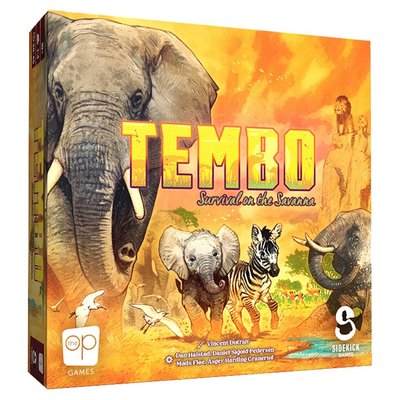
Hey everybody, Kimberly here, and boy am I excited today because I am going to show you the game that won my heart at BGG Con back in November. This game was just recently released and I got my hands on a copy of Tembo: Survival on the Savanna. This was my favorite game of the con. I got to do a demonstration in the exhibitor hall, and it was just it just captured me. Now, when you look at it, I want to show you what's out here in this video. I want to show you what comes in the game, how replayable this game is, how clean it is, how fun and engaging. I would say family-friendly in the sense that you're working together cooperatively to navigate an elephant herd through the savanna, avoiding all those pitfalls and dangers that are essentially trying to nab you along the way. Um so, I want to show you again what's in this game, what it offers players for gameplay, and why I still, after getting my hands on this, really enjoy this game. It wasn't just a good first impression, it's a good game.
Okay, so let's take a look at this. Players have these elephants, and there are four, so you have a one to four player game, and it takes about 30 to 45 minutes to play. Um so, I'll talk a little bit at the end maybe about the solo variants, but I've played multiplayer only, and I think it just works really well. So, you've got your yellow, your orange, your gray, and your purple elephants. Players are going to start with three elephants that are active. They have more elephants in their pool that they can essentially refresh. They're kind of getting them to the watering hole to give them water and food so that they can continue this elephant journey. This is your matriarch all the way up here, and you are going to configure these six square tiles. These are your tiles. You'll see here like this.
And so, you've got your tiles, you're going to be um essentially putting these out in a different arrangement every time. Now, to start the game off, they give you an easy kind of entry-level game, and that's one of the strengths of this game is that it is super scalable for challenge. Um so, difficulty. This is the B side, you'll see down here, that's the tile where the matriarch starts. You've got your six tiles configured, that's where the lioness is, and that's where you want to get to. Now, again, um this has a an A side and a B side just to start off, and you only have one lion that's out there, but there are two lions in the base game. So, I'll show you some of the other configurations, but for now, I wanted to show you this B configuration. So, matriarch starts here, and players have a hand. They're going to be hand cards that are dealt out to all players. They are shuffled up. There are 12 because there's four players, everyone starts with three.
Now, again, for scalability for uh challenge and difficulty, there are these five cards that have this kind of night time moon symbol. You can put zero to five of these on the top of the deck, adding more of these cards for an easier go. It essentially kind of staves off the lionesses because you're going to have a morning in your journey, you're going to have a noon in your journey, you're going throughout the day, and then by night, you better get to your destination. This is going to be the internal time clock for the game. So, once a player isn't able to play a card, that's going to be one of the end game triggers. So, you've got those all shuffled up in there, and this is the configuration. In the morning cards, there are 10 cards that are just regular path cards. There are four that are the matriarch cards, and then there are three that are the lion and lioness cards.
Then you've got more of these cards here, but fewer of the matriarchs, and it's going to get more of the baddies. So, towards the end of the night, things are going to get really dangerous. So, this is the makeup of the cards, so you can kind of count a little and kind of see what's the what's the percentage of me when I draw a card of drawing one of the basic cards, one of the matriarchs, and one of the lions. So, on your turn, what you're going to do is you're going to take a look at your three cards, and you're simply going to either extend your elephant walking by playing a card, um and you're going to add with your elephant colors on spaces that have circles, or you are going to play a card down into a space activating what you cover up. So, here's an example of a card that you can have that you can uh essentially is configured. And if you play the card down to play down elephants, you play down in this configuration or this configuration. And if there's an arrow, your arrow must point in the direction of the this way you're facing the board.
So, if there are four players, essentially, I'm facing this way, this player is facing this way, this player faces this way, and that player faces the other way. So, you all have your cards, but they're going to be played with the arrow pointing toward the board if there's an arrow. And if there's not, as you see in this card right here, this can be rotated any direction you would like. And you're going to be putting out, again, your elephants in that configuration. So, that's one thing you can do on your turn, and you're going to play a card, do the thing adding your elephants into the space, or you're going to play your card down, and it's going to cover up a space, and you're going to gain uh elephants. Um as you see here, you have pictures of elephants in all those spaces with the variety of iconography.
Now, right now, there's not too many places that are uh our fellow players can get out. So, our matriarch, we have to essentially connect to. I'm going to play this card down here right here, and I can turn it any way. The arrow isn't going to matter for this. So, if I want to make it this direction, I want to make it here, I want to make it there, it's it's entirely up to me. Uh let's give ourselves a nice little path going across that we can get here, maybe this direction, and then we can also get going this direction. So, I covered up um one of those that says four. It's purple, and it shows uh an elephant arrow going that direction. Let's take a look at that. Our book has a really nice uh list of icons of what actually is going on. Here it is. It's called Fill the Savanna. These are going to be our symbols.
So, I did this guy. Another player of your choice gets four rested elephants. So, that means they take four from their side pool and put it on top of their elephants uh uh token, which is their kind of elephant board. Um this one, you will see little spikes says everybody gets two. That's really good for a four-player game. That means eight total elephants are coming back into the game. In this case, you, the player who plays and covers this up, gains five rested elephants, and someone else loses two. Um and you may choose someone who has one or zero. And lastly, this one says you gain three rested elephants, then you place a single elephant, ignoring rough terrain, which has a little paw symbol, a little um foot symbol. And so, you'll see here that these spaces right here require extra uh elephants. All that means is it requires two elephants to go there, or you get to place an elephant there with no restrictions because you got this guy. You put it on the um this this kind of like plus three, and you get across through the two. So, there are going to be ways to do special things in this game that allow you to kind of work around stuff. Now, at the end of your turn, you have to draw a card from the top of the pile. And you draw your card and you're going to add it. Now, in this case, I know that these top five cards are going to be nice. They're not going to be mean. So, I'm going to add this to my hand and then play is going to pass to uh the left and we are all going to take one turn playing a card down, uh
creating a path, or playing the card in your player area with your arrow, of course, following arrow rules, and placing down elephants. So, let's see if this player can start playing down elephants because there's a pathway now. Uh oh, somebody got four elephants. I'm going to give this player four elephants cuz they're the next player to come up. Um and again, that was because I placed it on this guy, but I never did my action. So, they got four elephants and now they can do a whole bunch of stuff. All they did was go from their supply and put it into their their exhausted and now they're uh rested. So, this player's going to take a look at their cards and they have to play all this Wait, wow. All the arrows are pointing that direction. So, in this case, the person's coming from this side. This is going to be my player. So, they're all going to be playing this direction. So, they've got lines going this way, which is perfect for what I'm going to do. I'm going to play one of those two. I think that's fantastic. So, let me pick one of those two and I'm going to pick this red one over the green one for one specific reason.
If I play this red one, there are already red trees out here that you can activate and playing this means that we are not going to have this card in play, saving the green trees because you can only activate trees uh once before you play a matriarch card and they all refresh. So, this is a good choice over the green tree. Um and I'll I'll I'll show you more about that in a minute. So, again, this player's going to go this way. They're going to take not three, but four of their elephants and they're going to play this direction. They're going to have to put two elephants down here in this space so that they can activate that first spot and it's okay if they lay down and one here and then one here. So, that's going to be my line. This is going to go into our discard pile and then I'm going to take this red tree right here. This is going to be a red tree and you'll see in that space right there in the corner says plus one. We're going to move the sun back and we're going to lay the red tree down on its side. All the other trees are active and we take this sun marker that's right here and we are going to gain one more into the yellow space.
The sun marker is the sun going down and if this marker ever reaches the center here, we lose. So, you want to gain that sun because when you play matriarch cards, you're going to lose the sun as you wait for matriarch mama to walk all the way from the end of the elephant line to any other connected space to the elephant train. So, they place down in a configuration activated a tree. If you stand here at the watering hole, you gain three elephants, which is that plus three symbol like this guy right here. You'll see that is a plus three with the blue. Um and then that's the example of the green tree and the green tree is extra special because you get two sun movements back um in your favor cuz you rested underneath these beautiful trees and the green is extra special. All the other trees are plus one. So, now that player is done. They're going to draw their card, take a look at it. Looks like they keep coming from the arrow direction. They don't have too much flexibility here.
Um but they do have some possibility when it comes to some trees. Again, players are just going to keep on doing this. Now, what is the overall goal? You have to hit the landmarks first. You're going to see a landmark right here and it's this figure. You have to fill in all of these spaces that are uh circled in purple. To do that, you have to put elephants in any of those spaces, including the matriarch, and when you do, you pop up and you put your your landmark right there on the board. There's one here. There's this kind of icy spot here with one space in the center. Whenever you get that, you'll set it up. There's this kind of rocky um terrain right here. There's this little waterfall space. There is a nice, beautiful, green, lush land over here, and then a rocky pass down here, and you have to to activate all of those and get your matriarch to the end, of course, before this goes to here. If any player can't play a card um from there they can't play a card down on their turn. If any player loses every single one of their elephants because they were eaten or they were lost in some way, that's going to trigger the end of the game as well. And then lastly, if both of these lion and lioness markers are on the same space as a matriarch in the same tile, they take down the matriarch, and that's going to trigger the end as well. So,
there's a variety of ways you're going to lose, but there's the one way you're going to win together cooperatively. Now, as you go through these cards, you're going to start seeing I'm going to kind of pass through those, and I'm going to show you these first pink cards. So, you're going to start to see these guys. Again, you've got the lion cards and you've got the matriarch cards. So, let me show you these guys up close. There's the lioness card. It tells you exactly what to do. Um you're going to move the lioness first, uh and then you will move the lion second. And if they are laying down because they just fed on some of your elephants, you just simply stand them up. So, you kind of get like a one-turn head start to get out of the way if they come and uh essentially stand on the space where your elephants are.
Um and then you're going to essentially they're going to eat those elephants and then lay down. So, if this guy comes into a space over here, let's say gray got a space over here, and then the lioness moved into this space, they would say, "Yum, yum, yum." Eating all the elephants in the tile, which might be a lot, lay down, and this guy goes into the box. Um and so they will be essentially munched on. Then the next time they're activated, they simply stand up. And then the next time they will move, and they always just move one orthogonal space closer toward the nearest elephant. So, that's our that's our lioness and lion. They both are going to activate in a normal game. Now, the matriarch card is fascinating because you are going to get the matriarch card into your hand. And you can keep the matriarch card in your hand. You can even tell your fellow players, "I have a matriarch card in my hand."
You don't have to play it though, but if you draw two matriarch cards, they trigger. And it's one player who essentially has two matriarch out of the three cards in their hand. And it's going to trigger and be extra damaging to the players, but the same thing is going to happen when you just trigger it yourself by playing this instead of doing what the two things I just said. You're going to move the matriarch down the line to any adjacent space to your elephant train. Then you're going to um gather all the animals, all the herd of your elephants that were on that train, and you go to put them into your exhausted space. So, they're tired, but you can still essentially rest them and bring them back into play. Then you're going to take off two points on the sun if you activated your matriarch willingly. If you had two uh cards in your hand, you are forced to, you lose five sun. It is risky. There's a There's a press-your-luck in this game. So, that's why you don't want to wait too long, and you also look at the card to see how many matriarch cards are left, what's the likelihood of me drawing one, should we do it now? And then the last thing you do is you stand up all of your trees. So, you're going to refresh all your trees so that you can essentially cover up those spaces again. So, here's my matriarch, I moved over here. These all are going to come back, and now my matriarch's for oops, put them in the exhausted space. One, two spaces down in the sun, and that's how that card's going to activate. But, all the other
cards you're going to see here are just the regular cards. But, you're going to see those These are going to be those uh those matriarch and lion cards, and of course you've got that distribution here all shuffled individually into their spaces. So, that's the kind of game you got to play. There's a little bit of risk, there's a little bit of press-your-luck. But, again, the goal is to get the landmarks, move your train down where you need to, and of course get your matriarch to the end. Now, I keep saying you want to get your matriarch to the end. She can just be one of the elephants in your herd that fills up all of those locked spaces. So, let me show you this guy up close. Okay, so here's the board. Um once you've got your two folks here in the locked spaces, which are the purple spaces, they look a lot like the other purple spaces in your landmarks, that's going to trigger the end of the game, and you're going to win. So, any elephant, including the matriarch, and that might be a really great last move is like play the matriarch card to bump her up there so that you can then move other elephants to fill those spaces. But, but that's it. So, matriarch's going to get you all the way and along the way and keep your herd safe as you play her card to bring those back into safety so that the lions don't eat you. There's a lot of really great theme here and And mechanics that play along with the theme of time throughout the day, the sun setting, and then of course the landmarks as elephants move through the savanna.
They use the landscape and the landmarks to kind of guide their way to safety. Um and you see the safety up here is like that really nice kind of like, you know, paradise they used to see um picture with all the different animals. Um so yeah, there's just a lot to like here. Now, one thing I do want to do is spend just a little bit of time talking about the scalability cuz I've mentioned that there are a variety of ways to make this game more challenging. Uh one way is by playing one of these cards. So, for instance, these are going to be the easier configurations and you'll see that at the bottom of your card you're going to see the number. So, this is like 1 2 3 4. It shows you the configuration of your tiles, which of course it doesn't say which tiles, you just shuffle them up and place them. And then you've got your elephant in your starting space, your matriarch, and then it shows your lioness, and then your lion.
That's one thing. So, these are going to be your level ones. They have one star. And then you've got others, which are your level twos. You'll see here there's the level two star and there's four of those. And then you'll see here there's the level three stars. And so, it really makes it super hard for you to do what you need to do and they are incredibly challenging as you continue to move down the path. If you want a game to be just a little easier, you might play with these guys. These guys again are kind of like the night before, you're preparing your team your for for battle. Um but you have these set out um and you've got five of them and you can play them on your turn and you can play any number of them on your turn and they give you what it says. It gives you a sun, you move back on your sun space. It gives any one person two elephants refreshed into their pool.
This one says you can turn your card any direction, even if it says you can't. And that one says you can place down one of your elephants that's refreshed into one of those paw spaces that requires two. So, in case you're short an elephant and you really need to get there, you put that down for um you essentially spend it. All you do is you take this and you turn it over and you're like, "Well, I spent that guy." Now, the other thing is that you've got uh event tiles. And event tiles are going to challenge players. They're going to definitely um be a little bit harder. They say to play the game several times. Um I would even say maybe play without adding these moon cards, right? To start with, to just kind of like again, bit by bit, game by game, start making the game a little bit more challenging, especially if you're winning um more than you're losing, because this can be an incredibly challenging game. Um and you will just keep adding the challenge. So, with these guys, what you have are these events, and you have two events that are active. You'll shuffle this entire deck, and then you'll have two things.
Um and when a thing moves to the right um or it activates, it then does its thing. And there are ways to get rid of the events and to kind of mitigate them. Most of the time they're not going to be that great. Like this one says, "When you go to a watering hole, instead of getting three, you get none." Right? That's what this guy says. That guy says uh yikes. This one says, "Exhaust your red trees." Um this one though, on the other hand, says brown trees will give you two sun instead of one sun. So, some are good, some are bad, and you really need to play It's a little bit more like up in the air. You've got a game that has just a little bit more chance and a little bit more things happening than just the cards you're playing and the route that you're taking. So, events are going to change up the game. And ooh, this one says get five at the watering hole. Uh and it definitely does throw a lot more complexity your way.
Now, the last thing I want to mention is that there is a campaign. And on the back of these tiles that are going to be your configuration tiles, they've got these different setups for campaigns that are going to be easy, medium campaigns, and then hard campaigns. And uh you'll just read the instructions in the back for how to set up. And you essentially you're playing game to game. And you want to game. And you want to uh win those games individually over the course of a three-game campaign. And a three-game campaign is a one-star success, two-star success, then a three-star success. So, it just makes the game so replayable. You want to jump back in. You want to try the new configurations. You want to see if you are up for the challenge to kind of take the training wheels off and to take off those bonuses that really make the game just a little bit easier from the start. And you kind of want to see where that point is in your strategy and your gameplay. And of course, there is a little bit of chance and luck with the cards coming up in the deck as they're shuffled.
But you want to see as a team, um your two, three, four multiplayer game, how well you can do and how well you can mitigate against those lions and against the the challenges and the dangers. So, this game is so fun. It is just delightful, wonderfully themed, still lives up to the excitement that I had the very first time I played. And I just can't wait to keep playing this, jumping into the campaign, but then trying some of those harder configurations and taking off again the training wheels that I talked about. You have got to check out Tembo: Survival on the Savanna. What a delight. What a true, true delight. And don't forget there is going to be a solo experience. So, if you want to play this and it sounds like a puzzle for you, this solo is going to knock your socks off. All right, everybody. That's it for me. I'll see you later. Bye.