




Game Info
Year
2026
Players
1-4
Age
10+
Playtime
45 min
Collection
Your Tier
Loading…
Mechanic profile
Not enough video data yet
Vibe profile
Not enough video data yet
Description
A cooperative survival game where players guide a herd of elephants across a dangerous savanna using dual-use cards.
Featured Videos
Ask a Rules Question
All mentions
Browse transcript mentions, sentiments, pros/cons, mechanics, topics, quotes, and references.
Total mentions: 10
This page: 10
Sentiment:
pos 6 ·
mix 3 ·
neu 0 ·
neg 0
Showing 1–10 of 10
Video YMkrnTtlbNk
Board Of It Other at 9:59 sentiment: positive
video_pk 99369 · mention_pk 276262
Click to watch at 9:59 · YouTube ↗
Overall sentiment (raw)
positive
Pros
- Very engaging puzzle with interesting decision spaces.
- The difficulty ramps up significantly in the proper mode, adding more jeopardy.
- High replayability due to random card draws and map configurations.
- The cooperative nature discourages quarterbacking.
- Offers a good challenge for co-op players looking for something different.
Cons
- Can be quite brutal with the loss of elephants.
- Sacrificing elephants to lions is a depressing but necessary mechanic.
Thematic elements
- Leading a herd of elephants across the savannah while avoiding lions and resource depletion.
- The Savannah.
Comparison games
- Aqua
- Hutan
Mechanics (from transcript analysis)
- cooperative play — Players work together to achieve a common goal.
- Hand Management — Players manage a hand of three cards and decide when to play them for optimal effect.
- Modular Board — The game uses a configurable setup of six boards with landmarks.
- Set Collection — Players aim to have their elephants visit six specific landmarks.
- Worker Placement — Players place cards (representing actions or elephants) onto quadrants of the board to gain bonuses or make pathways.
Video topics + discussion points
No key topics recorded for this video.
Quotes (from this video)
- I wouldn't be surprised if this ends up in one of my maybe top 10 of the year.
- It has everything that's great about Blatro in a board game form, but also it works really well because you're just playing poker at the core of it.
- It's just a good fun decision spaces with with not that much, if that makes sense.
- It's indescribable in many ways. It's it's a massive space opera.
- This game is absolutely brilliant.
- It's so good. I really recommend it.
References (from this video)
No references stored for this video.
Video VjHwkR9-5kM
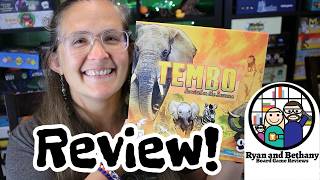
Ryan and Bethany Board Game Reviews Review at 0:06 sentiment: positive
video_pk 94798 · mention_pk 259311
Click to watch at 0:06 · YouTube ↗
Overall sentiment (raw)
positive
Pros
- Awesome art on the inside of the box lid.
- High quality cardboard.
- Clever use of a single resource (elephants).
- The matriarch card offers pivotal strategic moments.
- Energy component adds much-needed tension.
- Very little bookkeeping in a cooperative game.
- The game plays itself progressively, not with a separate board turn.
- Variety of setups for replayability.
- Great table presence with cool wooden standees.
- Vincent Dutrait's art is awesome.
- Fun puzzle to solve with great decisions and timing.
Cons
- The matriarch card, when played, causes all progress and pieces on the board to be lost, which can be a setback if not timed well.
- Elephants eaten by lions are out of the game permanently.
Thematic elements
- cooperatively guiding a matriarch elephant and her tribe to the end of the savanna while visiting landmarks and avoiding lions.
- the savanna
Comparison games
none
Mechanics (from transcript analysis)
- Action Point Allowance — We only have so many actions to work with, though.
- Card Play — On your turn, you have a hand of cards, and you're either going to play one out there onto the board...
- cooperative play — It's a cooperative game, we're all working together.
- Energy/Tension Track — You can lose the game by running out of energy, but you also just don't think about it while you're playing it. But, I like that that component is in there because it adds much-needed tension to the game.
- event cards — There's these lion cards, and when those pop up, when you draw one of those, you have to play it immediately.
- Hand Management — On your turn, you have a hand of cards, and you're either going to play one out there onto the board in order to kind of to connect the path or keep the path going for the elephants to move on, or you're going to play the card down uh instead, kind of discarding it uh to in order to put elephants out there.
- Path building — play one out there onto the board in order to kind of to connect the path or keep the path going for the elephants to move on
- Resource Management — Your only real resource is the elephants, so you have your whole supply, right? But then you have your rested elephants... and then when they're ready to move, you can move them over by placing certain things on the board, and then you can move them out into the board. So, I like how there's just this one resource, and all the different ways that that's being used.
- Set Collection — You need to fill in these requirements that you've been that basically shows that you've been to these various landmarks. You have to be into all six of the landmarks before the end of the game.
- variable setup — There's a ton of different ways you can set up the board uh and based off of the higher level of the challenge that you want to do... Lots of different ways to set up the game based off how difficult you want it to be.
Video topics + discussion points
No key topics recorded for this video.
Quotes (from this video)
- The whole game is Vincent Dutrait, which I love, but I just I don't know, that was cool.
- No, the cards have to be facing the way that you are facing.
- They want to do some sightseeing, some touristy stuff.
- Now what if you were also being haunted by lions?
- I really like how the supply works. Um, I think it's always cool when a game can have it feels like a lot's going on, but you don't have a ton of components to do that with.
- It's a big, kind of pivotal moment whenever you play one of those matriarch cards. It's kind of the the big strategy of the whole thing.
- I like that that component is in there because it adds much-needed tension to the game.
- This does not have that [separate game phase]. The only little bit of upkeep is the lions themselves.
- I like that there is it's all gameplay, very little bookkeeping um in a cooperative game, which is seems to be kind of rare.
- I this is a really solid cooperative game. I I wish more people were talking about it because I think it's really smooth and like Ryan said, it the game kind of plays itself.
- The game just keeps going, and and I think that's really unique and clever in a cooperative game.
- It has great table presence. You have these cool wooden I don't know if they're maples if they're the anime pulls if you would call them that or they just call them like these wooden standees. I'm not sure how you'd word it, but whatever they are they look cool.
References (from this video)
No references stored for this video.
Video 2dkzK7c6o8U
Grant Lyon Other at 50:22 sentiment: other
video_pk 82180 · mention_pk 206375
Click to watch at 50:22 · YouTube ↗
Overall sentiment (raw)
Intrigued
Pros
- Cooperative
- Challenging puzzle
- Replayable with different setups
Cons
- Difficult to win
Thematic elements
- Elephants escaping danger
- Savannah
- Cooperative
Comparison games
none
Mechanics (from transcript analysis)
- Card Play — where you sit is going to determine how the cards play because you're going to play cards down, and they have to be oriented based on where you're sitting and where you are in relation to the board that is out there.
- cooperative play — this is a cooperative game where you are playing as a herd of elephants moving across the Savannah.
- Resource Management — You're trying to manage your resources, you're trying to get more elephants.
- scenario play — There's also a bunch of different setups for the game. So, you know, there's sort of escalating difficulty setups and scenarios.
Video topics + discussion points
No key topics recorded for this video.
Quotes (from this video)
- This is a deck-building game.
- one of the interesting aspects of this is there's 13 ways to win the game.
- Essentially, 13 dark pacts in the game and each of those dark pacts is a unique win condition that feels, you know, it feels like crazy to get.
- You can also play two times and three times multipliers on those cards to double every aspect of the card.
- that just feels like a very satisfying aspect of the game.
- the main mechanism of the game is I split, you choose and that's always one of my favorite mechanisms because it's it's not a difficult game to teach, but it's a difficult game to make decisions.
- So, what do you sacrifice and what do you keep is also an interesting aspect of that one.
- This is a great family game if you want to.
- And so, there's a lot of lying and promising of other people where you're like, "Do you want to go there with me? Nobody else go there.
- I swear to god, don't go there."
- And so, there's a lot of sort of lying and intrigue and where you're going and promises that you're making and stuff like that.
- please, you know, check out my new series. It's all funny and games when it drops in May.
References (from this video)
No references stored for this video.
Video N8axtGDB_YM
BoardGameGeek Top List at 6:32 sentiment: positive
video_pk 81563 · mention_pk 203244
Click to watch at 6:32 · YouTube ↗
Overall sentiment (raw)
positive
Pros
- Cooperative game in a series with animal themes.
- Beautiful art.
- Elephants are cool creatures.
- Interesting tough challenge to bond over.
- Features Vince Detroit art.
Cons
- Multiple ways to lose (lose all elephants, run out of deck).
- Lions can chase off elephants, making the game harder.
Thematic elements
- Guiding a herd of elephants across the Savannah to a destination, visiting landmarks along the way.
- Savannah
Comparison games
- Aqua
- Hootan
Mechanics (from transcript analysis)
- cooperative play — Players work together to achieve the game's objective.
- Hand Management — Players play cards to fill out the Savannah, move elephants, or trigger actions.
- Pattern Building — Elephants must be placed according to a pattern required by the played card.
- Set Collection — Players need to visit specific landmarks along the way.
Video topics + discussion points
No key topics recorded for this video.
Quotes (from this video)
- Vince Detroit, one of the best.
- like probably the one today still, uh, that has the most name recognition, I would guess.
- So, what we want to do is talk about our favorite games that feature Vince Detroit's art and we're going to do that now.
- Number two is Unconscious Mind, which actually has two artists, very centrally involved in the game.
- So this is one for my money that works the best because it really kind of it reinforces the theme.
- Number one is going to be probably my favorite racing game, and that's going to be uh The Quest for El Dorado.
- I love this game. I really enjoy this race game a lot because this one always ends up being close.
- Quest for El Dorado is great. It's a great intro deck-building game, great intro race game, and make sure to check it out.
- Again, we were ranking them in terms of how much we like the games, not so much how much we like the art. Although again, the art's a banger in all of them.
- So much good stuff out there for Vincent Dutrait. They're so prolific. I don't know how the heck they do it, but they're just it's just the best.
- Vincent, keep doing what you're doing. Please make art forever. You're awesome.
References (from this video)
No references stored for this video.
Video 9EYPac_IzSQ
Tabletop Tolson Review at 0:13 sentiment: positive
video_pk 81210 · mention_pk 200493
Click to watch at 0:13 · YouTube ↗
Overall sentiment (raw)
positive
Pros
- Favorite game of BGG Con
- Captivating and engaging
- Family-friendly cooperative play
- Super scalable for challenge and difficulty
- Works really well in multiplayer
- Wonderful theme
- Mechanics play along with the theme
- Replayable through different configurations and campaigns
- Delightful and exciting
Cons
- Can be incredibly challenging
- Event tiles add complexity and are not always great
Thematic elements
- navigating an elephant herd through the savanna, avoiding pitfalls and dangers.
- the savanna
Comparison games
none
Mechanics (from transcript analysis)
- cooperative play — Players work together to navigate the savanna and avoid dangers.
- Hand Management — Players have a hand of cards that they play to extend their elephant path or activate tile effects.
- Press Your Luck — Elements like drawing matriarch cards and the sun tracker introduce risk.
- Resource Management — Players manage 'rested' and 'exhausted' elephants.
- Set Collection — Players need to fill circled spaces on landmarks, which requires placing elephants.
- tile laying — Players configure six square tiles to create the game board.
- variable setup — Tiles are configured differently each time, and there are different difficulty levels and campaign setups.
Video topics + discussion points
No key topics recorded for this video.
Quotes (from this video)
- This was my favorite game of the con.
- It just captured me.
- one of the strengths of this game is that it is super scalable for challenge.
- This game is so fun. It is just delightful, wonderfully themed, still lives up to the excitement that I had the very first time I played.
- What a delight. What a true, true delight.
References (from this video)
No references stored for this video.
Video XQQ_D-jlf6U
Playthrough at 0:18 sentiment: mixed
video_pk 66869 · mention_pk 162682
Click to watch at 0:18 · YouTube ↗
Overall sentiment (raw)
mixed
Pros
- Cooperative nature
- Thematic elements (elephants, savannah, lions)
- Engaging mechanics like card placement and resource management
Cons
- Can be brutal and difficult
- High risk of losing elephants
- Difficult energy management
- The double matriarch mechanic can be punishing
Thematic elements
- Getting a herd of elephants safely across the savannah while managing fatigue and avoiding lions.
- Savannah
Comparison games
none
Mechanics (from transcript analysis)
- card drafting/playing — Players draw and play cards with various effects, including placing elephants, building the savannah, or activating special abilities.
- cooperative play — Players work together to achieve a common goal.
- Hand Management — Players use cards from their hand to perform actions or gain benefits.
- Push Your Luck — Elements like drawing matriarch or lion cards can lead to negative consequences if not managed carefully, especially with double matriarch draws.
- Route Building — Players are trying to guide their herd across a series of boards to a destination.
- Set Collection — Players aim to collect specific sets of items or cover specific spaces on the board (landmarks).
Video topics + discussion points
No key topics recorded for this video.
Quotes (from this video)
- We got to get mossy.
- We got a destination to get to, baby.
- The matriarch has spoken.
- The strength of elephants is shocking.
- Hilarious.
References (from this video)
No references stored for this video.
Video Mb5LBSp3f9c
Review at 0:19 sentiment: mixed
video_pk 66849 · mention_pk 162654
Click to watch at 0:19 · YouTube ↗
Overall sentiment (raw)
mixed
Pros
- Beautiful artwork
- Unique cooperative experience
- Tense theme
- Good job conveying the tension of moving the herd across the savanna
- Helps prevent alpha player syndrome due to card orientation rules
- Low alpha gamer possibility
Cons
- Minor issue with landmark identification
- Setup cards feel arbitrary
- Can feel repetitive
- Can feel punishing
- Can get a bad deck makeup
- More interesting than fun
- Missed the fun of it
- Doesn't gel for me
- Might take longer than 30-45 minutes due to being a thinky game
Thematic elements
- Cooperative game where players take a herd of elephants across the Savannah without lions eating them.
- Savannah
Comparison games
none
Mechanics (from transcript analysis)
- cooperative play — Players work together to achieve a common goal.
- Hand Management — Players manage cards in their hand to perform actions.
- Modular Board — The game board is composed of several modular pieces that can be arranged differently.
- Push Your Luck — Players take risks, such as drawing cards, that could lead to negative consequences.
- Resource Management — Players manage resources like elephants and energy.
- variable setup — Different setup options are available to adjust difficulty and board layout.
Video topics + discussion points
No key topics recorded for this video.
Quotes (from this video)
- The game is, as many cooperative games are, a procedural game.
- Because it has this weird hand management where you're all like, 'oh Mike, you're almost out of cards.'
- The game to me is more interesting than fun.
- I do feel that tension of getting my herd across the savanna.
- If you don't like any punishing elements, then you might be on the other side of that continuum.
References (from this video)
No references stored for this video.
Video pt5OAtMHqCg
TheGameBoyGeek - Hi Quality Hi Energy Board Game Reviews Rules Teach at 0:18 sentiment: positive
video_pk 60171 · mention_pk 152611
Click to watch at 0:18 · YouTube ↗
Overall sentiment (raw)
positive
Pros
- Strong thematic focus on elephants and savannah life with cooperative play
- High replayability due to variable journey tiles and random setup
- Rule-school approach reduces the learning curve for new players
- Tension from energy management, lion threats, and deliberate matriarch movement
- Card rotation and orientation mechanics add depth and player interaction
Cons
- Relatively steep initial learning curve due to multiple interacting systems
- Orientation-dependent placement can be confusing for newcomers
- Rule complexity with various exceptions may require a patient moderator or longer initial play
- First games can feel lengthy due to setup and rule explanation
Thematic elements
- Cooperation under threat from predators (lions) with resource management (energy) and elephant herding as core mechanics
- Savannah, Africa during a cooperative elephant migration toward six landmarks and a destination board
- Cooperative, tile-driven journey with variable setup and evolving board state
Comparison games
none
Mechanics (from transcript analysis)
- Card rotation and icons — Some cards feature an icon that allows rotation; rotation can alter outcomes and board state, and is the only time you can rotate under certain conditions.
- Elephant placement and adjacency — Elephants are placed in a fixed paw-pattern adjacent to the matriarch or other elephants; diagonals count as adjacent within the given adjacency rules.
- Energy management and trees — Eating trees grants energy; energy loss is a central lose condition, and tree colors/flip mechanics influence energy dynamics.
- Landmarks and standees — Landmarks are completed by occupying purple circles; completing all landmarks yields standees and moves you toward the win condition.
- Lions and lioness activation — Lions wake up from cards, move toward elephants, attack and remove elephants; this raises risk and can force strategic shifts for all players.
- Matriarch movement and herd pushing — The matriarch can move to adjacent spaces, pushing the herd toward landmarks; moving costs energy for players and triggers regrouping of elephants.
- Pattern placement and orientation-based card play — Players place cards on Savannah boards in quadrants; the card's directional arrow must align with the facing orientation, making siting and direction matter.
- Rough terrain and resource costs — Rough terrains require two elephants per space and cannot be used on the same turn to gain energy, injecting strategic cost into movement.
- Support cards and tokens — Support cards provide one-time benefits; tokens are spent before actions and are limited in number, adding a layer of planning.
- Tech Trees — Eating trees grants energy; energy loss is a central lose condition, and tree colors/flip mechanics influence energy dynamics.
Video topics + discussion points
No key topics recorded for this video.
Quotes (from this video)
- Tempo is a cooperative game for one to four players where you're all collectively trying to move your herd of elephants to six landmarks and then get to your destination.
- You always have to be on the lookout for lions because they're going to come up as you draw cards as well.
- And over the course of the game, your matriarch elephant is going to be pushing the herd forward to the goal of the game.
- There's four ways to lose and we'll go over those as we come up to them.
- It's a bit of a pressure of luck because if you hold one of these in your hand, you don't have to play it.
- Cards with that icon can turn the card and rotate it, even if they're placing elephants.
- The object of the game is to visit all six landmarks.
- You win.
References (from this video)
No references stored for this video.
Video IJRZTHeegJQ
Before You Play Playthrough at 0:00 sentiment: mixed
video_pk 39254 · mention_pk 118208
Click to watch at 0:00 · YouTube ↗
Overall sentiment (raw)
mixed
Pros
- Cooperative gameplay emphasizes teamwork toward a shared objective
- Dynamic board layout from rotating cards and footprint configurations adds variety
- Energy management and tree-based energy gain contribute meaningful decisions
- Multiple difficulty options and optional helpers offer accessibility and challenge
Cons
- Lions and matriarch mechanics create high risk and potential for sudden loss
- Rules complexity and deck RNG can be punishing and hard to master
- Choke points and board randomness can force suboptimal plays or fatigue
Thematic elements
- Cooperative wildlife management and herd survival
- Savannah, Africa; elephant herd migrating toward landmarks while avoiding lions
- Array
Comparison games
none
Mechanics (from transcript analysis)
- Adjacent placement (including diagonals) — Elephants must be placed adjacent to existing elephants; diagonals allowed.
- Card placement and board-building — Players place Savannah cards to build usable spaces on the board.
- Card rotation and footprint shapes — Rotation allows card orientation to adapt to seating; footprints define placement patterns.
- Cooperative play and information sharing — Players discuss plans but cannot reveal exact hands.
- Difficulty modifiers (support cards, optional event deck) — Support cards and optional event decks modify game difficulty.
- Lions as threats (immediate play and pursuit) — Lions activate immediately when drawn; they move toward the closest elephant space and can wipe out elephants.
- Matriarch cards (multi-step reset) — Matriarch cards trigger a four-step sequence that moves the matriarch, resets elephants, costs energy, and un-exhausts trees.
- Resource Management — Elephants exist as rested/tired; energy is tracked; trees provide energy when exhausted.
- Resource management (elephants and energy) — Elephants exist as rested/tired; energy is tracked; trees provide energy when exhausted.
- Tile Placement — Elephants must be placed adjacent to existing elephants; diagonals allowed.
Video topics + discussion points
No key topics recorded for this video.
Quotes (from this video)
- Tempo Survival on the Savannah.
- This is a fully cooperative game for one to four players.
- We chose to go with an easier configuration by leaving out the event deck.
- Lions are the main aggressors and can wipe out elephants.
- We visited all six landmarks and then the matriarch was moved to secure the final steps.
References (from this video)
No references stored for this video.
Video 8BaSaQdsN78
Watch It Played Rules Teach at 0:07 sentiment: positive
video_pk 38709 · mention_pk 116643
Click to watch at 0:07 · YouTube ↗
Overall sentiment (raw)
positive
Pros
- Cooperative, encourages player discussion and teamwork
- Varied setups with multiple Savannah boards and difficulty tiles
- Clear, teachable progression with demonstrable rules in the video
- Campaign and solo options extend longevity and replayability
Cons
- Rule complexity can be challenging for new players
- Lions and footprint pattern rules require careful teaching and setup
- Some mechanics (patterns, terrain interactions) may feel fiddly in larger player counts
Thematic elements
- cooperative herd survival against predators (lions) in a dynamic savannah landscape
- Savannah, Africa; elephant herd migration and survival
- tutorial/educational
Comparison games
none
Mechanics (from transcript analysis)
- build the savannah — place Savannah cards onto boards, oriented by arrow rules or freely if the card allows, to shape the map and gain benefits
- deck management and matriarch interactions — a draw/deck system with multiple card backs; matriarch resolution, including double matriarch scenarios, affects energy and draw penalties
- Deck Manipulation — a draw/deck system with multiple card backs; matriarch resolution, including double matriarch scenarios, affects energy and draw penalties
- end-game and failure states — lose conditions include energy reaching the end, depletion of elephants, lions in matriarch area, or an empty draw deck
- energy track and trees — an energy track governs game termination; trees and energy events provide energizing or penalty effects via standees
- Events — optional event cards and support tokens modify rules or grant benefits; events can be immediate or persistent
- events and support tokens — optional event cards and support tokens modify rules or grant benefits; events can be immediate or persistent
- landmarks and win conditions — players must visit all landmark spaces printed on Savannah tiles; once all purple spaces are filled, the game ends with a win
- lions — when activated, lions move toward the nearest elephants, potentially removing elephants and imposing penalties on players
- matriarch — play or move the matriarch, then resolve its effects and reset or adjust elephant placements; matriarch interactions affect penalties and card resolution
- place elephants — rested elephants must fill footprint patterns on the board according to the exact pattern, orientation, and terrain rules
Video topics + discussion points
No key topics recorded for this video.
Quotes (from this video)
- The savannah is beautiful, but it can also be dangerous, especially for elephants making their way to its various destinations as they work to find food, protect the herd, and avoid attacks from lions on the prowl.
- Join me at the table, and let's learn how to play.
- The game is played over a series of turns, starting with the first player and then going clockwise around the table.
- If you ever reach this final space of the energy track, the players all lose.
References (from this video)
No references stored for this video.
Transcript Navigation
Showing 1–10 of 10