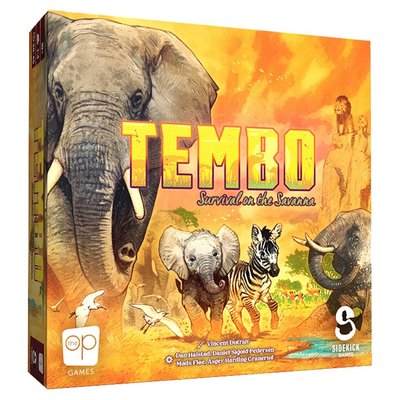
Tembo: Survival on the Savanna Review: It's Bananas on the Savanna
Games in This Video
1 game is featured in this video — it unlocks as you watch.
Transcript
Hey everybody, I'm Tom Vassal.
I'm Mike Delisio.
And today we're taking a look at a game called Tembo: Survival on the Savannah. This is sort of a series of games that uh Sidekick has been doing in the app. Uh they did Aqua and they did um
Hutan. Hutan. They did them about a year apart.
Yeah, the first one was about the water, Hutan was about the jungle, now we're in the Savannah. This one is very different than the other two because the other two were more about placement and they were competitive games.
Yeah.
This is a cooperative game in which you are taking a herd of elephants across the Savannah without lions eating you.
That's basically it, yeah.
Yep, that's the game. Mike is going to show us how to play it.
When setting up a game of Tembo, there are several things that you can do to adjust the difficulty in the game. One of the first things you can do is determine what layout you want for the boards. These six boards, these Savannah boards, are going to be placed out in random orientations, but the way that they're actually set up is going to be dependent upon which of these journey tiles you choose at the beginning of the game. These journey tiles with one star and the green background are the easier setups. This is actually the setup they uh suggest you use for your first game, but there is a bunch of these different tiles, several of the easy ones, more intermediate, and then more difficult ones with three stars. There is even an intro game you can play if you want that is shorter and the easiest setup. In addition to the layout of how these are going to be placed, it shows you where your lion and lioness are going to start and uh the matriarch will always start on this space, which is a kind of the entrance and the exit, if you want to look at it that way, the beginning and the ending.
What you're trying to do in Tembo is you are trying to build elephants across the savanna, herds of elephants that are going to eventually get into these two purple spaces at the exit there. You'll see those lock tokens, those only get unlocked when all of the different landmarks have been unlocked. You unlock these landmarks by placing elephants on those colored spots. And so once something like this would happen, this landmark would then be activated. If those elephants later get removed from the game, it doesn't turn that back down. Once they've been activated, they've been activated. When all six of these have been activated, then those two spots become actually all four of these spots become unlocked. And when you get two elephants in there, you would win the game if you don't hit one of the many loss conditions that could happen as well. The other way you can determine difficulty is by putting up to five of these support cards at the top of the deck. These are three decks that get randomly or they get shuffled randomly, decks one, two, and three.
They get placed on top of each other. And then if you wanted to make it easiest, you would add all five of these support cards to the top. And the number of support cards you put to the top of the deck is also the number of these support tiles that you'll have access to as a team, this being a cooperative game. On your turn, you're going to be doing one of two actions. You're either going to build the savanna or you're going to place elephants. When you're building the savanna, you're going to be placing cards from your hand. Everyone starts with three starter cards. And you're going to be placing them onto the savanna boards. They can go into any open spot, which just essentially means any place that doesn't have a pre-printed landmark graphic on the board. You can even put them in places where the lion or the lioness is. That's a fine, but you just cannot cover up the pre-printed areas.
When you place savanna cards, when you're doing it to build the savanna, the orientation of where you're at the table matters. So, let's say that the purple player is sitting where I'm at at the table facing in this direction. If the card shows a straight arrow like this one does, it has to be played with that arrow pointing in the direction as it relates to me. If the orange player was sitting over here, if they were to place a card with a straight arrow, it would have to be placed with their orientation facing ahead of them. When you play them, you have particular things that might happen. So, whatever you cover up on the board is what you will take into effect. So, let's say for example that the purple player here, they're going to build the Savannah for their first turn, they're going to go ahead and place this here. They're covering up these icons which say that they're going to be adding five elephants from their exhausted area to their ready area. Everyone starts with three elephants in the ready area, but then another player has to move two elephants from their ready to exhausted.
You'd have to discuss that as a team. Let's say that the purple player played this here, they would take five elephants, place it onto their ready area, and let's say for example that the gray player said, "Well, I'll just go ahead and remove two for me." They just took one for the team, so to speak. Once you have done uh that, you would then draw a card from the top of the deck to get your hand up to three cards. The other thing as I said you can do is place elephants. So, let's say that the orange player is next and they're going to play one of their cards to place elephants. When you are placing elephants, what you're looking at is the patterns on the top of these cards. And if they have straight arrows like this, they also have to conform to the orientation of where you're sitting. So, the orange player is sitting this way, if they played this card, it would have to be three elephants in a vertical line like this.
Elephants have to be placed adjacent to any other elephants that are on the Savannah or the matriarch. In this case, the matriarch is the only elephant on the board. You could not play this card because there would be no legal placement. There's no place where you can place three elephants in a straight line like this. However, if the card has a arrow like this, let me get that in focus. You could rotate it. This also counts for when you are placing cards to build the Savannah. So, if orange was choosing this to place a card on the Savannah, unlike the cards with the straight arrow, they can put this in any orientation they want. Same thing with the with the elephant adding elephants. They can put this in any orientation they want. So, maybe what they're going to do is they're going to play it this way. With that orientation, they've got three ready elephants. They can put it in that orientation because these both of these spaces are adjacent to the matriarch. You can count diagonal when it comes to adjacency. And maybe they would just go ahead and place that, that, and that. One of the things you might notice is that these two blue tree spaces were filled. When that happens, you take the tree. Actually, these would normally be standing up, but for the purposes of the overview, I had them laying down. These would be standing up, and when you complete one of those, you flip it down, and what it tells you is that you're going to add some energy.
So, depending upon player count, this energy marker is going to start on a particular place. This would be going this way. When you add energy, you're moving toward the matriarch space. When you lose energy, you're adding towards going towards this kind of desolation space. One of the losing conditions is ending here. If the energy marker ever gets onto this space, that is one of the losing conditions. In this case, we gained some energy, and that's a good thing. This would get discarded and get replaced. So, those are the two things that you can do on your turn. Either build the Savannah by playing cards from your hands onto open spaces, doing whatever the icons underneath tell you to do, or adding elephants as long as you have a legal way to place them. As I mentioned, if you are building elephants in such a way that you are able to cover up the purple spaces on one of these, you would flip up that one like I already showed you here, and that would be one of the ways that you're going to That's the really the only way you can unlock these spaces. When all six of these have been activated by placing elephants on all the purple spaces, now you are eligible to get elephants placed onto these spots, those two being the ones you need to win the game.
There are other ways that you can lose the game, however, other than getting the energy marker all the way down here. Another way you can lose is if you need to draw a deck a card at the end of your turn from the deck and there are no cards left in the deck. Another way is if both lion meeples Here, you've got the lion and the lioness. If both of these, let's say the matriarch at one point was here, if both of these were on the same space as the matriarch, that would also end the game. Or if a player has completely run out of elephants, they have no ready elephants, no exhausted elephants, that would also trigger the end of the game. But, there are a couple of cards we need to talk about and they're related to the matriarch and to these lions that started over here. Let's first talk about the matriarch card. When a player has a matriarch card in their hand, they can choose to play it. It's likely something you'd want to discuss as a team. You likely would not want to play it this early. But, when you play the matriarch card, a couple of things are going to happen. When you play the card, you have the option to move the matriarch. You can move it adjacent to any elephant on the board. It can also stay where it's at or move to a space it's adjacent to. But, let's say for example, it just decided to move here.
The other thing that you're going to do is gather the herd. All of these elephants are going to be uh returned to the players in their tired space. So, these would go here, these would go here, and these would go here. Then, you're going to lose energy. You're going to move the energy to Let's say that we were here, you'd move it two back on the energy board. And then, any trees that had been triggered would be refreshed, and they'd stand up. You could potentially retrigger those trees. That's what happens when you choose to play a matriarch card from your hand. However, if ever a player is holding a matriarch card, and they have to draw from the deck, and they get another matriarch card, they are forced to play them. That's called a double matriarch. And what that's going to do is you're going to have to perform those steps that I mentioned twice in a row. And instead of losing two energy for each, you would lose a total of five energy.
So, it's an extra penalty towards energy. So, you are incentivized, if you have one of these in your hands, to play them because it's a bit of a risk to draw another matriarch card. And also, there is an idea of the distribution of how many matriarch and lion cards are in each of the three decks in the game. There are no matriarch or lion cards in these support cards, which is why it can make the game easier if you include them. We haven't talked about lions yet, so let's talk about lions. When a lion card is drawn, it has to immediately be played. The first thing that would happen is if any lions are lying down, they would stand up. So, the first lion card that's played is purely making those lions active. However, if another lion card is drawn, and they are standing up, now they're going to activate, and they're going to move.
They're going to move in the closest the the the quickest direction towards the nearest elephant. In this case, the only elephant on the board is the matriarch. And so, lions don't occupy these squares. They occupy entire regions. So, this lioness, which always goes first, would move here. Then, this lion would move here. If there's ever a tie for the the nearest, you would just use this little indicator here to tell you first you'd go north, then east, then south, then west. Otherwise, you're going to just go to the the nearest elephant taking the quickest route possible. If a lion were or a lioness is on a tile that has elephants on it, they're removed from the game and not put back into their supply, just removed from the game completely. If there was ever a situation where the lion and the lioness were on there, like I said, that would be a loss condition as well. There's a couple of things that uh I'm not going to go into huge detail about. There are some terrain effects like these are rough spots, which mean that to place elephants here, you'd have to place two of them. So, to place on these two spots, you would need four elephants. Uh however, there are cards that would allow you to ignore that requirement, something like this. If you're using this to place elephants, you can ignore those.
Um and there are the support tokens. As I said, these are to make the game easier. Someone could use this on their turn, spend it to get one of these effects, either gain an energy, gain a couple of ready elephants, rotate a card if it couldn't be normally, ignore rough terrain spots. Again, these are one-time use that could be spent if you wanted to make the game easier. If you wanted to add another element to the game, an advanced element into the game, you could add these event tiles. These are going to be tiles that are going to kind of change up some of the effects of the board. Some of them could be good, some of them could be more difficult, things along those lines. But, you probably want to add those after you've played the game a few times. And so, all right, there you go. That's Tembo. Let's head back up and let you know what we think.
So, this game has a few First of all, the artwork is beautiful.
the pieces are fine. I don't mind them. It's easy to tell where stuff is. And the I do have a issue. It's a very minor issue. I don't care about They're like, "When you pass this checkpoint then tip that
one over and I'm like, wait, which one is which? This is for goodness sake. I'm like, just tip one over.
Yeah, there's only there is one tree that is different that gives you I think one more energy than the other ones do.
No, I'm not talking about the trees. I'm talking about when you see the landmark
Oh, the landmark.
I'm like, okay, which landmark matches the one we saw? It doesn't matter. It just
a landmark.
I almost would rather that it just been a track
Sure.
move down the track as you see each landmark. Just extra pieces.
Yeah, yeah.
But other than that, the game looks really good.
I'm I'm not convinced that the setup cards are like how you put the pieces out. It feels like I could have thought of that. Like, oh, this one you put them in a square and this one they're in a length of one. I'm like Yeah, I get it. I could have just made those.
Yeah, it it does seem a little bit arbitrary. I mean, I know that it can't be because they have these difficulty levels on them.
Sure, because obviously you're going to move farther and and the way that the landmarks are on them and the lions are set up. The game is, as many cooperative games are, a procedural game.
Yes.
And it's an for better for worse, I don't know that I played another cooperative game quite like this one.
That was something I was definitely going to mention is that this gets unique points from me for sure. I don't think I've played a cooperative game like this at all.
Because it has this weird hand management where you're all like, oh Mike, you're almost out of cards.
Yep.
We will help you.
Mhm.
That sort of thing and just the knocking of trees down. I felt like the lion being a danger
Mhm.
was the least of my concerns as much as it was more running out of time.
Running out of time being an issue for sure. Um
lions pushes that. I actually I meant to look this up. Like, how many times do baby elephants get killed by lions? I don't know if that happens very often. Cuz elephants are pretty powerful.
Very powerful.
they protect their young fiercely.
Very protective of their young. Um yeah, I don't know. Uh but but you're right. I think that the the lions have a sense of danger, but it's more hand-in-deck management that is the biggest
always I'm like, "Oh, I'm almost out of cards. Oh."
Yeah, and try and keep track of okay, how many matriarch cards have been have we seen so far because if you double up on those, then you have to do two things in a row, and you really don't want that to happen if you can avoid it. You know, kind of when you play those can be a consideration. Um and I think that's going to be probably uh for people that have issues with the game, that might be the biggest part is that sometimes you can get a bad deck makeup, and it's going to feel punishing. Um if you get a bad run of matriarch and lion cards, you can just feel behind the eight ball through nothing other than kind of how those cards happen to come out.
I don't love the game, but I that's a little true for me.
Mhm.
I the the whole setup Some tabs are harder than others. And they have this rule at the beginning, when I first read it, I was like laughing like you can spend some energy to move you know, to move one of the tile or rotate a tile. And I thought, who cares? And then after we played, I was like, "Oh, I would have cared."
It's a huge deal. Can be.
Because you can Although it doesn't make any thematic sense at all.
No, no. You can rotate the savanna, yeah. But it is definitely a game that requires you to talk a lot
Yes.
to say, "Oh, we need to do this. We need to go over to the trees and this." It for me, it does feel like you're doing the same thing over and over and over. And it's like, "We're now going to reset." Okay.
Yeah.
We move the elephants to the next spot. Okay, we're going to reset. Let's do it again. We got to hurry up or time is running out. The lions are moving. What are we going to do? There's a lot of talking. As with any cooperative game, an alpha gamer could kind of control the game, but I I don't feel it's too bad in this.
Yeah, I think this one is relatively low on the on the continuum of alpha gamer possibility. Sure, you can have somebody, but it I don't think that it's designed in such a way that that is going to be, you know, pushed forward. The The The other aspect we haven't really talked about that I think is particularly interesting is that when you're placing when you're building the fan the Savannah by placing a card out, you're you have a direction at the table
kind of that you are is your kind of facing direction. And most of the cards have a have a straight line straight arrow, which means that you have to face them towards whatever your direction is that was established at the beginning of the game. Or you have the ones with the little curved and you can twist it any way you like.
Yeah, I found that more interesting in theory than in practice, and in practice the thing I did not love about that was the cards that let you go in any direction are just clearly the best cards in the game.
Absolutely they are, and they're and they're fewer.
I felt restricted. Like you you can cut yourself off your whole path if you're not careful, and you have to be cautious on that or just you're just slowly going in a circle or covering up too many things and you're like, "We're wasting time." So, placing those cards is important. The directional thing is I I I think the directional thing if anything it stops people from being alpha player cuz I can't look at the cards in your hand.
Cuz that's exactly it.
Um and so I'm like, "Does it Can anyone place it this way? We need to move this direction." I hate playing diagonal cards because the movement that they allow is so critical sometimes.
is, yeah.
Yeah, it's interesting The game to me is more interesting than fun.
I understand what you're saying, yeah.
For me it's a six. It's not a bad game. Um it works, and I think some people are going to like it. It says 30 to 45 minutes in a box. I don't know that 30 minutes is going to happen very often. I definitely think it's going to go a little longer than that because it's a thinky game.
to be considerate, yeah.
It is somewhat thematic, the whole moving the elephants across thing. I like that concept a lot. It just didn't gel for me cuz I I I kind of missed the fun of it, I guess, is is my strongest negative. But I also can see that a lot of other people would enjoy it. So, for me, it's a mediocre type game, but I'm not If someone said we're playing it, I'll be like, "Okay."
I'm one of those people that like it, right? I'm giving it a 7.5. Um I I think the uniqueness of it helps quite a bit. I think the theme helps quite a bit because I do like the theme. I do feel that tension of getting my herd across the savanna. Like, I do think it does a nice job of that. I think for people that uh you've already mentioned you that you're not as big of a fan. I think that that if you're wondering whether this game is for you, you probably have to look at are you okay with cooperative games feeling punishing? Because this can feel punishing. Um and you know, there are other games like that, Gloomhaven, things along those lines. Where are you at on that continuum on the cooperative
feel halfway through your journey going, "We can't win."
Yeah, yeah. So
might want to restart at that point.
Correct. Correct. And so, I think if you're wondering whether this game is for you, maybe look at those things. Um I like it because I've played a lot of cooperative games and it feels unique. That to me gives it a push. I love the theme. I still do have fun, uh but I 100% understand what you're saying cuz I have that feeling about other games where it's more unique and interesting than fun. This one for me is still fun, but if you don't like any punishing elements, then you might be on the other side of that continuum.
Well, there you go, folks. That's Tembo. Thanks for watching. I'm Tom.
I'm Mike.
We'll see you next time on the savanna.
Ooh.
Hey, everybody. Thanks for watching this video. If you like this review or whatever you just watched, wasn't it amazing? Uh check out our channel, Dice Tower. Uh we have all kinds of things. We review games, we do top 10s, we play games live. It's all about board games, but especially the people who play them. Check out Dice Tower YouTube channel.