How to Play Tembo: Survival on the Savanna (Rules School)
Games in This Video
1 game is featured in this video — it unlocks as you watch.
Transcript
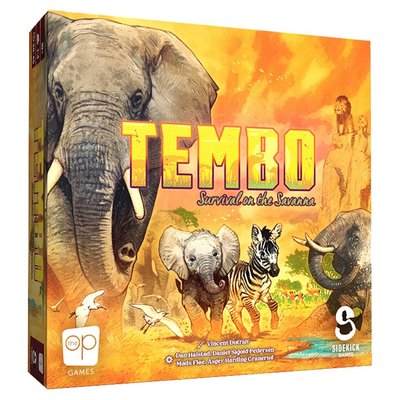
Hello my friends. It's the Game Boy Geek here and today we're a herd of elephants on a thrilling journey of survival across the savannah. Now you'll be searching out food and water, navigating shifting terrains, and avoiding the fierce lions that can roam the land in order to reach your destination. Tempo: Survival on the Savannah is a cooperative game for one to four players, takes 30 to 45 minutes to play, is for ages 10 and up, and published by The Up. Today we'll be doing a rule school where I'm going to teach you how to set up and play the rules so that you don't have to read the rule book yourself. Let's get started.
Tempo is a cooperative game for one to four players where you're all collectively trying to move your herd of elephants to six landmarks and then get to your destination. You'll be building the savannah by playing card in a specific direction that you're sitting in order to then be able to place elephants on there. And you might be trying to do things like eat trees, which gain you energy, which is important because if you run out of energy, that's one of the ways to lose the game. And when placing elephants, you're using a specific pattern on the card that you're using again in the direction that you're facing the board. And over the course of the game, your matriarch elephant is going to be pushing the herd forward to the goal of the game. And you always have to be on the lookout for lions cuz they're going to come up as you draw cards as well. And they're going to be waking up and then moving and then attacking your elephants, removing them from the game, giving you less options. So, let's see if you have what it takes to navigate the savannah. Keep your energy high, visit landmarks, and get to your destination.
To set up, each player is going to take an elephant board of a certain color, in this case, purple, and they're going to take the corresponding elephants with it. Now, if you're playing a two-player game, you'll use all 13 elephants. If you're playing a three or four player game, you'll only use 11 elephants, meaning you can put two of those back in the box. It doesn't matter which ones you place. Their poses and sizes have no impact on the game. You'll then take three of those elephants and place them on your playerboard. The rest of them will stay off in your own supply. The ones on the player board are rested elephants, and the ones off the board are tired elephants. Now, I have them laying down here just so it's a little bit easier to see in this shot, but you'll be having them stand up as normal. Next, you're going to select a journey tile, and they range everything from an intro game that has A on one side, B on the other side. And you might want to try this for an easier journey to learn the game and introduce it to other players because it's, you know, it's a bit easier and shorter. Uh, but there's three other types, and you'll see levels one, two, and three. You can choose any one of these you like. If you're not playing the intro game, I highly recommend starting with one of the green tiles. Now based upon the journey tile you selected you are going to lay out the tiles and the starting and destination tiles as well to match this orientation. Now these tiles are going to be shuffled face down both with normal shuffling but also turning and randomizing their orientation as well.
So each game is going to be very different. And so when you're done it should match your journey tile and it might look something like this. Now again, notice that some of the tiles appear to be upside down, but that's part of the randomness of the game is that some of these tiles are going to be in different orientations. You'll then take the six landmark standees and either place them near or on the destination board. On your start board, you're going to place the matriarch mele right on its corresponding spot. And you're also going to take the energy token and place it on the spot for your player count. One or two players, three players, or four players. In this case, we're playing a three-player game, so we'll start it there. In future games, once you know the strategies of the games, you can now optionally move this energy token two spaces towards the center, which is essentially spending energy in order to reorient any one of the savannah boards. That means keeping it where it is, but spinning in any orientation you want. I wouldn't recommend this for your first play since you don't really know the strategies yet. Next, you're going to place the lioness. And and when you look at this, you'll see that she's placed in the bottom right quadrant of this specific tile. You always place them laying down at first. And also the lion is in the top one, top right quadrant. It's okay to have them on the landmark like that, but make sure they're laying down. Next, you'll place all four tree standes right next to the start board. Next, take all of the cards and separate them out into their five different decks as you see here. Shuffle each deck independently.
The one with the hands are the start cards. Each player is going to receive three of these cards that they can look at. The rest of them that aren't being used can be placed back in the box. Generally speaking, you're encouraged to communicate anything about your cards, but you can't ever show them to other players. Next, you'll see that these cards have levels. Level one, level two, and level three. First, you're going to stack level two on top of level three. Then, you're going to stack level one on top. So, it starts with level ones, then gets to twos, then gets to threes. So, now you have one large tiered deck there. Next, these are support cards. You optionally can choose your difficulty. uh if you add zero to five cards. The more cards you have add, the easier it will be. For your first game, we recommend using all five support cards. So, you'll place those support cards on top of the deck that you've already created, and you'll place one token for each of the cards. So, if you added all five cards, you'd have five support tokens next to the deck. And finally, you're going to randomly choose a starting player. The object of the game is to visit all six landmarks.
There's one on each of the savannah boards and then get to the destination board placing elephants on the two purple circles and you've won. But there's four ways to lose and we'll go over those as we come up to them. Starting with the start player, each player is going to take a turn and then it's going to go to the next player clockwise. On your turn, you can do one of two things. The first option is to build a savannah. Now, to do that, they're going to take the card from their hand and they're going to place it on an empty quadrant in any of the savannah boards. It can be in any empty quadrant. An empty quadrant is one like these that don't have a card. And they're ones that's not a landmark. These one quadrant of each Savannah board already has preprinted artwork and some circles. That is the landmark for that Savannah board. You cannot place a card ever on top of a landmark. But you don't have to always just place it in the board that you're closest to. You can place it anywhere as long as it's empty. Now, there's some important placement rules. By default, you must play the card in the direction of this arrow facing how you face the board. So, if this is us and we were actually sitting at the bottom of this board, I have it here just to show you that we are looking at the board from this way.
When we play this card, the arrow has to be going in the way that we're facing. Whereas, if I was sitting on the left of this board, facing it this way, playing that same card in the same quadrant, now the arrow continues to face in the direction that I'm facing. But, it does change the layout. So, it really matters which card you're playing depending on where you're sitting. The exception to that rule is there are some cards instead of having that arrow facing out has this icon. And that means that when you play it, you can rotate it. It's the only time you're able to do that. Now, when you place the card, you're going to take the action on what you're covering. And there's different types of things. So, if I place a card here, I'm going to be able to do this. Anytime you see plus elephants, you're going to gain rested. Anytime you see a minus someone or you are going to lose rested elephants. So in this case you would get to gain five rested elephants and you get to choose a player to lose two rested elephants. So let's talk about that. Now at the beginning of the game I have three rested elephants here. Now if I gain five rested elephants I'll move them from my supply which are the tired elephants onto the rested site.
Conversely if I were ever to lose like let's just say I lost a rested elephant. it would come off there. And now that elephant is tired because these are the ones, as we'll show you in just a moment, are going to be the ones, the rested ones that you're going to be able to actually place out uh onto the different terrains. So again, if it just says plus, it's you. So I would gain five. If there's an arrow, it's another player. You choose another player to lose two rested elephants. And when choosing which player to lose two rested elephants, you can choose a player with zero or one rested elephants. This would mean all players gain two rested elephants, signified by the arrows above the elephant pointing to all players. Another one you might see is like this. If it's an arrow, choose another player to gain four rested elephants. This last one that we haven't covered yet, I'll go over it after we talk about terrain types and and rough terrain. At the end of your turn, you'll always draw a card from that tier deck to refill your hand up to three cards. Then it'll be the next player's turn and they have the same choice. They get build a savannah or the other option is to place elephants.
So, let's say the next player plays this card. Again, let's say the yellow player is facing the board in this direction is how they're seated. And so, they place it with this arrow facing in this direction. Now, all they care about when they're placing elephants are the paws here. You must place in this case two elephants in this exact pattern. And when you place an elephant, it has to be either adjacent to the to the matriarch, which is the this mele here, or an elephant already placed of any color. Diagonal is considered adjacent in this. So in this case, they place this one because it's adjacent to here, and they place this one diagonally up. And again, it's always in the direction that they're they're sort of playing there. After they've done that, they would discard this card, and they draw a card from the deck. Keep in mind, though, that any player when playing a card with that icon can turn the card and rotate it, even if they're placing elephants.
In this case, this player still played it the way they were they're facing this way. But a different player could have come from a different side of the board and rotated to place their elephants in the same pattern by rotating this. Now, you may notice that there are different types of spaces on some of these cards. So, let's talk about that. Now, like this one here, if you place an elephant there, it says plus three. So, as you might guess, the player who places there gets to gain three rested elephants. Now, you notice this one, the trees, the trees are interlocked with two trees there. So, right now, only one of these elephants have uh are on the tree. For example, if this was the card they had played and they did this and now they have uh two elephants on the the trees there, the elephants eat the tree. So, they'll find that tree color and if it's standing up still, they will flip it down like this. And normally, they're going to get one energy, which means increasing this. And this is important because if this energy ever gets to the center, that's one of the ways to lose the game. Now, if somebody else has two elephants on two blue trees and this is still down, then no effect happens.
We'll tell you later how you flip these up. But also keep in mind the green tree is a little special. You actually get to get two energy instead of just one when you flip it down. So let's say the next player, the gray player sitting on the opposite side of us placed this for his turn. And then it comes back to us. Now as the purple player, we're facing this way. We play this and we're going to play three elephants. Now remember, anywhere uh next to the matriarch or any of the elephants including diagonal that has a space and these three. So I could build right across and this brings us to the last type of space which are rough terrains. Now, we already talked about this space is that when I placed here, I would get three rested elephants. However, in more detail, you cannot play those rested elephants on the same turn that you gain them. Now, in order to place on the rough terrain, you'll notice there's a little number two number there on the paw. That means you have to place two elephants for each of those cuz it's rough terrain. So, I would have had to have spent all five of those. And again, I couldn't have gotten any of these from the bonus of this for this turn. So, let's talk about landmarks. Each landmark has between one and four purple circles. Once you have elephants on all of the purple circles, you have visited and completed that landmark and you take the stande from where it's near the destination board and you place it right near there. This is to indicate that you've completed it.
And remember, you have to complete all six of these before you can get to the destination and win the game. Now, let's talk about the matriarch. We've talked about this mele here. They actually count as an elephant. We're going to show you how this moves here in just a moment, but since they're counted as an elephant, you can use them to complete landmarks and things like that. Now, as you draw cards, you might get a matriarch card. Now, this card, if you play it on your turn, it's a special card because you can play that card instead of doing one of the two main actions, building a savannah or placing elephants. Now, there's a bit of a pressure of luck because if you hold one of these in your hand, you don't have to play it. But if you ever draw a second one, you have two of them in your hands, then something special happens. We'll talk about that in just a moment. But let's just assume that we only had one in our hands and we just played it. Now, the first thing you'll do is you'll move the matriarch. Now, you'll move her adjacent to any elephant or adjacent to herself. Or you don't have to move her at all. So, in this case, I could basically move her to this space, this space, this space, cuz they're all adjacent. These pretty much any space that's open right now that I can see, I could move her to. And if you do move there, move her to a space that has a uh hard terrain or rough terrain, you it doesn't matter. She just she can just go through the rough terrain with no penalty. Then all of the players that have their elephants, take them back and place them in their general supply as tired elephants. Make sure you do not place them on your board as rested elephants cuz these are tired. Then you're going to lose energy. So you're going to move this down two because you've lost some energy. It says minus two right there. Earlier, if you remember, we ate those blue trees and now it's reflipped. So if someone eats blue trees again, you'll gain energy.
Now that player will discard the matriarch card at this point and then draw back up to three. Now, let's say instead of playing one, they had drawn a second matriarch card. They already have one in their hand. In that case, on your turn, your next turn, you have to play both. That's a double matriarch. And you do everything the same, except instead of losing two energy, you lose five energy. Remember, if you ever get to there, you lose. After that, the player would discard both of these cards and draw back up. So, they have three cards. And in very rare circumstances, you might draw another double matriarch when you're drawing up to those cards, and you would resolve it again. Now, when drawing back up, you might draw a lion card. If you do, you're going to resolve the lions and then you're going to discard that card and draw back up. So, you have your three cards again. Now, when you draw a lion, the first thing you'll do is you will activate the lioness. Now, if the lioness is laying down, then you simply just stand her up and that's it. Then, you would go to the lion. And again, in this case, he's laying down, so he would stand up. Now, if the lioness is activated and she's standing and she's in an area where there are elephants, all of the elephants that are here get removed and placed in the box. They're out of the game for good. Now, if the matriarch was in that area, these normal elephants still get removed. The matriarch's not affected, but all players must remove one rested elephant from their board out of the game into the box. If they have no rested elephants, you would lose one tired elephant. If you didn't have either, then you're not affected. And then if any elephant were removed by
that lion, lay that lion down in that same area. Then you'd go off and you'd activate the lion. Now, let's say it activated now. And the lion is in this upper right quadrant standing. And it's going to move. Well, it moves in the shortest distance towards the closest elephants. And in this case, moving here or moving here puts them one tile away. And when this happens, you look at the compass and what happens is you go to the lower number. So it's always has priority going up or to the right next or down or left. And that's to keep it going towards the destination, if you will. So in this case, it could have either moved left or down. Since this is lower number, it's going to move down. And so it would move down, but it would stay standing. And so now if another lion card comes, uh, it's going to come over here and attack. So let's just say another lion card comes in a future turn or while we draw back up. And now it's going to move. and then it would move and attack as we showed you earlier.
Now, if you remember, we set up support cards or support tokens at the beginning of the game. In this case, we used five cards and the matching five tokens. Now, obviously, these cards are going to be getting drawn into people's hands over the first couple turns. Uh, and then here we have the token. Now, before you take your main action for the turn, you can take and use as many of these as you want, and they give you different benefits. from left to right. You gain one energy. You gain two rested elephants. You rotate your the your next card and you get to place a rested elephant ignoring rough terrains. Now, you only get to select one of these on this on this token, but you can use multiple tokens yourself before taking an action, but you're limited to the amount that you have for for a team for the whole game because they're onetime use. And when you use it, it goes into the box. Now, to win the game, you are trying to get to all six destinations and get to the purple circles in the destination board. you win. But I told you there's four ways of losing. One of them we've already talked about. If the energy ever gets to zero, if the draw deck ever runs out and someone needs to draw a card from there and there's no cards, that's another way to lose. If the lioness and the lion are both in the same area as the matriarch, well, you lose in defeat that way, too. Or if a player has zero elephants left, meaning zero rested, zero tired, and none on the savannah. Now, there's other ways to play the game. You can add events, which you can see on page 10 of the rule book.
These are tiles that affect the game and make it more challenging. On page 11, you can learn about a campaign that links several games together and how to do that. And also at the bottom there, you can learn the solar rules. And on the back of the rule book, there's a good reference as well as the card distributions for the different cards within the deck. Well, I hope this helped you dive right into tempo faster than you normally would if you had to read the rule book yourself. Now, if you have more questions about the rules, there's a link in the description of this video. That's the best place to ask them because I'll be notified, but so will the OP.