



















AQUA Deep Dive
What the Community Thinks About AQUA
AQUA has garnered enthusiastic praise from board game reviewers who consistently highlight its accessible yet strategically rich gameplay. The community consensus centers on AQUA as an exemplary tile-placement puzzle game that feels deceptively simple on first glance but rewards careful planning and spatial reasoning. Reviewers across multiple platforms note that the game delivers aesthetic beauty alongside meaningful mechanical depth. While some observe that the learning curve demands attention to layered rules and scoring conditions, most characterize AQUA as a game that successfully bridges gateway-friendly accessibility with the kind of strategic satisfaction that appeals to experienced players. The game's replay value and thematic coherence have earned it comparisons to other hex-puzzle tiles placement games like Cascadia and Calico, with several reviewers noting that AQUA carves its own distinct space rather than being overshadowed by its predecessors.
Core Mechanics That Define AQUA
Tile Placement and Pattern Building
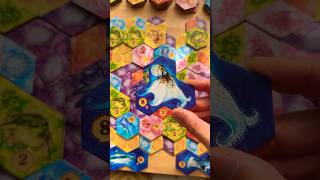
At its heart, AQUA is built on a tile-placement mechanic where players draft coral tiles and add them to their personal tableau. Each placement must connect to at least one existing tile of a matching color, creating adjacencies that gradually form larger patterns. This constraint-based placement is elegant in its simplicity, yet the resulting spatial puzzle grows increasingly complex as players build out their reefs. Reviewers highlight how this mechanic rewards both immediate tactical decisions and longer-term strategic planning. The beauty of the system is that failed placements or missed opportunities do not permanently derail a player's progress; instead, they force adaptive thinking. The designer Dan Insworth and publisher USOHB crafted a system where every tile placement carries multiple consequences, creating the kind of puzzle satisfaction that keeps players returning to the table.
Compound Scoring Through Ecosystems
AQUA's scoring system is multifaceted, drawing points from multiple independent categories that combine additively. Players earn points for small animal tiles that inhabit their matching-colored habitats, large animal tiles that crown those habitats, reefs formed by groupings of four or more coral tiles, and various ecosystem-based scoring conditions. This compound approach means that no single path to victory dominates the game; a player focused primarily on reefs can still compete with one pursuing large animals. The system encourages players to juggle competing priorities simultaneously, never allowing them to tunnel-vision on a single strategy. While some reviewers note that tracking these multiple scoring conditions requires attention during the end-game phase, the depth that emerges from this layered structure is precisely what transforms AQUA from a pleasant spatial puzzle into a strategic experience with meaningful decisions.
The AQUA Experience
Quick and Accessible Gameplay
AQUA plays remarkably fast, typically completing in 30 to 45 minutes depending on player count and familiarity with the rules. Reviewers consistently describe the game as quick to bring to the table, emphasizing that while setup can be slightly involved due to the component organization, the insert design mitigates most setup friction. Turns flow smoothly without excessive downtime, and the 17-round structure provides a natural rhythm that feels neither rushed nor overstretched. The swift pacing makes AQUA an ideal game for families or casual gaming sessions where players want meaningful engagement without committing to an hours-long experience. The approachability of the core rules, which require only three pages to grasp the fundamentals, means new players can participate fully from the start rather than sitting through an extended teaching phase.
Spatial Puzzle Satisfaction
The game delivers a strong sense of puzzle-solving satisfaction through its tile-placement decisions. Players must visualize how hexagon shapes interlock, plan several moves ahead to position themselves for valuable large animal tiles, and manage the tension between pursuing reefs and habitats. The spatial reasoning required is sufficiently challenging to remain engaging across repeated plays without becoming so demanding that it frustrates casual players. This puzzly feel is reinforced by the thematic integration, where the act of building a coral reef ecosystem feels narratively coherent with the mechanical choices being made. Reviewers note that the game strikes an effective balance between restriction and player agency, presenting enough constraints to make decisions meaningful while preserving enough options that players never feel powerless or purely reactive.
What Makes AQUA Stand Out
Exceptional Artwork and Production Quality
Vincent Dutrait's artwork is the immediate attention-grabber, and reviewers universally praise the visual presentation. The coral tiles feature vibrant, saturated colors that evoke the diversity of undersea life without becoming garish or difficult to distinguish during play. The large animal cards are double-sided, allowing players to choose between aesthetic variants like a dolphin or manatee without mechanical implications. Every component, down to the first-player snail token and the box interior, receives thoughtful visual treatment that signals the care invested in the final product. Reviewers specifically note that this level of art direction is uncommon in hobby board games, and it elevates AQUA's table presence significantly. New players often react to the visual appeal before even learning the rules, making AQUA an effective conversation-starter at game nights.
Extensive Variant and Replayability Options
AQUA ships with a remarkably comprehensive rulebook that includes a standard game mode, an advanced mode with randomized scoring conditions, family-friendly rules, solo play with achievements, multiple scenarios, challenge modes, and modifications that adjust difficulty. This wealth of options means that repeated plays can feel substantially different without requiring expansions or additional purchases. Reviewers express genuine appreciation for how these variants are presented as designed pathways rather than scattered appendices, with the rulebook explicitly guiding players through the progression. The inclusion of solo rules is particularly noteworthy, as it expands the game's appeal beyond multiplayer-only experiences. This commitment to replayability ensures that AQUA remains fresh and engaging across dozens of plays, rewarding players who wish to deepen their mastery of the system.
Potential Drawbacks
Scoring Complexity and Rules Density
Despite the accessibility of the core tile-placement mechanic, some reviewers observe that AQUA's scoring rules can feel surprisingly intricate. The reef-scoring system, which requires tracking adjacencies and color-matching alongside the ecosystem-tile bonuses, occasionally creates moments of calculation and double-checking during the final tally. Players accustomed to simpler area-control or pattern-matching games may find the end-game scoring phase requires more reference-checking than anticipated. While the included player aid on the rulebook back helps clarify these conditions, the sheer number of possible scoring combinations means that a player's first few games may include minor scoring disputes or moments of confusion. This complexity is not a flaw per se, as it supports the game's strategic depth, but it does create a slight learning curve that extends beyond the initial rule explanation.
First-Player Token Mechanic in Two-Player Games
The first-player token functions as a tile that players can draft instead of claiming a coral piece, granting first-player advantage on the subsequent round at the cost of a tile forfeit. This mechanic adds meaningful choice in multiplayer games where turn order rotation has practical consequences. However, in two-player variants, the first-player advantage becomes less impactful, and some reviewers feel the token feels extraneous or even pointless in that context. The alternative of simply passing the first-player marker between players would streamline the two-player experience without altering the game's core loop. This is a minor quibble that does not significantly impact enjoyment but represents a design edge case where the implementation could be better tailored to different player counts.
If You Enjoy AQUA
Players drawn to AQUA's spatial puzzle and tile-placement foundation will find kindred satisfaction in Cascadia and Calico. Cascadia shares AQUA's focus on hexagonal pattern-building and ecosystem assembly, though with a lighter complexity floor and a more streamlined rule set. Calico similarly emphasizes color-matching tile placement with a quilt-building aesthetic, and reviewers note that while Cascadia and Calico occupy distinct niches, all three games reward the kind of spatial planning and forward-thinking that AQUA champions. AQUA distinguishes itself through its greater rule depth, more comprehensive variant suite, and stronger thematic integration of underwater ecosystems. Those who appreciate games with beautiful, eye-catching artwork will find AQUA's Vincent Dutrait illustrations align with games from publishers prioritizing visual excellence. Fans of rewarding mastery and games that unfold differently across repeated plays should note that AQUA's ecosystem-tile variants and advanced modes provide the kind of mechanical variation that professional players and enthusiasts consistently revisit.
What Reviewers Are Saying
"You are incentivized to build because when you build there are some games that when you build on top of something you lose the points that are underneath this game it doesn't do that when you build you just keep stacking those points upon points so you're very much incentivized to build to build up your ecosystem to attract those animals to get those bigger points."
— Board Game Buzzz
"Vincent Dutrait is my favorite artist in board games, and when I saw this cover I was instantly sold before I knew anything else about it. But then doing a little research, seeing what inspired the game and what kind of game it was, I was even more interested."
— Board Game Animal
"Aqua is a board game that incorporates this rule of three into each and every puzzle piece. Basically this game is comprised of lots of hexagons; each hexagon is divided into three sections and each section has a coral pattern associated with it. The idea of this game is that you're connecting these coral patterns to then attract different species to the coral."
— Board Game Sanctuary