Point Galaxy | How to Play | Learn to Play in 7 Minutes!
Games in This Video
1 game is featured in this video — it unlocks as you watch.
Transcript
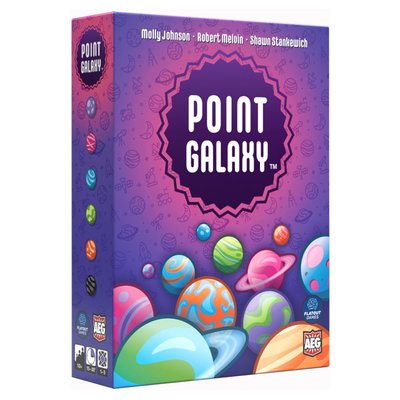
hello everybody my name is Elia and my name is Tyler together we make up c a couple that loves to play board game and today we'll be teaching you how to play point Galaxy Point galaxy to the Stars space Point Galaxy is designed by Molly Johnson Robert Melvin and Sean stowit it's published by Flatout games who help sponsor this video let's go to the table and let's learn how to play as always you'll begin by setting up you'll Shuffle the planet space cards thoroughly making sure to shuffle with the Planet Side face down then remove a set amount of cards based on your player count these cards will not be used for this game with the remaining cards you create three roughly equal draw piles you'll flip over two cards from each placing them in a column below each pile you've now created a market for the game you'll then shuffle all the rocket tokens face down and select a number of tokens based on your player count you'll flip them face up and put them next to the market and return the unchosen Rockets back to the box you'll Shuffle the starting Sun cards and deal one to each player additionally each player will receive a random player Aid make sure you deal one out with this symbol as the player who receives it will go first you're not ready to play in point Galaxy you'll take turns taking any two cards to the market which you'll add to your solar systems building a Galaxy and competing for the most points the game will end when every player has taken 13 turns which you'll observe when there's only seven cards left in the center on your turn you'll take any two cards the market this could be two Planet cards
two space cards one of each or even two space cards from the same deck the planet cards you take will not be replenished until the end of your turn meaning you cannot take two Planet cards from the same space once you've taken your two cards you'll now place them into your solar systems you'll aim to create numerous solar systems in front of you each one could have a sun which could be accompanied by an asteroids card and planet Moon and Wormhole cards which which will be directly below them in a sequence there are specific card placement rules for all cards which we'll go over now but know that cards can generally be placed below or above any existing cards and sequences let's start with the planet cards these must be placed in sequential order each planet has a number initially any can be placed to form a new solar system but when a second planet is added it must be a different number and where it's place will set the direction for the sequence planets will score points for each solar system based on the number of unique values present to a maximum of seven possible number values you'll notice a planet with an X this planet can be considered any number between 1 and seven when placed which certainly gives you some flexibility there's no restrictions on color placement of the planets but you may want to pay attention to the colors as you'll potentially score additional points from the Sun cards Moon cards and Rocket tokens you'll acquire a sun card can be placed above any card sequence in a solar system each solar system may only
have one sun and the Order of placement does not matter meaning you can start a new solar system by placing a sun or add one to a set of planets which does not have one yet each Sun card will provide a scoring condition for only the solar system It's associated with moon cards may be placed above or below any existing sequences in any solar system in front of you additionally they can also be used to start a new solar system in order for them to score they need to be adjacent to their preferred color if a moon card only has one color it just needs one planet on either side to satisfy the scoring condition however if the moon has two colors both colors must be present and on opposite sides in order for the moon card to score you'll notice some planets are multicolored these can only be one color for scoring purposes so you'll have to pick one when scoring the moon cards at the end of the game Moon cards can be placed even if they do not score asteroid cards must be placed above a sun and only one asteroid card can be present at each Sun meaning you're limited to these cards by the amount of suns you have as you cannot place an asteroid card first it must always be placed tucked above the sun these will score depending on how many you have in your solar system compared to other players Wormhole cards may be placed into any sequence in any solar system or be used to start a new new solar system what they do is reverse the pull of gravity and reset the number sequence either below or above where
placed this means that some of the numbers that were skipped may still be included in the sequence remember though you'll score for a number of unique numbers in a solar system which means using a wormhole to repeat numbers will not yield you additional points but using it to add numbers you missed will you'll see that some cards also have rocket and research symbols rocket symbols anywhere in your Galaxy help you obtain rocket tokens and research symbols will score at the end of the game for the number of unique research symbols in your Galaxy now once you've placed your cards you'll check for rockets for every multiple of five symbols you'll receive a rocket token meaning you'll receive one when you reach 5 10 15 and so on Rocket tokens will score for your entire galaxy at the end of your turn you replace any Planet cards you've taken with new ones from the corresponding Stacks if at the point the drop pile Runs Out take the largest stack left and split it in half placing the bottom half in the empty space uring the card on top of the largest pile does not move it's now the next player's turn you'll keep playing taking cards and building solar systems until the game ends which happens when the last player in turn order has taken their 13th turn you'll know this because the market will have seven cards at the end of this player's turn you'll discard the seven cards and you're now ready to score you'll first score all of your sons and yes if you have multiple sets within a scoring condition you'll score each of them you'll then check for Unique
planets add up the points for each solar system based on how many unique numbers you have in each you'll then add up the points for the moon cards again tallying them if the moon cards are adjacent to the required colors of the planet cards you'll score for Unique research symbols across your Galaxy and for each of your rocket tokens you've acquired finally you'll compare your asteroid quantity with other players the player with the most will score 10 points second will score six and third will score two if tied you'll add up the points for your placement and the one below it and divide it by two for example if two players are tied for first you'll each score eight you'll tally the points and the player with the most wins and that's Point Galaxy so many planets to discover where will you be which planet are you going to inhabit M how many solar systems are you going to make is the better question probably a lot cuz then I'll score the most points hopefully quantity is not always the best fine well if you have any questions leave them in the comments down below we'll get back to you as soon as we can and of course if you found this video helpful make sure you give us that Thumbs Up Hit That subscribe button if you're new here cuz we love talking board games and teaching them to you if you want to learn more about this one check out the description and for our question of the day we have if you discovered a planet what would you call it and why what would you call it and why something great I hope I
hope well thank you so much for watching and we'll catch you at the next one bye