Leviathan Wilds is Spectacular
Games in This Video
1 game is featured in this video — it unlocks as you watch.
Transcript
Hello! I'm Efka and I hate climbing. Games are good at many things, but one video game feature that always made me extremely curious is the ability to relay experiences that would otherwise be unavailable. Sometimes it's because you have physical or mobility restrictions, other times well, maybe something scares you. And video games, which are not real, let you explore those experiences in a safe way. Obviously I haven't really got the bod for scaling mountains or, God forbid, hanging down, but for as long as I can remember I've been terrified of heights. And when I say terrified, I don't mean scared - I mean that whenever I'm at least 2 metres above ground, I get this nauseating sense of vertigo.
And I'm a little better with it now, but whenever people say that climbing is exhilarating, I'm right there going "Yeah you don't know the half of it!" I'm not the only person who feels this way so it's entirely unsurprising to me that climbing is something you can do in video games. Zelda's 'Breath of the Wild' and 'Tears of the Kingdom' will let you cling to any surface like you're Spider-Man, but push it too far and you'll run out of stamina - and wahay ouch! That hurt. But also because the vertical is just as traversable as the horizontal, stand at the precipice of a cliff and you can literally feel yourself get dizzy. But unlike in the real world, it's not terrifying. It's exciting. Playful. Other games lean into this further making climbing their main mechanism, like Jusant, which turns scaling cliffs into a traversal puzzle as you explore an abandoned world and the remnants its inhabitants left behind.
I mean, *I* would abandon it. The only way you can get around is by climbing. What kind of an existence is that?! And if you want to take this even further, why not a game where you scale those cliffs with your own hands? 'The Climb' is a VR game that does pretty much what it says on the tin: it lets you climb. Your hands are responsible for keeping you alive as you scale from one ledge to another, trying to figure out routes towards various checkpoints. I'm not going to say that the climb is amazing, but for a healthy 30 minutes you can emulate an experience that otherwise would be impossible. All of these games made climbing an accessible activity, but one game... one game made me *get* climbing. 'Shadow of the Colossus' is not the first video game to feature climbing, or even have climbing as the main mechanism, but there's a reason this 2005 game is still one of the most well-regarded video games out there.
In it you play an unnamed character in a strange world imbued with a quest by a mysterious force to slay mythical colossi(?) for what is very probably a baaaad reason. I'm really trying to get across how deliberately vague the storytelling is, but that's just one part of it. The other is scaling these giant colossi as they thrash and howl and stomp and crush and do everything in their power to shake you off, like the ant that you are. Until you violently stab them with your sword. Black goop sprays out of their wound, and then you stab them again and again and again until... [Rumbling, sad music] Please, there are so many things to unpack about 'Shadow of the Colossus', and if I could I surely would.
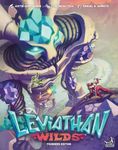
But I am here to ask a different question: How does all of that work in a board game? Leviathan Wilds should not work. I mean this. The idea is so brazen, so hubristic, that by default it should be destined to fail. In our last video we talked about 'Slay the Spire: the board game' - another video game to board game adaptation, and I attributed that game's success to the fact that the original was pretty much a board game to begin with. There is nothing board game about 'Shadow of the Colossus', yet Leviathan Wilds manages to translate the full gamut of experiences present in the original, many of which are physical. But also, Leviathan Wilds is not an actual adaptation, it's not a licensed game, it's an homage instead.
And so it has the freedom to not just adapt but also expand, inject new experiences, recontextualise things, and it does it so deafly that it quietly surpasses the work that inspired it. Maybe. I don't want to promise too much. Here's how it works. What I'm going to need you to do right now is put your hands in your pockets and take out all those metal marbles, Acme anvils, all that fruit cake - because it's time to climb. In Leviathan Wilds you play a team of climbers who will scale gigantic leviathans to strike them down. And when I say strike them, I don't mean the leviathans - I mean the evil crystals that grow on them and make them feel bad. Awww, you're helping the leviathans! What a twist(!)
Each expedition, you will build your climbers, creating a deck of cards that represents them. "Oh no!" I hear you say, "Not deck construction! Nobody has the time for that in their lives anymore!" Belay those worries sailor, because all you need to do is take a deck of cards that represents your profession and a deck of cards that represents your character, smoosh those two together and voila, deck construction done. You will notice that your deck is very petite and we'll get to that in a little bit, but first I want to show what you do and how you do it. Each turn you will look at your hand of three cards, pick one of them, and play it. The card will grant you a number of action points and possibly some protection against one of the three kinds of damage. Each action point can be spent to climb.
One point, one move along this grid, which so far doesn't really sound like climbing. So let's add some verticality. Instead of climbing you can jump. That costs you a whopping three action points but it lets you move two spaces. Which sounds like a more expensive form of climbing, but with the caveat that it lets you skip the space in between. For example, let's say you want to move to the other side of this gap. If you just use a basic climb action you will enter an unclimbable area and immediately proceed to 'wahay, ouch!' - hurtling through various spaces that cause damage to your health and your deck, until you reach a safe ledge or the ground. And finally, you can glide. Which is kind of like a combination of climbing and jumping, where you spend only one action point per move and move as far as you want but only the last space you move to has to be a climbing point - for not falling down purposes.
The only catch here is that you can only move downwards, hence gliding. Now let's talk about your deck. Which isn't actually called your deck, it's called your grip - because the deck size represents your stamina. If you ever draw the last card you immediately start 'wahay ouch-ing' so you want to time it so that when you empty your grip you are actually standing on a ledge. Talking of ledges, the last three things you can do is rest which is, when you're standing on the ledge, you can take your discard pile, shuffle it and place it underneath your deck. You can also heal. And finally, you can strike these crystals, which I will tell you about later because it's time to introduce you to the real stars of the show. [Rocky music] Observe before you, the scenic landscape of the British Midlands, bathed in the magenta rays of golden hour.
Truly one of the most colourful sights in the world(!) Now let's add a Leviathan. Oof, that's big! How do you transpose this size, this verticality, to tabletop? How do you imbue this artwork print-out with the majestic scale necessary to dazzle and awe? And the answer, turns out, is simple. You make them deadly. The leviathans won't just let you have a carabiner picnic on their back. They'll thrash and shake like a dog after bath time. To represent this, each of the game's 17 leviathans comes with their own set of behaviour cards. The way your turn is structured is that you will draw one leviathan behaviour card, which will tell you how it will hurt you.
Then you can play your card for action points, and when you're done gallivanting about, it will hurt you exactly like it told you. Unless, of course, you draw a behaviour card with the 'Swift' keyword, in which case it will hurt you immediately. The cards themselves normally paint a target exactly where you're standing. And when I say 'paint', the game comes with this crown that you literally place over your character. Is it a bit too big? Yes. Does it get its point across? I think so. It's not just the exact space where you're standing, these cards usually have diagrams depicting all the spaces around you where pain will happen. But you have a whole turn worth of action points. So you can climb, jump, and glide out of the way. But but but what if one of your friends is standing right next to you in the danger zone?
Or what if you draw a card with the 'Swift' keyword and need to react immediately? Are you all just stuffed? No, and this is where the very finely weighted, fun part of the game pops up like a Jack-In-The-Box. Your cards don't just grant you action points, they also have abilities. But you can only spend them for action points *or* for the ability. These let you do a whole number of, to put it bluntly, cool things - including, but not limited to, leaping the heck out of the way. And the best part is, is that you can play these virtually anytime you want to - your turn or not. Meaning that if you are about to get smacked, it's all right, there's probably something in your hand that might just save you.
This interplay of cards is, not going to mince words, the beating heart of the game. You always redraw three cards at the end of your turn, which means you have to survive with at least one card until the start of your next turn, so that you can play it for action points. And then remember if you draw your last card from your grip you immediately start falling, which can happen very fast because, remember, your grip is like nine or ten cards. And obviously this is much more difficult in a four-player game, where you have to dodge three leviathan attacks before the turn comes back to you. There's a real sense of grit during each behaviour card reveal. Because there are only five of them, you very quickly learn what they do.
Which means, you know the odds of doom. So very often this game puts you in situations where it's 50/50 and it all depends on a card draw. Do we survive this? Argh! That's the stuff tense co-ops are made of. But then that's juxtaposed with how powerful your abilities are, and with how freely the game lets you deploy them, so you can quickly turn the fortunes back in your favour. So the game ebbs and flows in this choppy sea of Arghhh! Arghhh! Baaad...Oh yay! Good! Oh wayhay, ouch. Did I mention that these behaviour cards get progressively worse too? Each time you draw through the full deck of five, one of them is flipped to its blighted side and becomes a stronger version of the effect.
And if you if you think that's bad, wait till I tell you that you don't even know which of the cards will be powered up. Are you ready? Okay. You don't even know which of the cards will be powered up! A lot of these blighted versions will deal you blight damage. You have two types of health. Regular health, which ticks down when you take damage, and blight, which ticks up when you take blight damage. If these two cubes ever meet, they kiss and get married. Just kidding, you all lose. You can dodge some of these blight attacks, but others are just various versions of 'The highest person will take blight damage' or Everyone will take blight damage' and that's not particularly interactive, but also fine. The game needs a clock. Where it does get interactive is the various protections you get when you play a card for your action points.
Some spots on the grid will deal you health damage or grip damage when you climb through them. Or, funnier yet, fall through them. But you can also deploy a card for action points with blight protection. This will not prevent the blight from a leviathan attack, but it will prevent blight damage when you strike a blighted crystal - which is yet another layer of tactics in this inverse Spelunky-from-hell. Look, I like this game. It's cute, it's fun, it's tense, it's clever, it's got a character that has to flip a coin every time they try to do one of their card effects. Like, I need to jump... Shall we just start the game again? You don't have to play with that one, there's loads and loads of character combinations.
You could be the mushroom guy, cos of course there's a mushroom guy in this game. He goes around the leviathan and picks up these mushrooms (that I forgot to place in the before shots so quickly had to do it in between these scenes) and so he gets them, and then he powers himself or other people up with various abilities. You know, cos mushrooms power you up... and insert another joke that would get me demonetised. But I don't know if you need this. Like, I'm keeping it cos I think it's too delightful to not enjoy. But there's so many light co-ops out there. This year alone it's competing with Daybreak. I think they're... you know. But here's a few more things about it that bug me. The rules are written in this weird way where they are super approachable.
Great! We definitely need more of that. But then it's also trying to cater to people who enjoy complex card interactions with strict timing rules, but it never makes those timing rules clear enough. Each of the 17 leviathans feel very different. The first ones just a durdley turtle to teach you the ropes of the game. The second one is the one we've been showing you in the video that teaches you verticality. But then it ramps it up with this cool lightning pillar mechanism on the third one, where behaviour cards affect entire columns on the grid. Draw a triangle effect, all the triangle columns get hit. Draw a square effect, all this the square columns get hit. And the higher you go, the more the leviathan becomes more vertical and more lean, meaning there's scant few nooks and crannies to hide in.
This is just the tip of the iceberg in the ambition of leviathan design. But as that ambition increases, so does the rules confusion. I introduced this game to some friends of mine with leviathan four. Which has a convoluted eye mechanism that isn't explained clearly. And I was like "You guys! This game is so cool! You're going to have so much fun!" "Wait how does this work?!" "One second, I'm going to have to BGG this." Bad. Bad game. Bad. No biscuit for you! And finally, here is an actual mechanical criticism. Although, I guess it's not so much a criticism, but more of a statement of preference. The game lives entirely in the reactive domain.
It's not random, you have a lot of control over how you respond to things. But the flow of it is that: bad thing's gonna to happen, how will you respond? And there's a lot of leeway in how you craft that answer. But even your forward planning is limited to what card will you throw away for danger. Contrast it to another co-op like Daybreak, where you can formulate strategies and plans - what your aims and goals are, and the difference is quite stark. In Leviathan Wilds, when you begin the game you'll draw a vague line towards a crystal and say to your friends "I guess I'm going to go that way and see what happens" But what you can't do in Daybreak is wrest yourself to the very precipice of a gangly hulk and then intentionally plummet down to a ledge right near the bottom, strike the last crystal, and save the game in one chandelier-swinging turn!
In moments like this, Leviathan Wilds lets you feel invincible, impossible. You are conquering gravity in a way like divers in squirrel suits exploit the rules of physics. Or actually, not exploit, they find niches within the rules where they can thrive in. So you too find niches within this game's rules set. The leviathan is an unkindly beast, not by nature but by circumstance, so this exploitation feels good. Wholesome. Scientific, even. It's not easy to rope yourself to the tip of this Brobdingnagian colossus, but when you do - when you make that dive, I can't show you why you'll actually feel like you're plummeting, but I promise you, you will. I'm sorry for using the word Brobdingnagian.
But come on, it's such a good word, and this is like my one chance to use it in the video appropriately, so I have no regrets. If you remember 'Shadow of the Colossus' fondly and would love a dip into a similar world, less grim and much more tactical, I think this box will do you good. One small note. This game is from an indie publisher so the first print is already out of print, but it's back on crowdfunding now. Yay. If you do back it, make sure they do good on that promise of an FAQ or maybe even a rulebook rewrite, cos this game really needs it. Talking of indie, guess which board game review channel is also independent and does not accept review copies from publishers or work with them in any way? That's not entirely true, we...we did email this company and say "Hey, can we have a high-res image of a leviathan that we can superimpose over the British landscape?"
And they said "Sure here you go." but I don't think that really counts. So if you'd like to support that kind of work, please head over to our Patreon where you can give us a bit of money every month, and in exchange you support our work and get bonus episodes of our podcast. It's a podcast. About board games. Of course it's amazing. Everybody likes those. I do! You probably do too! So do that, support us. And see you soon!