Sagrada: A Revisited Review with Sam Healey
Games in This Video
1 game is featured in this video — it unlocks as you watch.
Transcript
Hey folks, welcome back to a revisited review with yours truly, Sam Healey. Here's the twist. I never actually reviewed the core box of Sigrada. I've only reviewed the expansions. Tom did a review of the uh Sigra box. Gave it a uh approved rating way back in the day, eight years ago. I think I just got to play this a couple of more times here recently in the last about week and a half and I wanted to come back and let you know how it has stood the test of time in my opinion. So, let's get down to the table. I'll show you how it works and then we'll have some final thoughts afterwards. Let's get to it.
So, here's a four-player game of Sigraata set up for you. And uh it's really simple to set up. Each player gets their own little um uh placard basically. And they're given two of these cards at random. And then you have to choose one of them. These are all uh double-sided. And they have different patterns that are going to show up in their windows as you can see down here. Uh, a couple of things here is that there are these uh, three influence dots that are down on the bottom or on the other side there's five over here. So, basically that translates to how many influence tokens you're going to get uh, in the game to work with. And these are worth points at the end of the game if you don't use them, but they are for using these different tool cards. And it's also going to give you a different uh, pattern that you're going to have to uh, fill in on your window, so to speak.
Then you're also going to take uh three uh randomly chosen tools and set them up over here. And then you're also going to take three public objectives and put them out over here also. And then everybody is going to get their own personal objective. And basically the personal objective just has to do with a specific color in the game, one of the five different colors. And you're basically going to get points at the end of the game equal to the number of pips that are in your window matching your color. Now, in a four-player game, the first person is basically going to take nine dice out of the out of the uh bag, and they're going to roll them. And then once he or she has rolled all of those dice, they're going to be able to choose one of those dice. And then this person will choose one in clockwise fashion.
And then this person, the last person, will get to choose two. And then it'll come back and uh the last person will have one per one two to choose from. The last one will go over here and denote that it we have basically completed round one and then we're going to move on to round two. Round two, we do the same thing. We pull out nine dice. We roll them. The uh the person that goes first chooses one, one, one, two, one, one, one, and so forth and so on. When you're placing your dice into your um uh window here, you have to start on the outside. And then once you have done that, you can now start placing adjacent to it. Uh diagonally when you're placing things is okay. Now, a couple of other things about placing dice. When you place dice into your thing, you cannot place next to some place that already has the same color or the same number.
So, for example, this placement right here would be fine because it's a green dye, not a yellow, and it's a one, not a six. Now, other restrictions are considered by what your window is actually looking for. For example, this right here means that it wants a five of any color. This one has to be a blue of any number. This one has to be a red of any number. But as we already discussed, this cannot be a blue five because you're going to need to place a a five here. And here probably shouldn't be a blue or a red because you're going to need to place those kind those colors dice there. These white ones over here, you can basically place anything there. you still have to follow the restriction of not matching orthogonally the color or the number. Other ways to score points are going to be based on these public objectives like for example light shades. So you're going to get two points for every pair of one and two that are in your window at the end of the game. Color does not matter, just the shades, the numbers. And then you also have deep shades. So, you're going to get two points for every uh pair of five and six in your window at the end of the game. And then this one says column color variety. So, for every column in your window that each spot has a different color, that's going to give you five points at the end of the game.
Now, placing these dice into your windows, especially deeper into the game, can become pretty difficult at times. And that's why these uh tools are part of the game. Now, when you're using tools, if the card doesn't have any influence tokens on it, when you want to use it, you just have to use one. But if it has any number of influence tokens on it, you have to use two. Now, this tool here, it says after your first turn, immediately draft a die and then you skip your next turn. So me as the first player, for example, if I chose one die, instead of having to wait for it to come back all the way around to me, I could place one or two influence tokens over here and make my second choice immediately. This one over here, the glazing hammer, says that I can roll all dice in the draft pool. Uh, this may only be used on your second turn before drafting, not your first. Basically, this tool over here is pretty cool because it allows you to ignore some of the different color restrictions that places in your window might have, but you still have to adhere to the adjacency color uh rules of the game.
So, this one says uh move any dye in your window ignoring color restrictions. So, if you had this red over here and you really needed uh to place another red, you could move this one down here um using this tool because normally you wouldn't be able to place a red on a purple, but using that tool you could. And so that's how the flow of the game pretty much goes. You do that through 10 rounds and then at the end of the 10th round, you can take all of these dice off, flip this over, and use these tokens to com to tally your scores. And then whoever has the most points is the winner. Noticing that these can be flipped over for 50 points if you are fortunate enough to go above 50.
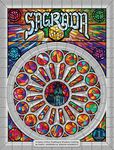
So, my first pro for Sigrada is going to be this. Um, it's super aesthetically pleasing. It's very it's it's a very beautiful game with all of those different colored dice and the fact that uh you're basically building these uh mosaic like uh stained glass windows in the church at Sigrada. That's a really cool theme and it looks really cool and it looks really cool on the table. I love games that are aesthetically pleasing to the players and to to those who might be walking by and look down at the table and go, "Ooh, wow that looks really cool." I love it when games do that and this is definitely one of those. It is not an overly rot game as far as that's concerned. The mechanisms are super simple. You roll the dice, you take the die, you have to follow the placement rules, and you're just trying to fill up your your window. Not difficult at all, but boy oh boy, can it get super thinky about which one should I take? It almost has kind of like a pusher luck feel to it. Um, not really, but it's not a pusher luck game, but it kind of gets that because I'm going to take this, but I don't know how I'm going to get that one filled. You know, that kind of thing. It takes simple mechanisms and makes you think and it's challenging, even though how you're playing the game is very simple, which is one of the reasons why I think it's such a great uh gateway game for a lot of different people. I was able to uh you know I mentioned earlier that um I was able to play this recently in the last week and a half and one of those situations was where I wasn't actually
playing. I just sat down with four other guys and taught them and two of them had never uh played the game before. One of them had, no, I'm sorry. Three of them hadn't played the game before. And it took maybe five, six minutes to explain how the game uh worked so that everybody could could could, you know, basically uh jump into it on the same uh level. And they had a blast with it. I stuck around and watched the game and and answered questions and all of that kind of stuff. But it was one of those things where it's such an easy game to teach and everybody had such a great time at the game. I really enjoy these things and I I like it's it's a very simple thing, but I love how this kind of fits in there and it becomes your own personal uh quest, so to speak, on filling in this thing. And I love how everybody's is different. Um, it's not vanilla, and I like that about the game.
The other thing is all of these dice. I love these dice. These little tiny rounded corner dice. These are my favorite kinds of dice. I really enjoy them. and the colors just really pop on the table once you have begun playing. My next pro is going to be the fact that uh you have not only private objectives, but you also have public objectives. And I like that you have more public objectives than you do private objectives. Because often when you have private objectives, you have no idea how people are doing. And really there is that sense here, but because you have more public objectives, you can kind of see how everybody's doing on a a a broader term than you would if most of your objectives were private. So, I do like the fact that they have objectives and I like the fact that there are both private and public ones out there. My final pro is going to be about the tools. And one of the things that I really enjoyed about the tools is that you don't ever have to use them and you can keep all of your um influence tokens and just use them for points at the end of the game if you want to. But having the influence tokens and being able to use those tools when you get into a sticky situation as far as where you can and can't place dice, I really have enjoyed that. it it gives you some mitigation that you wouldn't normally have and I really enjoy that a lot.
Now, as far as a rating is concerned for me, I haven't ever reviewed this one. I have reviewed some of the expansions. I gave the one that I looked at was an eight out of 10. So, that's a good foundation uh for uh this game as far as what it does and how much I enjoy it. I do believe that an eight is a great place for this game's rating to to live because even after all of these years, it's still a game that I will readily pull out and I will readily have fun playing. It's it's an 8 out of 10. I'm going to say it's still an eight out of 10 for me. Now, another thing that's pretty cool about this game is that it uh it is getting a 2026 version. The only things that I really know about this is the fact that I've been able to see that some web stores are having a pre-order and they're slating that release for February. So, there's going to be a 2026 version of Sigrada that's coming out from Floodgate Games. And that's something I'm really interested in looking forward to. Um, I don't know much about what the box is going to uh entail. All I know is that it's going to have some new art, uh, some new graphic design. Uh, but from what I've been able to tell, basically what AI told me from what it's pulled in is that it's going to have basically the same kinds of components, just a beautified existence.
And who knows what's going to happen past that. But I can tell you this, I'm interested in seeing what the 2026 version has. So, I'm going to hold my breath. Metaphorically speaking, it's an 8 out of 10 for me. I love this game and I'm really excited for that new version to hit so that uh we can see what's inside. But that's it for me. Thanks for joining us. We certainly appreciate you. We'll see you guys and gals on the flip side. Take care.
Hey everybody, thanks for watching this video. If you like this review or whatever you just watched, wasn't it amazing? Uh, check out our channel, Dice Tower. We have all kinds of things. We review games, we do top 10s, we play games live. It's all about board games, but especially the people who play them. Check out Dice Tower YouTube channel.