Vantage is Perfect. I Don't Like it.
Games in This Video
1 game is featured in this video — it unlocks as you watch.
Transcript
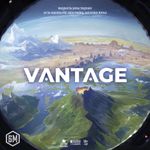
Okay, then you asked for this Vantage review in five 4 3 2. Vontage is a storytelling game of discovery. Specifically, you crash land on an alien planet and have to figure out what its deal is. On paper, this is EA's dream game. The exact type of fruit that makes me go fruity. the top of the pyramid of Maslo's hierarchy of needs. Pizza and brisket reviewing board games, playing board games, standing in front of a camera talking about board games and weird alien planets. I live for this. I watched Interstellar five times and I don't even like it. I just want Matthew McConnA exploring planets. They weren't even exciting planets. One was rock, the other one was water, and it still gets me. But it's not just the premise. Mechanically, Vantage sounded like it was doing exactly the sort of things I appreciate in games. As Eugene Hutz is my witness, if I have to play another narrative adventure game where you're constantly punished for trying things because the designer thinks it's so very funny to trick their players.
Please stop. That kind of design work belongs in the 80s together with Spandow Ballet and Margaret Thatcher. advantage not only does not punish you for exploring, but it also lets you go and do whatever you feel like doing. Each session, you'll get a mission and a destiny, but you don't have to complete them to quote unquote win. The rule book even says pursue something you want to do. And if you succeed, well, that's a victory. Nice. More of that, please. But, and you know where this is going, I did not like Vantage. Or more specifically, I hated my first place. Then I learned to appreciate and respect it. And then I ended up still not liking it. It's a game that takes Wild Swings, goes all out, streaks across the stadium of cheering board game fans, but I just do not care for what's on display. So, I want you all Stonemare champions to put your pitchforks down. I'm not going to roast this. I'm just going to tell you why I want it to put its code back on.
Okay, so imagine you're on a spaceship and it's crashing. What is the first thing you do? Create your character, obviously. On offer are six people, and you have to be one of them. Each is color-coded to correspond to one of the game six skills: move, observe, engage, help, take, and blood. It's not called blood, but it's more fun this way. Thus, each player chooses one character, gains a corresponding skill token, some more random skill tokens, a mission, a vantage card, and it's already the point where we arrive to the part of the video where I have to tell you there's going to be spoilers. But not really, though. I mean, if you want to know nothing, then you already know my stance. I didn't end up liking it, but lots of people do. Is it me that is wrong or is it everyone else? Obviously everyone else, but you're also everyone else. So there, glad I could help. There is no way I can meaningfully discuss this game without breaking the spoiler seal. So if you want to know what and why I feel about it, I'm just going to have to show you some things. But I will try and keep it to a minimum. Anyway, back to these cards. The mission card is sort of your objective. This could be a thing you're doing. It's not something you have to do, but might as well, right? Otherwise, you're just wandering around aimlessly.
In this example, we have to collect stuff that's worth dollar so we can leave THIS PLANET. RICH, RICH, I tell you. Now, if your brain is anything like mine, it's already asking, "Wait, didn't we just crash land? Wouldn't our mission be find food, shelter, examine the air for dangerous bacteria and or parasites? I've seen Alien. I know how this goes. No, no. The mistake you're making is thinking that this is anything like a traditional sci-fi story. Again, I'm going to try and avoid spoilers, but in the Vantage cinematic universe, anything, and I mean absolutely anything goes. No idea was discarded as too outlandish in the creation of this game. More on that later. The other card is the Aonomous Vantage card. This is the world you see from where you landed. The trick is if you're playing this game with other people, everyone crash lands in random locations, meaning that you're all looking at different things.
Finally, you get a location card, the place where you actually are. There are, and I am not joking, hundreds and hundreds of them. And each location offers at least six different things you could do. You can probably pick up from the size of this card that Vantage is intensely visual. It is not an exaggeration to say that the core design element here is illustration. It acts not only as a descriptor, but also like an invitation. The very first time I dipped my mits into Vantage, I was greeted by a strange rock, a glowing symbol, and an adorable rat type thing all in one scene. Obviously, I immediately wanted to do all the things like pet the rock, kick the symbol, activate the strange rat, but slow down there, cowboy. You're only allowed to do one thing. Each of the game six skills is tied to a possible action on each of the location cards. Or in other words, if there are hundreds and hundreds and hundreds of locations, you can visit each of them having six things you can do. That means there's literally thousands of narrative prompts that propel the story in any direction you could possibly conceive. Once you pick an action, you'll note the location cards number. Take the skills that the action belongs to booklet and look up that number in the book. This will ask you to perform a test, meaning it's dice rolling time. And when you succeed,
you'll read the result. Notice I said when, not if. And this little distinction is the key to understanding Vantage. You have three quote unquote health pools, time, morale, and health. Each dice you roll in a test has the potential to reduce any of them. And once one of them reaches zero, that is technically game over, buddy. But you only fail any given test if it reaches zero because, well, that's when the game ends. Otherwise, anything you would like to attempt is a success. Of course, when you select an action, you don't actually quite know what you'll be doing. The verb tied to your chosen skill paired with the illustration gives you some clue, but often times, I am certain it is deliberately misleading. And also, you don't know how many of these dice you'll be rolling. If you have skill tokens in the related skill, you can spend them, reducing the number of dice you roll. And your character card comes with dice slots where certain results can be negated. Isn't this all a bit random? Sure, but only a bit, much less than it would seem. Some results are blanks, meaning you don't get any penalty. And some dice have this arrow, which means you return that dice back to the unrolled dice area. This matters because once you run out of dice, they all reset. Okay, what does that mean?
Well, remember I told you that you could place certain undesirable results on your character card? That's actually not the only card that can store these. As you engage in various adventures and escapades, you will get rewards, items, gear, skills. In one of my adventures, I got a boat just like a real life-siz boat I carried around with me. Don't ask how. It's not important. Point being, there's a dice slot on that card that lets me place any die there as long as I'm doing a move action and as long as I'm on water. And by water, it literally means look at your location card. Do you think you're traveling on water? If yes, then you can place a dice on it. As you progress through your adventure, you'll collect a menagerie of various equipment, weapons, companions, each with intricate dice mitigation abilities. thing is once you placed a dice, it stays there and your ability is no longer usable, which is where the reset comes in. Once there are no more dice available to roll because you've either resolved the results or stored them on cards, they all refresh, making your cards useful again. What all of that means is that taking any action is a risk, just not the kind of risk you expect. You will always achieve something. You just don't know quite
what you'll be achieving or how much it will cost. But the further you progress, the more you can intuit it how much you're prepared for any given risk. At the beginning of your session, a seven die task could be game ending. If you've equipped yourself accordingly, if you reset all the dice slots, if you armed yourself with boosts which give you rerolls, it's a walk in the park. This mechanism is more genius than might seem at first because it solves multiple narrative adventure problems with um one weird trick problem. In a narrative adventure game, you want to present the player with multiple choices because if they don't have choices, they're just reading a novel. But if you want the choices to seem meaningful, some of them have to have negative outcomes. Which then creates problem two. If some choices produce a state of success and others produce failure, then there is a binary quality to these choices. Options A, C, and D are good and options B and E are the bad ones.
Now, not only are you writing narrative strands players don't desire to engage with, but you're saying two out of five times players will feel tricked into picking the bad option. On the other hand, if all choices are equally good, then there is no mystery or suspense. The player is demotivated to make any choice because the choices produce an overwhelming sense of monotony that glazes the player's soul with a gloopy liquid distillation of onwe rendering them catatonic. And that's an outcome that has potential scientific applications, but is generally not desirable in a board game. Vantage says, "Wait a minute, folks. Science can solve this problem. We make all choices more or less rewarding, but we will also hide what the choices actually are. We'll still give little hints visually and verbally so they don't feel entirely arbitrary, but we'll retain the sense of mystery and suspense because there's still a surprise no matter what choice you make." by Jo Jamie Stegmer crafted a genuine failforward system in a narrative adventure game that just works. There's only one little problem.
There's thousands of interesting narrative prompts to ride. In summary, Vantage is a game where you know how, but you don't know what, which has a certain kind of irony because I like what Vantage is doing. I just don't like the how. There are two promises the marketing of Vantage gives you. One, you will explore an alien planet. Two, this is not a campaign game. They're pretty forward with that second promise as well, which is again a kind of irony because I think it is strictly not true. Each game of Vantage begins with the same crash. The same six people get a mysterious signal. The same spaceship falls apart. They land on the same planet. It's kind of like Groundhog Day.
You start, you explore, you reach an end. Maybe you achieved your mission of befriending aliens. Maybe you fulfilled your destiny of sending out an emergency rescue signal. Maybe you got a quest of delivering a parcel. Exciting. And you decided that no, you'll just open it instead and keep the random item based on a die roll you found inside for yourself. Mine was a jetpack. Each time you start, it's probably a different location. Even if it's the same one, unlikely, you can do a different thing on it because each time you're only allowed to do one thing on it. You can travel away in a different direction. You can find new things to do, engage with things in a different way. But no strand is long enough. It's a game of short straws. You pick a thing, then you do it. Well, that was nice. Let's do another. The world resets each time, so there are no consequences. The rules vaguely allude to the idea that you can inject your own sense of permanence by using imagination, but mechanically nothing changes. The only thing that stays with you is what you learn. I think this is where the real appeal of Vantage lies. Each session is just a little dip, a survey. It's when you start adding them together and begin to see the strands of this world, you begin to harvest the fruits of its promises.
But correct me if I'm wrong. That is by definition a campaign game. I mean, there's no way I'm grabbing an innocent bystander off the street, tying them up to a chair, and forcing them to play a game where they have no clue what's going on. AND I'M LIKE, "AH, YOU FOUND THE CUTE LITTLE RAT THING. IF you tame it, it'll help you things." And they're like, "Liz, I just want to go home." Vantage simply does not work in this scenario or any scenario that involves a group of mixed experience or if I'm being very honest any kind of group at all if you're playing with other players. Each player gets a vantage card that they can't show and a location card that they can't show. The game, as I mentioned, uses visuals as its core communication tool. This is how it tells you things. But if you're playing with other players, then they have to sit there and listen to you as you go. So there's a rock and then on top of that another rock. Then there's a gap and then there's more rocks and then there's this rodent thing I can follow, observe, mimic, feed, catch, hunt. Fun. After I criticized this mechanism on our podcast, we got some responses from people who said they see this as an extra kind of challenge, a puzzle to solve. And listen, I'm not going to tell you what to enjoy. I just
don't see this as a challenge or a puzzle. There is no solution because any choice is equally valid. I'm just describing visual cues for people who can't see them for supposed input, which probably doesn't matter. After playing Vantage two-player once, I never wanted to play it with other people again. And I'm really glad I made that decision because given the learn more about this world nature of the game, I could focus on the game's strengths instead. Take this for what it is meant to be, not a criticism, a warning. I think saying that Vantage is not a campaign game or that it can play with multiple people is setting it up for experiences that skirt past its strengths and dip straight into vague town population two to six because sincerely I think the other promise Vantage delivers. It might take time and patience and a few plays where nothing interesting or cohesive happens, but play by play, session by session, you will begin to get a sense of the world Vantage is crafting for you. My first play was anything but exciting. I followed that route. I experienced some disconnected encounters until I accidentally stumbled onto my crash landed spaceship, which was now broken into multiple parts. And after trying to explore that debris, I did manage to find a cool.
But doing all that meant rolling a lot of dice. So eventually I got tired and it was game over. Nothing that happened to me had any kind of connectivity or reason. I didn't feel like I followed a trail of breadcrumbs. I just bounce from point to point, each offering a little narrative prompt that would seem like maybe a lead or a clue, but if there was a sensible way to explore that, I did not know it. So, my decisions felt arbitrary and the results felt unpredictable. But when I started my second game, Vantage gave me a mission to and I went, "Wait a minute. That's the exact thing I found in my crash spaceship. And because I can somewhat control the general vicinity of where I crash land, that entire session became about understanding the world's topography and how to navigate it to get to a specific location. That is also the session where I stole the jetpack. Big payoff. Each session, if you're lucky, will build on that, offering glimpses into different elements you can understand and learn to navigate. More and more of the world will unveil itself to you, and things will fall into context. So, here comes my real criticism, and I have to properly set it up because I have to make sure that
we're all very clear precisely what I am criticizing. It is not that vantage is vague or can feel arbitrary or that it doesn't offer you opportunities to explore and learn and discover. All of that is there and it works to treat for those patient enough to engage with it on its own terms. But how do I put this? Okay, so this is a Kinder surprise. Actually, no, scratch that. 44% of you Americans, so this isn't going to work. This is a Reese's peanut butter cup. Outside is coated in what 44% of you think is delicious chocolate. But when you bite inside, you discover an unctuous layer of dense peanut butter. A perfect compliment to the chocolate, but also different enough to create a pleasant contrast. And this, well, this is a ball of bukatini.
Outside is buatini. Inside also bukatini. Observe. See all of it. Bukatini. Structurally this ball is incredibly complex. Strands of spaghetti weave in and out in intricate layers. And I could probably spend endless hours untangling it to pick out each individual piece. But no matter what I do or how long I tinker with it, it's not going to become chocolate or peanut butter or even a drip of marinara. It's still just buatini. All right. The reason your spaceship is traveling to this planet is because of a mysterious signal from an entity known as the traveler. When you crash land and start playing, you'll observe the Traveler in various locations, providing you with bits of lore about this world. And if you're thinking, I bet if I play long enough, I'll discover what the deal with this traveler is, of course, you would be right. You might even do it on your very first game. Anything is possible. You just have to start with the right piece of spaghetti. But if you're thinking that that piece of information will be more interesting than any piece of information on any of these locations in any of these thousands of possible events. I mean sure maybe but not so much more exciting that it will somehow
stand out. What I can guarantee you is that you will get a Star Wars reference to go along with it that is very very bad. And I can also guarantee you that if you spend 5 seconds thinking about what you actually discovered, you will realize that it doesn't make narrative sense, it makes ludic sense instead. Vantage has a distinct feel of working as a game world, not a real world. And when I say real, I don't mean real real. I mean the sort of real you could imagine, say, in a speculative fiction novel. In Elizabeth Bonsteel's Arhangelisk, the plot of the book is segmented into two perspectives. A colony of human inhabitants surviving on a frozen planet where radiation levels should have already baked everyone and a spaceship of intrepid travelers who discover this world. From both perspectives, we start to learn more about this world, and the fiction takes liberties with what is scientifically possible, but the narrative makes it feel plausible. Adrien Chikovsky's Shroud invites us to inhabit a world that is pitch black, dense with a toxic and unbrevable atmosphere and full of intelligent life that does not recognize us as sentient and is perfectly happy to dismantle our organs just to see how they work. I don't think technology allows us to survive that even for like
10 seconds. But I believe the journey the protagonists of that story undergo because despite the impossible conceit, the arc of the story makes sense. The only thing that Vantage made me believe is that Bukatini is very good at forming a ball. Its world is less an alien planet and more Ready Player One, where thousands of disjointed elements coexist in one simulated ludic reality. And just so we're clear, I think Vantage is very aware of it and constantly plays on it. The rules of this world are an illusion because anything goes. And since anything goes, Vantage encourages you to do with it whatever you want. It's like Minecraft. There is no sense in why everything is made of blocks. It just is. And there's certainly enough fun to be had with those blocks. But putting blocks together is not what I want from a narrative adventure. I want a bigger vision for this world than a bowl of pasta. And whilst we're at it, better puzzles and mini games. The ones I found were dire real big content feel to them.
I have a history with Jamie Stagmire. Very early on in our careers back when we accepted review copies, he sent us an early copy of Scivethe even though we were nobodyies. I convinced him in an email that it was going to generate more eyeballs than sending an early copy to say the Dice Tower because everyone's going to watch the Dice Tower video anyway. However, if we relative nobodyies had an early copy, everyone would tune into that and also that Ice Tower. I wasn't wrong, by the way, but we came away from the game only modestly positive. I then made a review of Vitty Culture, where the premise was that I was getting progressively more inebriated as the video went on. It was not a welljudged video. Still a little bit funny, if let's face it, very juvenile. The relationship became tur.
We buted heads more than once. At one point, Jaime described us quite negatively and unfairly in a comment on his blog to which I responded on social media by jokingly dubbing him my nemesis. Privately, Jamie apologized for his words and very sincerely told me he does not wish to be my nemesis. I think that was the last of our fraud exchanges and with the exception of Libertalia, which we have showered with praise. None of our previous reviews of games published by Stone Mayer, the company owned by Jamie, have been very generous. I bring all of this up because on a basic level, it's good for you to know the various kinds of bias that might go into this video, but also because I don't think I am being just to Vantage.
According to Jamie, he spent eight years working on this game. And it shows the amount of time and effort that must have gone into writing all of these narrative blurs. And to tie them so masterfully with a system that is not only novel, that is not only sleek, but also breaks ground and solves many design problems. That alone should be worthy of ovation. And yet I have the audacity to not like it anyway. And maybe it is my bias. I don't know. I really don't know. I don't think it is, but I can't promise you that. And that's important, but I need something more than a world filled with anything goes. A menagerie of tropes and references does not do it for me. I want a vision that goes beyond a casserole of speculative fiction staples. And maybe in this system, the way it's constructed, more is impossible. I want Vantage to be what it isn't.
And that's okay with me. Very quickly, because this is unscripted and I only have one take, this is the end of the video. But if you would like more videos like this, then you can do a couple of things for us. First of all, you can subscribe to us on YouTube. We are very close to 100,000 subscribers now. That's amazing. In the last video, I said this is the video that could take us over. It didn't. This video could be you could be a part of that. Join join up. You know, I don't know. Whatever it is people say to get you to click that button, do that. Right. The other thing is, of course, we are independent. We don't have any deals with board game publishers. We don't take review copies. If you want more of that kind of thing in the world of board gaming, reviews that are not tied to any monetary transactions with board game publishers, then support us on Patreon because without you, we literally couldn't do this. Thank you so much. See soon.