How to Play Concordia - Chairman of the Board
Games in This Video
1 game is featured in this video — it unlocks as you watch.
Transcript
Hey everybody, and welcome to Chairman of the Board. Today I'm going to show you how to play Concordia, which is one of my favorite Eurogames. I'm not going to go into tremendous detail, but I'm going to give you enough kind of information about how the game actually works. Okay, so setup-wise, what we're going to do is we're going to take a bunch of these tiles. We're going to shuffle them up, and we're going to place them randomly on the board, matching the letters. Basically, once they're all done, you're going to flip them all over. And then, once everything is in place, you are going to put the most valuable good of each type in this spot here. So, for example, here in Venetia, which corresponds to this space on the map, out of the three goods here, the most expensive one is cloth. So, I put a cloth token on there. And And the same applies with everything else on the board, okay?
I've also got this card row here, which is kind of made of these kind of personality cards. And these are going to be available for purchase. The kind of height of the deck is kind of based upon how many players are in the game. You've got this bunch of resources at hand, ready to play with. And you're going to start with a worker and a boat, or a man in a boat, in Rome. Um In terms of individual players, you've got a bunch of houses here, 15, I believe. You're going to start with money. The first player is going to start less than the second player, and so on. You're going to have your little warehouse board like this, which holds your workers, and your boats, and your resources, as well. Sorry, that one's fell off there. And this also kind of dictates the value of goods. So, you've got brick as your cheapest, which costs three sestertii, which is your currency in this game, up to cloth, which costs seven.
Um These worker spots here, they can kind of be unlocked later in the game, which not only kind of gives you more presence on the board, but it also unlocks more spaces where you can actually hold goods in your warehouse. And you're also going to start with this bunch of personality cards, which um, is going to be identical for each player. Now, these cards here is pretty much how the game's going to work because the mechanisms of the game is basically play a card and then do what it says, and, um, and so on. So, let's go into those cards in more detail. Okay, so everybody is going to start with the identical, uh, hand of cards. And I'm going to run through these cards now. So, first off, we have the architect. Now, the architect lets you move your colonists, or your workers, um, a number of space equal to how many you have, and then build in adjacent, um, cities. So, for example, here on the main board, I have two two of my colonists. I've got a boat, and I've got a, uh, a normal man. And that means I can move two spaces. So, I can either do that twice with the same thing. So, for example, I can go one two, or I could split them up and go like one, and then that one go one, and so on. But obviously, if I have more workers, then I could move more. And but now what that that allows me to do is to build in the cities connected to those pathways. So, I can build here in Olbia, or here in Spalatum. Um, yeah, and basically, I'm going to have to have the, uh, resources in order to build on those spots.
And, uh, the resources that you need to build the cities are depicted on this card here. So, to build on a brick city, I just need a food and a coin. To build on a food city, I need a brick and a food and two coins. And so on all the way up to the cloth cities, which are kind of the most lucrative, which cost a brick, a cloth, and five coins. Now, something that's very important is that, um, the first person to build in a city just has to pay this fee. But anyone else to build in the city after that has to pay double the amount of money, or then triple the amount of money if you're playing with more than two players. So, getting into spots first is very, very important. The second card we have here is the senator card, which lets you purchase up to two personality cards, and then put them into your hand, or your deck of cards. Um, and obviously, that is being bought from that that card row here.
And those cards are very, very interesting. There's kind of improved versions of your starting hand. There's There's different ones. There's uh duplicate ones. But, I'm not going to go into all of them, but you get the gist. Um, the third one is the Mercator, which lets you take money from the bank and then trade goods. Um, obviously according to the value that's on that uh on the warehouse board. You've got the Diplomat, which lets you copy someone else's face-up personality card. So, basically the last card that someone else has played, you can copy them. So, that's a very powerful card and very useful in the right situation. This the This one here is the Prefect. Um, this is really, really good um a really good card. So, let's you turn over an active province tile to take the production bonus and then the province produces. So, what this means is I can either flip one of these here. So, for example, I had this one here, Venetia. I would get the good that's That's the most valuable. So, for example, that cloth.
And then if I had goods or or trade houses in Venetia, so I had one here and here. For example, I'd I'd already previously paid these like this. And when I flip that, not only would I get that good, but I would also get goods um for every place that I have a trade house. So, I'd get a cloth, I would get a tools, and I would get a brick. But, not only that, every other player who's in that region would also get these goods as well. So, say someone had Say the blue player had one there, he would be getting a cloth as well. So, you're kind of helping people when you use that card. Um, so it's a very, very good card. Um, but equally, uh obviously as the game goes on, these are going to get flipped and flipped as people take more and more goods. And obviously the other side of these tiles is money. And the more the more the game's on, the incentive to take the money is going to kind of override the good. So, you can What you can do is instead of producing, you can flip the coins and take all the face-up coins and they'd all revert back to their original facing.
Um another thing is the the last player starts with this Perfectus Magnus card. Now, this doubles the award that you get from producing and um then the card passes on. So, it's another way to kind of really um shotgun getting the goods that you need. And finally, the card we have here is the Tribune. Now, the Tribune is um a really cool twist in this game and basically, what it means is when you play the Tribune, you will take back all the personality cards that you've used previously and then anyone in a surplus of three, you'd get money. So, you're going to get rewarded for playing through your whole deck. Um and in addition, you can build a colonist or a new kind of worker to start in Rome for a food and a tools.
Now, not only are these cards obviously important for the actions themselves, but they actually dictate the scoring that you're going to get or the points you're going to get at the end of the game. And as you can see here, every card is assigned to a different god. So, you've got Jupiter, Vesta, you've got Mercurius, you've got Mars, you've got Saturn and and so on. So, what happens here is that every one of those gods scores on a different criteria. So, each Vesta card you have, you'll get one point for every 10 sestertii, which is your money. But obviously, if I had two Vesta cards, then I'll be getting two points for every 10 sestertii and so on. Jupiter kind of gets you points for every city you're in that isn't a brick. You've got Saturn, which scores for every province you're in. So, provinces are basically the the different regions, these different colored regions on the board.
Um that's a particularly good one. You've got um Mercurius, which kind of gets you points based on the production you you you make. Um you've got Mars, which gives you two points for every colonist you've got. So, that you can go a really good strategy that way. And the Minerva cards kind of score on kind of special criteria. Um I'll give you an example here one that's on the board. Um this Minerva here gets you um three points for every food city you've got. Now, what's going to trigger the end of the game is that once one person has built all of their buildings or when all of the cards are purchased from the card row or the personality cards. Um and as you can see from the card row here, um they start cheaper. You only have to pay the goods depicted on the card. For example, this one would only cost you one wine. But when you get up here, it will cost you a food and a random, a food and a random, um a food and a cloth, uh there you go, and so on. So, they get more expensive as they go up. But every time that you purchase cards, this row is going to slide down and they're going to get replenished. And these cards do get eaten up pretty quickly. So, getting the right cards is very important not only for the scoring but for the actions and so on. So, uh very very tough choices, very um you know, hot in demand those cards. And that is basically how the game works.
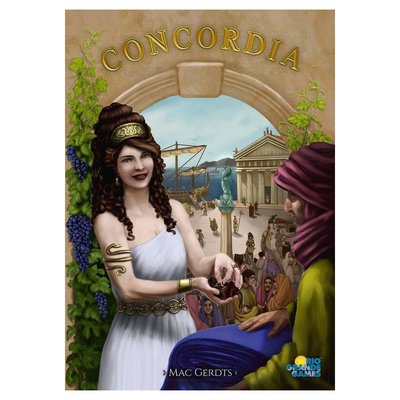
It's a very light mechanical game but with incredible depth to it. And just the fight to getting to these places is very very tense because sometimes you just cannot afford to get into the places that have been bought already. And um just that management of resources is incredibly tense. But it's a fantastic fantastic game. And every strategy is equally viable. And I've seen players do really well adopting various different strategies. One that I really couldn't recommend enough that is Concordia by Mac Gerdts. A brilliant brilliant game. Um this map here is the is the um one from the base game. It's kind of the lower player count one. But on the other side, there is a game for more players. And um basically the tighter the map gets, the kind of obviously the harder it is to get into these places because you're not kind of fighting over for the same places. But yeah, one that I couldn't recommend enough. Definitely check this one out. That is Concordia.